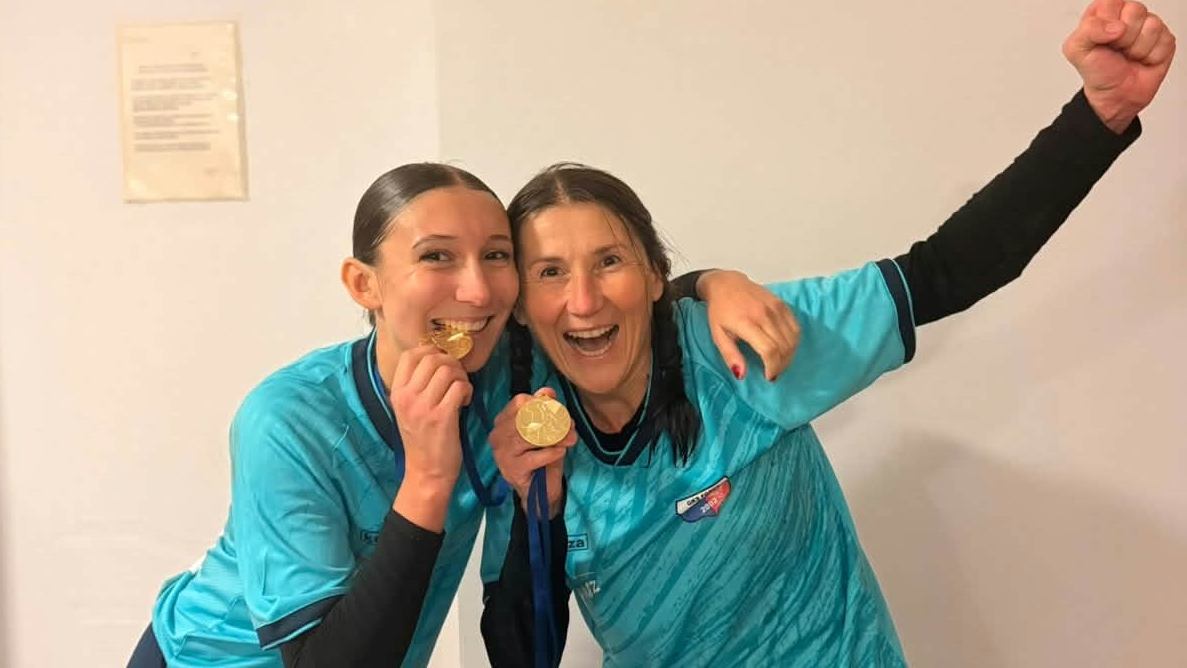
Gabriela Piszczatowska, a 53-year-old defender for third-tier Polish women's club Forty Piątnica, has been confirmed as the oldest female footballer currently playing in Poland, according to the Polish Football Association (PZPN). She plays alongside her own daughter, Gosia, in the same team.
An employee of the PZPN, asked to check the matter, recognised Piszczatowska immediately and compared her to the Disney character Pocahontas because of her long dark hair, which she wears in two braids during matches. The staffer said they had played against her two years earlier. Around the club, and even to her own daughter, she is known simply as "Gabi."
On Sunday, Forty Piątnica played Fuks Pułtusk in the third division, with Piszczatowska covering her hair with a cap as temperatures neared zero. She led the team's warm-up but did not wear the captain's armband and walked onto the pitch last, playing left back for the full 90 minutes without being substituted even though the coach used every change available to him. Her daughter started on the right wing before moving into central midfield after the break. The matchday roster listed players born in 2007, 2008 and 2010, alongside Piszczatowska, born in 1973.
The match stayed level at 1-1 for an hour before Fuks Pułtusk exploited defensive mistakes to win 4-1. Fuks, recently relegated from the second division and aiming for an immediate return, lead the league at the midpoint of the season. Forty Piątnica, nicknamed "Serki" ("The Cheeses") after a well-known dairy cooperative two streets from their stadium, sit fourth. Piszczatowska was among the last players off the pitch and thanked every opponent, many of whom lined up afterward to shake her hand.
A lifelong love of football
Piszczatowska said she suspected she might be the oldest active player, since she rarely saw women her own age at matches anymore, including at Poland's championship for women over 35. She said she now meets contemporaries only in informal "mums' leagues," including old friends from her first club.
She grew up near a football pitch in Silesia and would climb the fence to fetch balls for the players training there, hoping to be asked to fill in during games, sometimes in goal. There was no girls' club nearby; the closest options, in Gliwice and Sosnowiec, were too far away. She found a team, Podgórze Kraków, only after moving to the city for university in 1994 at age 21, skipping class the day she learned the club existed. She stayed there for ten years.
She said she never played with dolls as a child, crediting her two older brothers, whose training sessions she attended more often than they did. The brothers nicknamed her "Gaba" and warned her not to cry if she got hit by the ball, but she said they never suggested football wasn't for her.
Being a woman in football, then and now
Piszczatowska said attitudes have changed more slowly in Podlaskie, the region around Łomża where she now lives, than in Kraków, where she never encountered surprise at a woman playing football. In Śniadowo, where she lives, she said people still react with surprise and ask whether she, a woman, really plays football.
She said the region still lacks women's clubs: Forty Piątnica, neighbouring Łomża, one team in Czyżew and two in Białystok, and little else. Players travel long distances to train. She and her daughter travel 25 kilometres from Śniadowo, while teammates come from Pisz, 60 kilometres away, and even Białystok, 80 kilometres away. She said many players give up because it is hard to combine the travel with work, school and family.
Watching the game grow
In the 1990s, she said, Poland had only two women's leagues, and teams travelled across the country, sometimes from Kraków to Gdynia. Clubs linked to large companies could afford the trips and housed visiting players three or four to an apartment; in Kraków, the club also covered players' public transport passes. She said the sport has grown considerably since, though she believes there were more clubs around Piątnica when the club was founded in 2014 than there are now. She rates today's third division as roughly equivalent to the first division of her playing days. With Podgórze Kraków she won the Polish women's runner-up title in 1996 and a Polish Cup silver medal in 1995.
Mother and daughter on the same team
Piszczatowska called playing alongside her daughter "a miracle, a beautiful miracle." Gosia was not drawn to football early on, she said, but grew up around her parents' training sessions and gradually began joining warm-ups before asking to join Forty Piątnica's youth team. Before settling on football, Gosia tried swimming, horse riding, capoeira and karate, and sometimes trained alongside athletes supervised by her father, a physiotherapist.
Their first match together was in Białystok when Gosia was 14 or 15. Piszczatowska said her daughter felt lost playing senior football for the first time, despite youth tournament experience and a call-up to the Podlasie regional side, because senior football introduces more cunning. She admitted she was overprotective then, checking on her daughter after every hard tackle.
The pair both scored in a match against Widzew Łódź that drew attention from local media, neighbours and municipal officials. Gosia scored first, after missing several clear chances beforehand, and Piszczatowska said she ran toward her shouting that she had finally broken through. Five minutes later Piszczatowska scored herself. She said she scores far more often into her own net than her opponents', given her position at left back.
Team role and the future
On the pitch, Gosia calls her mother "Gabi" rather than "mum," having announced after a break from playing that everyone is equal on the pitch. Piszczatowska said her daughter is harsher on her than she is in return, though never out of spite, always with advice attached. She said she sees her daughter emerging as one of the team's leaders.
Piszczatowska said she does not see herself as the team's leader, despite captaining it for several years after it was founded in 2014 by her and her husband, its first coach, because no one else had experience running a women's team at the time. The club's president reportedly joked that she would only retire from football alongside her retirement from her day job; she said that would be nice.
She trains with the squad once a week because of her work schedule. She directs a municipal culture centre and leads a children's orchestra, playing piano, guitar, trumpet and tuba, and said the team sings songs together in the locker room after wins. She makes up for the limited training time with physical work, home exercise and daily dog walks, and said she has no plans to stop playing; once she can no longer keep pace with her teammates, she expects to take on another role at the club rather than leave it. Her husband, a physiotherapist, treats her and Gosia and watches their matches when his schedule allows.
Piszczatowska also competes in mud football, a discipline she took up nearly a decade ago after Forty Piątnica were invited to a tournament in Korycin. The event is held each year in the last week of June.
Test yourself
How old is Gabriela Piszczatowska?
By what score did Forty Piątnica lose to Fuks Pułtusk?
What does Gosia call her mother on the pitch?
Have your say
What do you think is the biggest barrier to growing women's football in rural regions?
Where it happened
Piątnica, Poland