

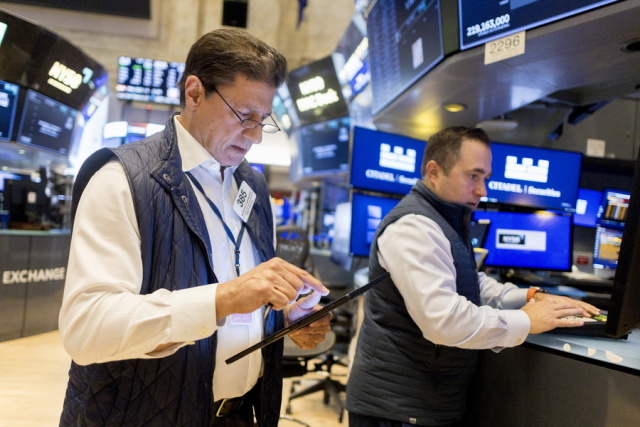
Wall Street closed out July on a positive note, with strong earnings from technology giants outweighing rising Treasury yields and uncertainty over Federal Reserve policy. The Dow Jones Industrial Average gained 0.53% to finish at 52,485, the S&P 500 added 0.70% to close at 7,489, and the Nasdaq rose 1% to 25,373.
For the week, the Dow Jones and the S&P 500 each gained roughly 0.9%, while the Nasdaq advanced approximately 1.2%. The monthly picture was darker: the S&P 500 and the Nasdaq posted losses for July, while the Dow Jones ended the month barely in positive territory.
Amazon Surges, Apple Slumps
Amazon was the session's standout, jumping roughly 15% after reporting second-quarter revenue that exceeded market forecasts. The strong performance of the company's cloud division reinforced investor confidence that large-scale investments in artificial intelligence are continuing to generate returns and support growth at the major technology groups.
Apple moved in the opposite direction, falling more than 9% despite reporting better-than-expected revenue for its third fiscal quarter. A 22% rise in iPhone sales was not enough to offset investor disappointment with the underperformance of the services segment, which is considered a key driver of the company's future profitability.
The semiconductor sector offered a brighter picture. The iShares Semiconductor ETF (SOXX) rose more than 1%, led by AMD and Micron, extending momentum from the previous session when it recorded its largest single-day rally since April 2025.
Microsoft Posts Best Month Since 2007
The technology rally had begun on Thursday, when Microsoft surged 16% after reporting results that beat expectations and showed significant acceleration in growth at its Azure cloud platform. The market took the figures as confirmation that the company's artificial intelligence strategy is already delivering meaningful financial benefits.
Microsoft extended those gains on Friday, adding a further roughly 2.5%, and finished July up more than 20% for the month , its best monthly performance since October 2007.
Despite the strong weekly finish, July proved to be a difficult month for technology overall. The Nasdaq-100 ended the month down nearly 7%, its worst monthly performance since March 2025. The declines were attributed to ongoing uncertainty around the war with Iran, sharp volatility in oil prices, a more hawkish stance from the Federal Reserve, and heavy selling in the semiconductor sector that preceded the late-month recovery.
Investors are also wrestling with whether the massive investments being poured into artificial intelligence can ultimately justify the high valuations carried by the large technology companies.
Bond Yields Keep Climbing
The bond market remained a central concern for equities. The yield on the 10-year US Treasury, a benchmark for mortgage rates, auto loans, and credit cards, rose 8 basis points to 4.743%. The 2-year yield climbed nearly 6 basis points to 4.287%, and the 30-year yield rose more than 6 basis points to 5.273%.
The renewed rise in yields reflects growing market skepticism about the Fed's ability to return inflation to its 2% target. Fed Chair Kevin Warsh said there is no magic wand for dealing with inflation, a remark that was read as a signal that the fight against elevated prices will prove more difficult and more prolonged than markets had hoped.
Terry Sandven, chief equity strategist at US Bancorp Asset Management, said the closer the 10-year yield gets to 5%, the greater the pressure on stock valuations. He described the current market as a roller coaster full of anxiety but also opportunities, noting that corporate earnings remain strong, inflation is showing relative stability, and interest rates are moving within a predictable range, while the Middle East war is keeping oil prices elevated and feeding fresh inflationary pressure.
Energy Wins, Novo Nordisk Falls
Chevron reported net profits of $12 billion, nearly four times higher than a year earlier, citing the rise in oil prices driven by the war with Iran. Adjusted earnings came in at $6.06 per share, well above analyst estimates. The stock rose roughly 1%. ExxonMobil also posted strong results but fell more than 2%.
Novo Nordisk suffered a steep decline, with its shares dropping as much as 10% after a late-stage clinical trial for a new cardiac drug failed to significantly reduce serious cardiovascular events compared with a placebo. The setback is another blow to the Danish pharmaceutical company as it works to rebuild investor confidence in its pipeline.
Consumer Confidence Edges Up
On the economic front, the University of Michigan consumer confidence index came in at 55.2, beating analyst estimates and rising 11.5% from the prior month. The index nonetheless remains roughly 10% below its level from a year ago.
One-year inflation expectations fell to 4.2%, the lowest reading since March, while long-term expectations held steady at 3.3%. Joan Hsu, the survey's research director, said American consumers remain most concerned about the erosive effect of high prices on their disposable income, even as geopolitical developments and military conflicts have receded as day-to-day economic worries.


