

ExxonMobil has informed the government of Kazakhstan that oil production at Tengiz, the country's largest oil field, will plateau in 2027 before beginning to decline, according to a Bloomberg report published on Thursday.
A presentation given by the US energy corporation to Kazakh officials indicated that output at Tengiz could fall to approximately 500,000 barrels per day by 2035, representing a drop of about 40 percent from its peak levels.
To offset the expected decline, ExxonMobil has proposed investing tens of billions of dollars in a new joint project at the Kashagan oil field, Bloomberg reported. The total proposed investment volume is $80 billion.
The proposal involves creating an equal joint venture between ExxonMobil and Kazakhstan's state-owned holding KazMunayGas to develop the untapped western section of the Kashagan field. This project could potentially provide production of up to 600,000 barrels per day.
Denials and no comment
KazMunayGas denied the information reported by Bloomberg.
Tengizchevroil, which is owned by Chevron and operates the Tengiz field, declined to comment. Kazakhstan's energy ministry and the North Caspian Operating Company, the operator of Kashagan, also did not provide comment. ExxonMobil and Chevron both declined to comment.
Caspian Sea oil fields
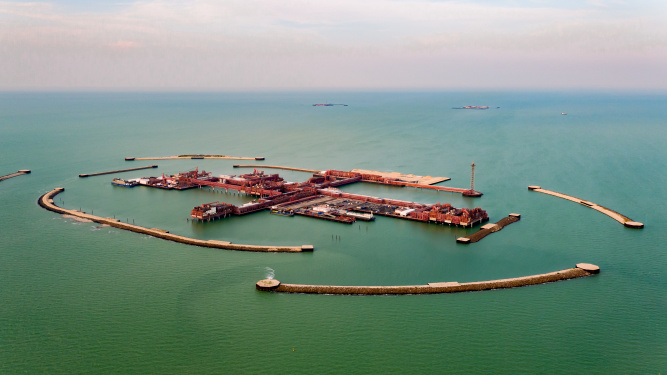
Kashagan, located on the Kazakh shelf of the Caspian Sea near the city of Atyrau, is considered one of the largest oil fields discovered globally in recent decades. Its reserves are estimated at 9 billion to 13 billion barrels of oil. Commercial extraction from the field, which is conducted using artificial islands, began in the autumn of 2016.
Kazakhstan has been seeking to increase its oil exports while diversifying its supply routes, particularly across the Caspian Sea and towards western markets. A decline in production at a primary field makes the development of new projects and infrastructure increasingly important.
The country faced disruptions to its oil exports routed through Russia in mid-2022. The issues arose after Kazakh President Kassym-Jomart Tokayev stated, in the presence of Russian dictator Vladimir Putin, that he would not recognise the independence of Russian-occupied territories in Ukraine.
Following the disruption, Tokayev announced that Kazakhstan would diversify its oil supplies using the Trans-Caspian route.
In early 2025, Kazakhstan dispatched its first tanker of Kashagan oil to Azerbaijan for onward transport through the Baku-Tbilisi-Ceyhan pipeline.
The Kazakh energy ministry and KazMunayGas subsequently signed a contract in June 2025 with the Chinese company CNOOC Hong Kong Holding. The agreement covers the exploration and production of hydrocarbons at the Zhylyoi offshore project in the northeastern Caspian Sea.


