

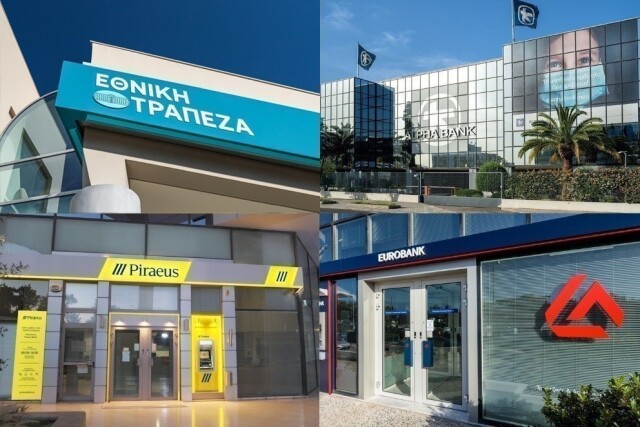
Greece's four systemic banks have revised their 2026 profit targets upward, driven by elevated interest rates, stronger net interest income, and accelerating credit expansion, a pattern that mirrors a broader trend of upgraded guidance across European banking.
Piraeus Bank led the round of revisions, followed by National Bank of Greece and Eurobank, both of which made significant improvements to their forecasts. Alpha Bank revised its earnings per share projection but said it would issue complete updated guidance in November, when it plans to present a new three-year business plan.
Interest income is the common driver
The primary force behind the revisions is stronger-than-expected net interest income. Greek banks continue to benefit from a high interest rate environment while simultaneously expanding their loan portfolios. New lending creates a larger volume of interest-earning assets, which translates directly into higher interest revenue.
The deposit mix also remains favorable: most deposits are held in low-cost current and savings accounts, keeping funding costs contained even as lending rates stay elevated.
Inflation is an additional tailwind. Although it has eased from earlier levels, it continues to support high nominal figures across the economy. Businesses are increasing their financing requirements, and projects funded through the Recovery Fund and the EU structural program known as ESPA are generating extra demand for bank loans. The combined effect is that actual net interest income has come in above levels originally forecast, prompting banks to lift targets for profitability, capital returns, and shareholder distributions.
National Bank details its upgraded outlook
National Bank of Greece provided the most granular revision. Management now expects mid-single-digit growth in net interest income for 2026, upgraded from an earlier forecast of low single-digit growth, and projects the net interest margin at close to 280 basis points.
Earnings per share are expected to exceed €1.4, while return on tangible equity is forecast to surpass 15%. Management also raised the possibility of paying an interim dividend in the fourth quarter, subject to regulatory approval.
Net credit expansion has already reached €2.1 billion since the start of the year, and the full-year target stands above €3 billion.
European banks set the wider scene
Greek banks are part of a broader European pattern. Italy's UniCredit reported net profit of €6.1 billion in the first half of 2026, up 24% on an adjusted basis, with a return on tangible equity of 24%. Fellow Italian lender Intesa Sanpaolo raised its full-year 2026 net profit target to above €10 billion after second-quarter results beat expectations, with second-quarter net profit of €2.8 billion supported by fees, insurance activities, and trading income.
Outside Italy, Reuters reported that Barclays posted a 17% rise in first-half profits, with pre-tax profit of £6.1 billion, exceeding analyst estimates. NatWest upgraded its guidance after strong second-quarter performance, raising its tangible equity return target above 19%.
Santander reported underlying profit of €7.3 billion in the first half of 2026, up 15%, a result the source described as perhaps the closest European parallel to the Greek banking story. For Greek lenders, conditions that initially looked uncertain have instead produced revenues that beat forecasts, and management teams are now setting a higher bar for the rest of the year.


