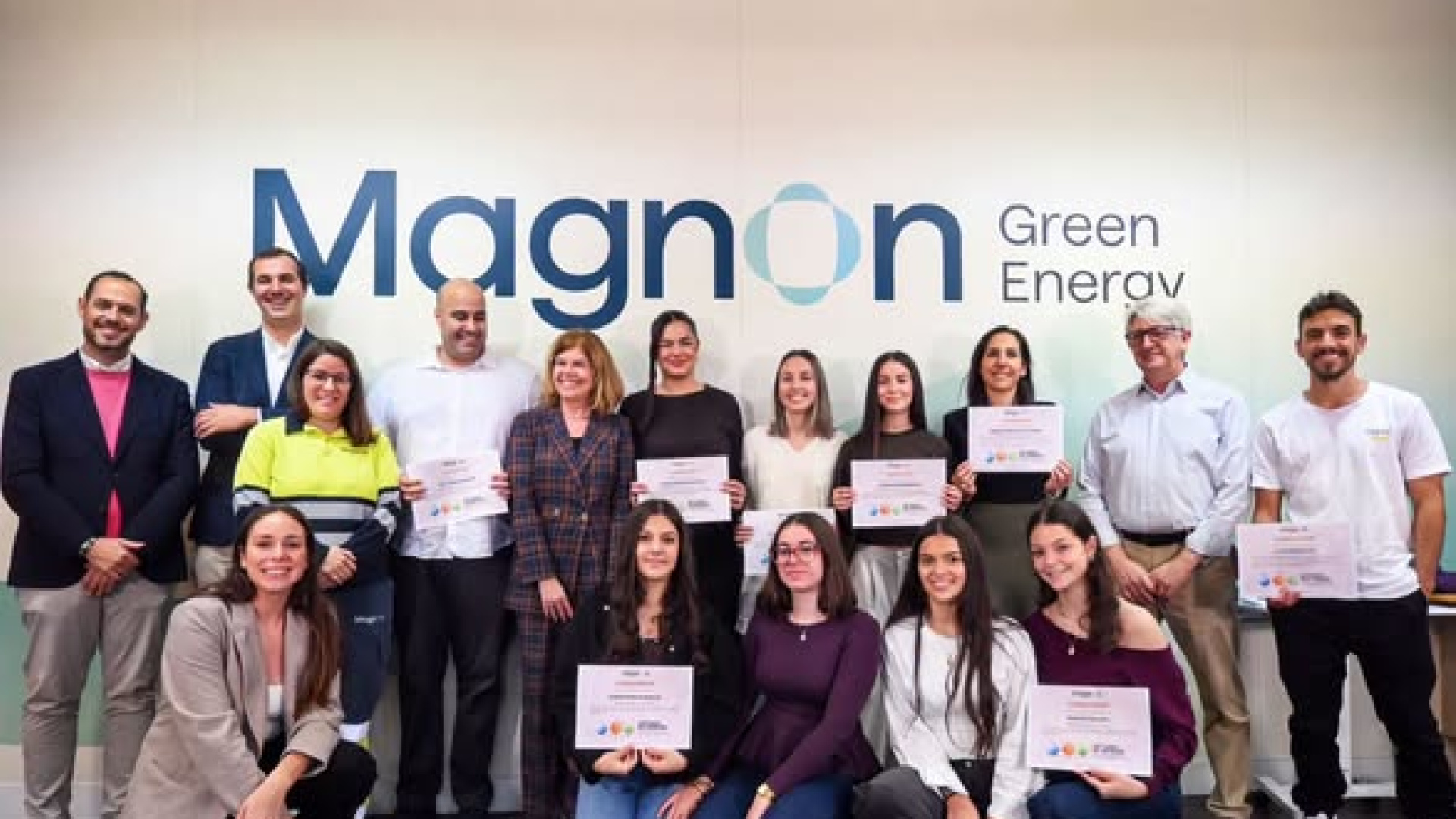
Secondary and vocational students in Huelva have been honoured by Magnon Green Energy for scientific projects showing how industrial waste can produce clean energy.
The awards, presented at the company's industrial energy complex in Huelva, were organised to foster interest in sustainability, renewable fuels, and resource recovery among young people. Magnon Green Energy, the renewable power subsidiary of the Spanish group ENCE, designed the competition to encourage research, critical thinking, and the ability to explain the challenges of the energy transition to the wider public.
The top prize in the vocational training category, worth 500 euro, went to a team of four students from the Instituto Diego Rodríguez Estrada in San Juan del Puerto. The winning team, composed of Lucía Carmona, Zaida María Pérez, África, and Víctor, created an educational project that used an animated character to explain how carbon dioxide produced during biomass electricity generation can be given a second life.
Carmona explained that the group wanted to show how industrial carbon emissions could be captured and utilised rather than released directly into the atmosphere. She said the team was surprised to discover that discarded organic waste carries significant value through the biogenic carbon dioxide it generates. She added that their research helped them realise that carbon emissions are not entirely harmful when industrial processes find productive ways to repurpose them.
Developing the project required several weeks of work, according to Pérez. She explained that the main obstacle was identifying a format that would resonate with both children and adults. The team ultimately decided to produce a comic strip to give greater visibility to an environmental topic that she felt receives too little public attention.
Vocational research on biogenic carbon
Marta Márquez, who teaches the Higher Vocational Course in Environmental Education and Control and served as the team's tutor, emphasised the value of an earlier tour of Magnon's local energy facilities. She said the site visit gave the students a practical view of the company's industrial operations before they chose to focus on biogenic emissions. Márquez commended the group for combining scientific rigor with clear presentation, noting that the students discarded an initial draft on their own initiative after deciding it was not accessible enough for general audiences.
Márquez observed that the project challenged the common perception of carbon dioxide as an environmental villain. She noted that giving captured carbon a secondary industrial use can play a vital role in environmental protection and long-term sustainability, praising the clarity with which the students communicated complex scientific ideas.
Magnon Green Energy operates several large biomass power generation plants across Spain, using agricultural and forestry residues to generate electricity. Unlike fossil fuels, which release subterranean carbon deposits that have been locked away for millions of years, biomass energy relies on organic matter that absorbed atmospheric carbon during its growth cycle. When managed sustainably, the biogenic carbon dioxide released from plant waste forms part of the natural carbon cycle, and capturing it enables industries to create clean synthetic fuels and sustainable materials without adding net carbon to the atmosphere.
Secondary school prize for Trigueros students
The second prize in the compulsory secondary education category, which included a 200 euro award for the educational centre, was awarded to four female students from the Instituto Dolmen de Soto in Trigueros. The group, consisting of Sara Gálvez, Andrea Pérez, Belén, and Iria, received the accolade for their research project titled Biogenic CO2.
Gálvez stated that the group knew nothing about the topic before beginning their research, but were drawn to the subject by their teacher's initial suggestion. Her teammate, Andrea Pérez, explained that their biggest revelation was discovering how biogenic carbon dioxide could serve as a cleaner substitute for fossil-based carbon. She noted that this form of gas is derived from everyday materials, including agricultural residues, wood, biogas, and food scraps.
Both students acknowledged that translating technical scientific concepts into their own words was the most demanding aspect of the competition. The experience influenced their academic and career ambitions, with Gálvez expressing interest in pursuing chemistry or environmental science, while Pérez said she hoped to work in environmental policy or law.
Antonio María Borrero, a teacher at the Instituto Dolmen de Soto who mentored the secondary students, expressed pride in their dedication over several weeks of research. Borrero said he was impressed by the accuracy of their work and stressed that a central objective was creating a presentation accessible to the public rather than producing an overly technical academic paper.
Regional education and renewable energy in Huelva
The competing schools are located in the agricultural towns of San Juan del Puerto and Trigueros, situated near the provincial capital of Huelva in southwestern Spain. The province is an important hub for both heavy chemical industry and green energy development in the Andalusia region. Spanish compulsory secondary education, known as ESO, covers pupils up to the age of 16, while vocational training cycles provide specialised technical instruction directly aligned with regional industries.
Magnon Green Energy established the science competition to bridge the gap between classroom theory and practical industrial sustainability. By challenging local students to communicate renewable technology, company organisers aimed to show that the future of the regional energy transition rests in the hands of younger generations.