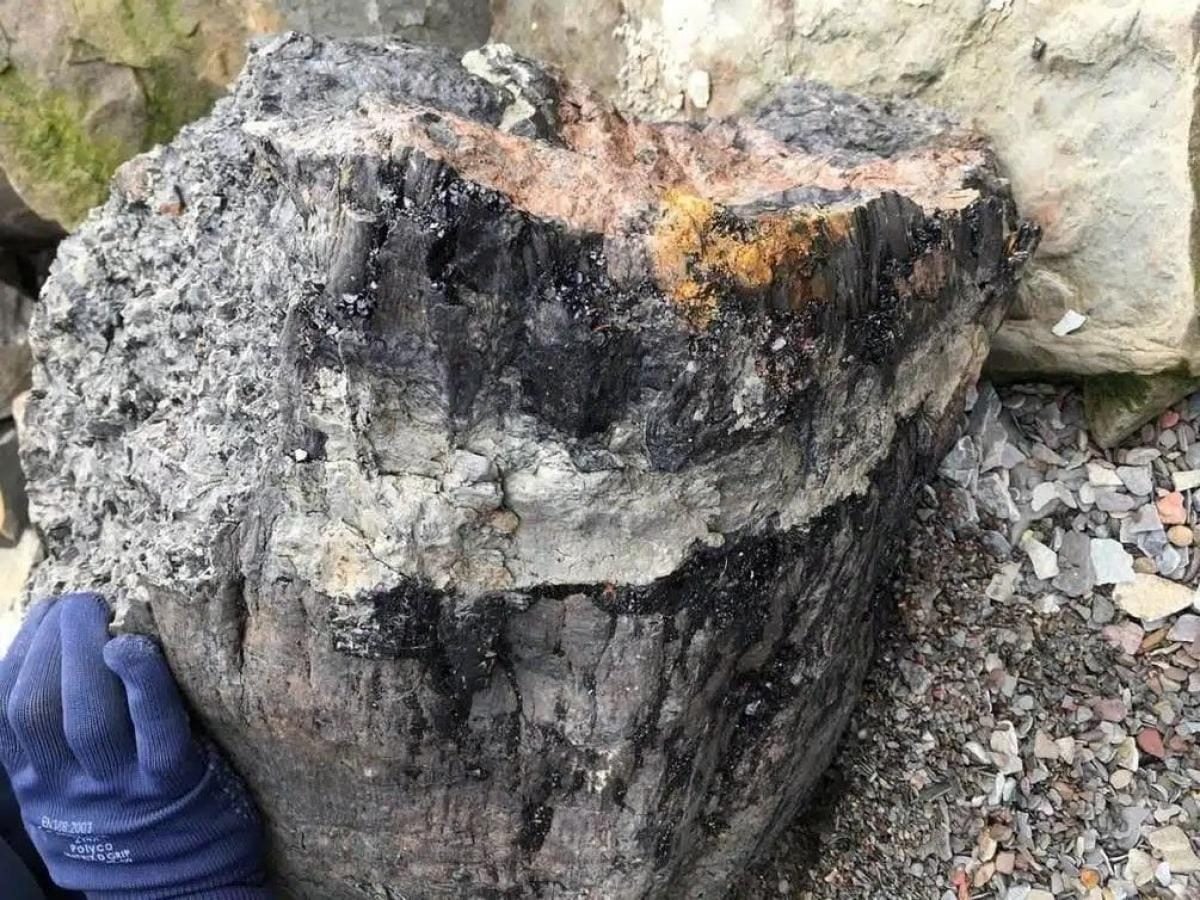
A tiny reptile fossil known as Hylonomus lyelli was found sealed inside a hollow, 315-million-year-old tree trunk on the sea cliffs of Nova Scotia, Canada, after a geologist split the trunk open in 1859, The Daily Galaxy reported.
The animal measured only about 20 centimetres from nose to tail and probably looked much like a lizard.
Hylonomus lyelli went on to become one of the most famous paleontological discoveries in North America. For more than a century and a half it was considered the oldest known reptile, its skeleton sealed inside the fossilised trunk for roughly 315 million years before it was found.
The fossil came from the Joggins Fossil Cliffs, a stretch of coastline along the Bay of Fundy in eastern Canada. The layered rock there formed between about 318 and 303 million years ago, during the Carboniferous period.
The layers preserve traces of three different ancient environments: an estuary where rivers met the sea, a humid tropical forest growing on a floodplain, and a wooded river plain with freshwater pools that was periodically swept by fires. Giant forests once covered vast swamps in the region, leaving behind coal seams and the fossilised roots of ancient trees that are still found there today.
According to UNESCO, Joggins has yielded the remains of 96 genera and 148 species of fossil organisms, along with 20 groups of trace fossils left behind by ancient creatures. The collection keeps growing because the Bay of Fundy has some of the highest tides in the world, and the water continually erodes the cliffs, exposing new fossil fragments along the shore.
Trees That Became Death Traps
The site first drew serious scientific attention in 1842, when it was visited by the British geologist Charles Lyell. He described the vertically standing fossilised tree trunks as the most extraordinary phenomenon. To him, trees preserved exactly where they had grown were visual proof that coal had formed directly from ancient forests, rather than from plant debris carried in from elsewhere.
In life, these trees towered 20 to 30 metres above the forest canopy. After they died, their soft inner tissue rotted away while the tough outer bark kept its shape, leaving hollow stumps behind.
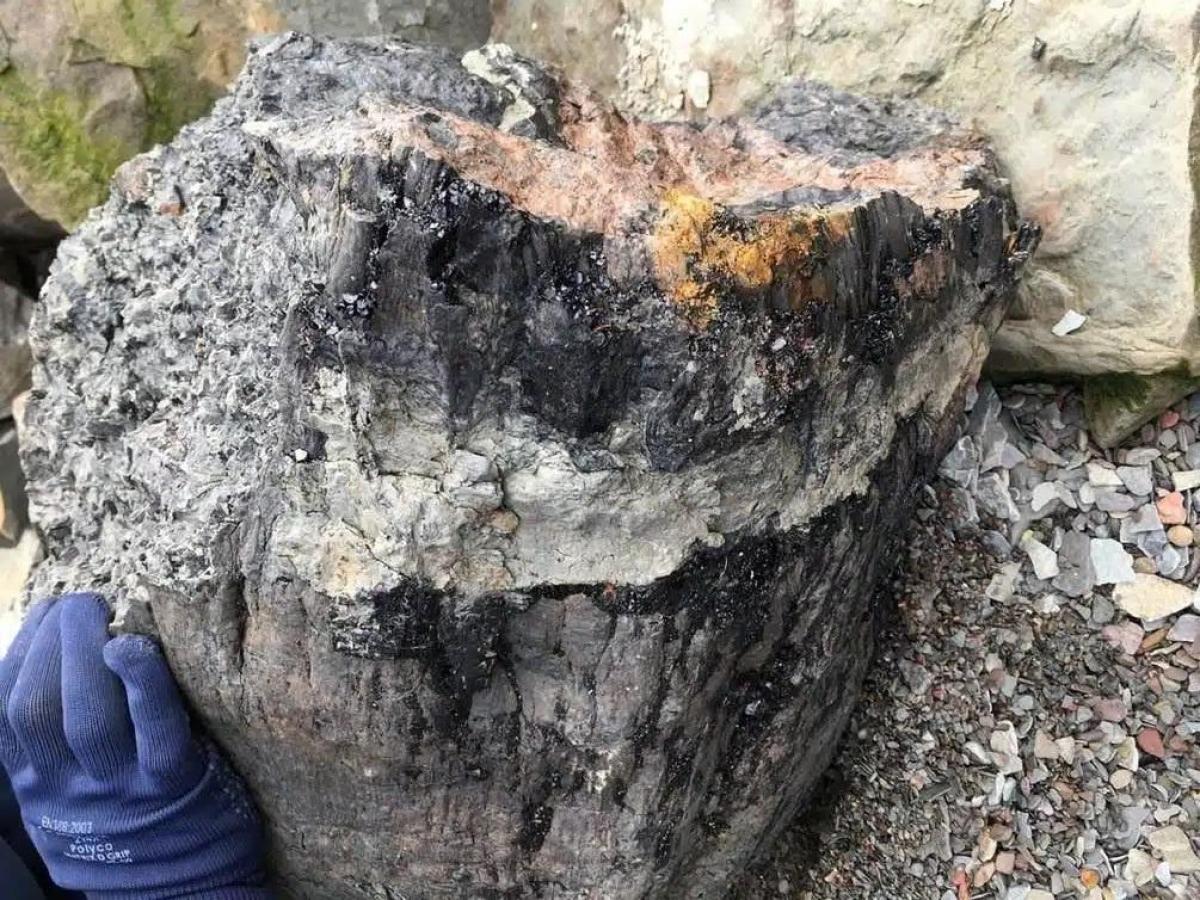
The paleontologist Hillary Maddin wrote that it was inside these hollow stumps that the remains of animals became locked away and protected, lying there for more than 300 million years.
In 1852, Lyell returned to the site with the Canadian geologist William Dawson. Opening up one of the fossilised stumps on the Joggins coast, the pair found the bones of an amphibian. In early 1853, a report was presented to a meeting of the Geological Society of London naming the animal Dendrerpeton acadianum.
How the animals ended up inside the stumps is still debated. The leading theory holds that they fell in and could not climb back out, though some researchers argue the animals may have used the hollows as nests. Either way, the standing stumps eventually filled with sediment carried in by the river system, which buried and preserved the skeletons.

A Forest Dweller Named After Lyell
In 1859, working alone at the same site, Dawson found skeletons inside another hollow stump. A year later he described the animal, naming it Hylonomus lyelli in honour of Lyell; the genus name translates as forest dweller. Similar skeletons were later found in other stumps nearby.
Hylonomus had small, pointed teeth and most likely fed on small invertebrates. For generations it held a special place in textbooks as the oldest known reptile, a key link in the process by which vertebrate animals moved from water onto land.
In 2002, the province of Nova Scotia declared Hylonomus its official fossil emblem. Other ancient reptile relatives have since turned up unexpected discoveries: one fossil found in Oklahoma, preserved along with imprints of its skin, revealed a breathing mechanism that used its ribs.
Oldest Reptile Title Now in Doubt
The creature's status as the first reptile has since been called into question. According to a 2025 study published in the journal Peer Community Journal, there is about an 85% probability that Hylonomus does not belong to the group that unites all living amniotes, the reptiles, birds and mammals whose embryos are able to develop on land.
Test yourself
Where was the Hylonomus lyelli fossil found?
About how long was the Hylonomus skeleton sealed inside the tree trunk before it was found?
What did the 2025 study published in Peer Community Journal suggest about Hylonomus?
Where it happened
Joggins, Nova Scotia, Canada