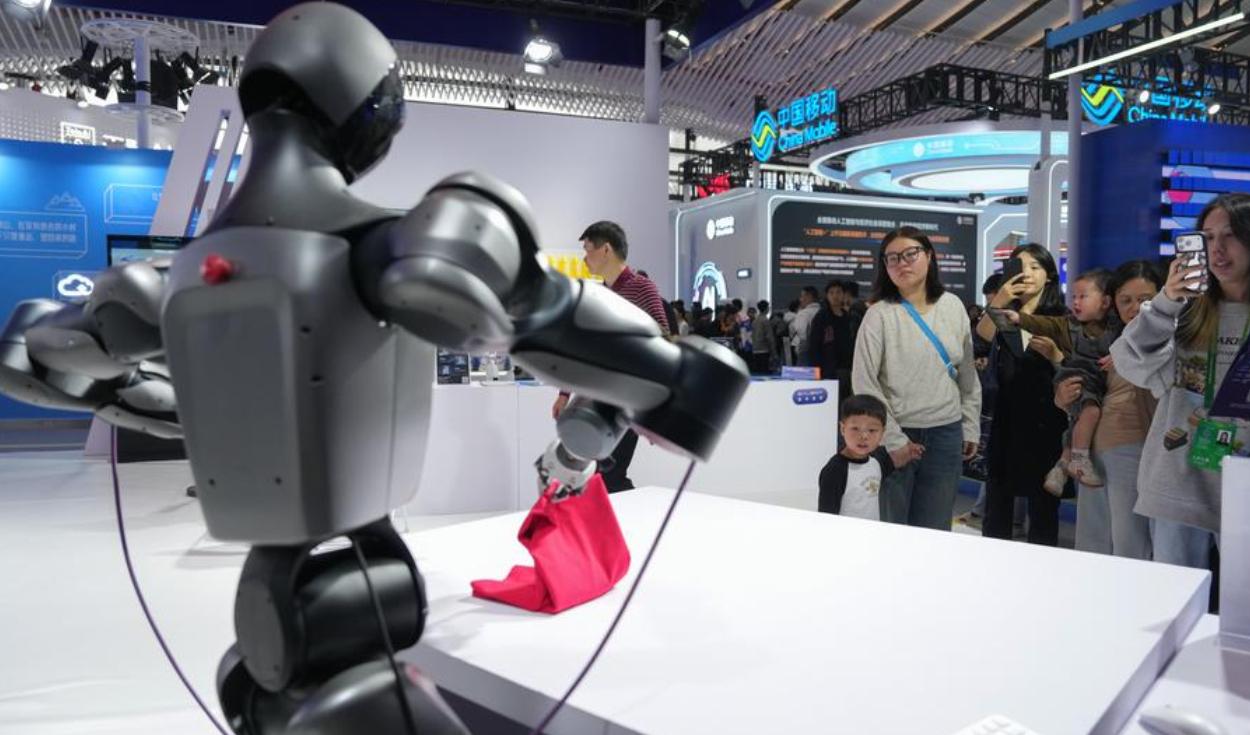
China is accelerating the development of humanoid robots capable of carrying out tasks that until recently depended exclusively on people, with machines already able to manipulate objects, serve drinks, clean rooms and handle laundry duties. Companies including AgiBot, Unitree and Galbot are working to expand the robots' applications, while the country concentrates much of the world's manufacturing of the technology.
China has more than 200 humanoid robot manufacturers and around 28,000 units installed in workplaces, according to a report by the Spanish newspaper El Pais. The government's Humanoid Robot Action Plan aims to reach 100,000 units in service by 2027.
Household tasks the robots can now perform
New models are no longer limited to exhibitions in which they dance or perform acrobatic moves. At the Web Summit in Lisbon, one of the world's largest technology conferences, Chinese manufacturers demonstrated machines serving drinks, carrying glasses to a table and manipulating everyday objects.
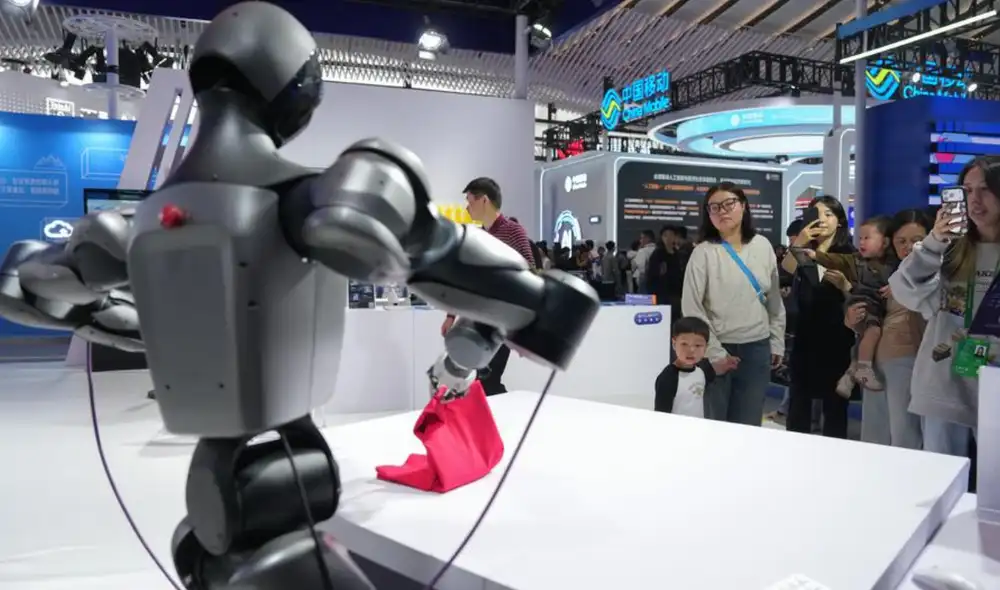
Demonstrations also highlighted tasks related to home care. Some robots can carry laundry baskets, load a washing machine, clean rooms and fold clothes. They even take part in tests that require interrupting one activity to attend to another.
Yuli Zhao, head of strategy at Galbot, said the robot has to carry out many complicated subtasks, including cleaning a room, doing the laundry, hanging clothes or washing them. Zhao said the robot has to search for and perceive, using only its camera, the edges of clothing and find the exact angle needed to fold it. Zhao added that throughout this process the robot can be interrupted at any moment: a doorbell rings, and it has to stop what it is doing, go and open the door and collect a package brought by a courier.
Companies leading China's humanoid robot industry
AgiBot, Unitree and Galbot are among the companies driving the industry. Their machines already have applications in workplaces, from industrial plants to shops and pharmacies.
Galbot, for example, has deployed more than 1,200 robots in real-world settings. Its units work at facilities run by Bosch, Siemens, Toyota, Hyundai and battery manufacturer CATL. They are also present in about 200 stores across nearly 50 Chinese cities, where they pick products from shelves, restock merchandise and make deliveries to customers.
William Shi, president of Europe and the Americas at AgiBot, said at the Web Summit that his company had sold more than 20,000 robots in total. He said more than 1,000 units are already working in factories in China.
Shi said there is a lot of demand for humanoid robots across different industries and that his company cannot reach all of them without applications. He explained that AgiBot does not sell robots directly but only through partners, who build different applications using the company's SDK and API.
How the robots learn human movements
Artificial intelligence is a key part of these advances. Manufacturers are working to make their machines learn new actions by observing human movements, without needing to program every movement from scratch.
Zhao said that to perform the entertaining dances humanoid robots do, engineers previously needed several days to train a robot. Now, Zhao said, they only need a person to dance in front of the robot and carry out the movements, and the robot can learn them that way.
A fast-growing but risky market
The development is accompanied by rapid commercial growth in the sector. According to the research firm IDC, the global humanoid robot market reached 18,000 units in 2025, an increase of 508% over the previous year, with a business volume of $440 million.
The Chinese firm GGII estimates that at least 15% of current manufacturers could go bankrupt or be absorbed by competitors over the next three years.
What happens next
China's Humanoid Robot Action Plan targets 100,000 units in service by 2027, while the research firm GGII expects at least 15% of current manufacturers to go bankrupt or be absorbed by competitors within three years.
Test yourself
How many humanoid robot manufacturers does China have, according to a report by El Pais?
Which company said it has deployed more than 1,200 robots in real-world settings, including at Bosch and Siemens facilities?
According to IDC, how much did the global humanoid robot market grow in 2025 compared with the previous year?
Have your say
Would you want a humanoid robot doing household chores like laundry in your home?