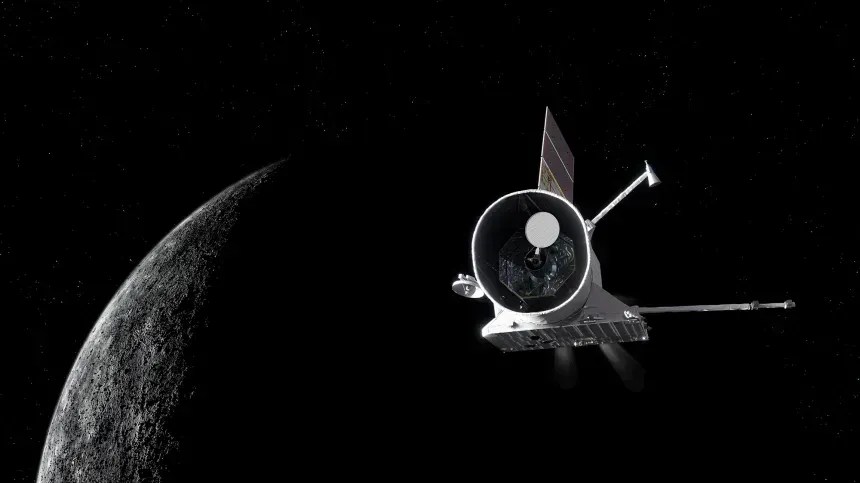
A software failure disrupted the arrival of BepiColombo, a $2 billion spacecraft built jointly by the European Space Agency (ESA) and the Japan Aerospace Exploration Agency (JAXA), into orbit around Mercury on November 21, leaving engineers searching for answers and reducing the margin for future corrections.
The probe was completing an eight-year journey to the solar system's innermost planet when it fired its thrusters for a planned 37-minute burn meant to lock it into a stable orbit. The burn ended after just 28 minutes.
Ignacio Tanco, head of ESA's Interplanetary Mission Operations for the Inner Solar System, said the first sign that something was wrong was that the signal arrived earlier than expected, which meant something had gone wrong. He said it was like flipping a switch, and the control room in Darmstadt, Germany, immediately shifted into contingency mode as the team worked out what had happened.
After four hours analysing data, the team confirmed the partial burn had still placed BepiColombo into orbit around Mercury, though not the one planned. The probe was meant to circle the planet every 58 hours but instead entered a 75-hour orbit. At its highest point, it will fly about 10,000 kilometres (6,200 miles) further from Mercury than intended, which Tanco called "inconvenient, but not terrible."
At a press conference in London on Friday, ESA acknowledged that the new orbit leaves less margin for future problems, though the spacecraft will operate as expected.
Tanco said that in the end the team had been quite lucky, since things could have gone far worse, and that they still hit almost every orbital parameter.
Still, BepiColombo faces a significant hurdle. Its two orbiters, ESA's Mercury Planetary Orbiter and JAXA's Mercury Magnetospheric Orbiter, need to separate to begin their own science missions. That manoeuvre is planned for December 9, but the recent problems have made it more complex and forced engineers to make changes. Tanco said there was a price to pay and that they would need to fix it.
Analysing an unlikely failure
In the tense moments after the abbreviated burn, engineers found BepiColombo had reached only 77% of the planned velocity change needed to reach orbit. An unexpected interruption put the probe into safe mode, shutting down all non-essential activity.
Tanco said there was immediate concern, because the spacecraft was clearly safe but the manoeuvre had not been completed, and the team did not know whether they were in orbit around Mercury or had just flown past it.
Had the probe failed to slow down enough to enter Mercury's orbit, it would have overshot its target and continued on its path around the Sun. Mission control would still have had a chance to recover the spacecraft and attempt orbital insertion again, Tanco said, but at a very high cost, since the fuel needed to return to Mercury would have made it difficult to reach an orbit suitable for collecting scientific data. He said they absolutely did not want to end up in that situation.
The failure resulted from an unlikely timing mismatch between the spacecraft's guidance software and its thruster controls, which triggered an abnormally strong command that cut short the planned 37-minute burn.
The scenario was among a series of simulated situations considered as possible challenges, though the mission team had not used it in training before the orbit-insertion attempt. Only afterward did ESA calculate a 1-in-6 probability of the failure occurring.
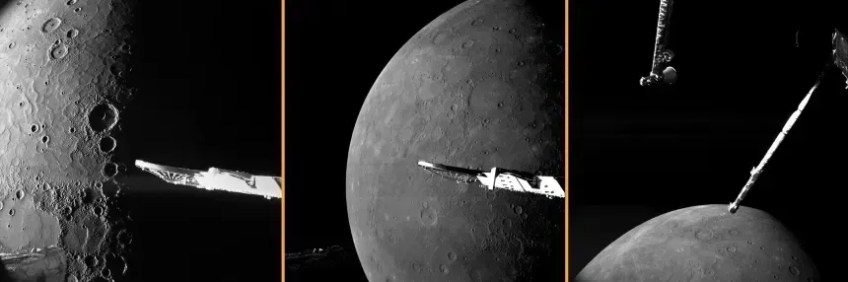
Tanco said problems like this are hard to manage on a mission like BepiColombo because the spacecraft is so far from Earth that a command takes about 20 minutes for a round trip, forcing engineers to plan ahead.
The probe also completely changed configuration in early September, when the Mercury Transfer Module, which had provided propulsion during the years-long journey to Mercury, separated from the pair of science orbiters. Tanco said the team was flying BepiColombo's software for the first time, and that since separating from the transfer module in September they had essentially been flying a new spacecraft.
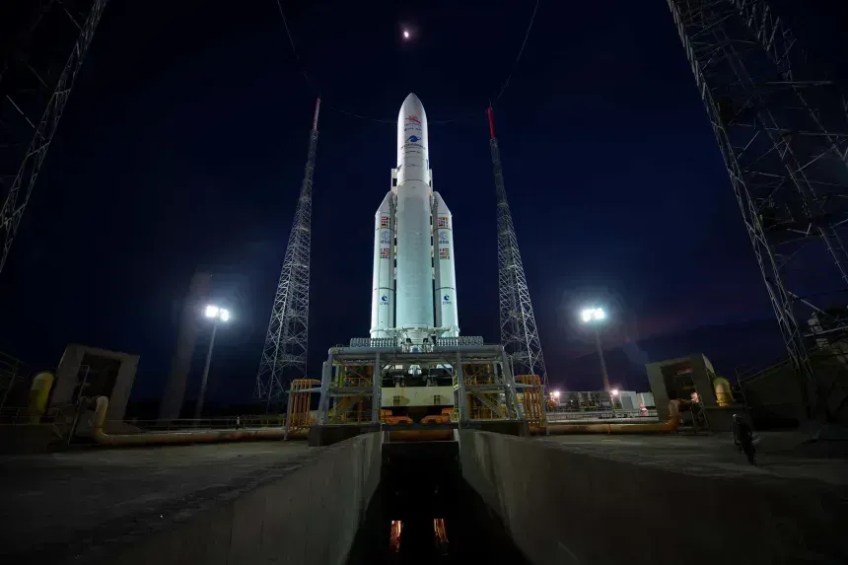
BepiColombo is named after the Italian engineer and mathematician Giuseppe "Bepi" Colombo, who studied Mercury's unusual rotation and proposed the trajectories that enabled NASA's first flybys of the planet in 1974. The spacecraft launched on an Ariane 5 rocket from the European Space Centre near Kourou, French Guiana, in October 2018, and has since travelled more than 10 billion kilometres (6 billion miles).
The mission already suffered an 11-month delay in its arrival at Mercury after a 2024 propulsion system problem forced engineers to rethink its route. The science phase of the mission is currently expected to begin in April 2027.
Avoiding a nightmare scenario
Mercury's proximity to the Sun makes exploring it especially difficult because of the star's immense gravitational pull and intense heat. Surface temperatures on the planet can reach about 430 degrees Celsius (800 Fahrenheit) during the day.
Two earlier NASA missions successfully studied the planet: Mariner 10, launched in 1973, and MESSENGER, which launched in 2004. Only MESSENGER entered orbit around Mercury.
James W. Head, professor of Earth, environmental and planetary sciences at Brown University and a MESSENGER co-investigator not involved with BepiColombo, said many fundamental questions raised by earlier exploration could now be addressed with BepiColombo's extensive set of instruments. Among the questions the mission could help answer, he said, is why Mercury is so small yet has a density similar to Earth's and an enormous core, and why it has an active magnetic field while the Moon, Venus and Mars do not.
BepiColombo differs from MESSENGER, which ended in 2015, in several important ways, according to Sean Solomon, MESSENGER's principal investigator and adjunct senior research scientist at Columbia University in New York City. He said the main difference is that BepiColombo involves two spacecraft, each carrying different science instruments and offering comparable coverage of the planet's northern and southern hemispheres, whereas MESSENGER flew an elongated orbit with far better coverage of the northern hemisphere.
Solomon said there are a number of features and processes that MESSENGER was able to describe well in the northern hemisphere but for which the team is counting on BepiColombo to provide matching information in the southern hemisphere.
Attention now turns to the moment when the two spacecraft, still joined together after the software failure, will separate and enter their own orbits. The event will be preceded by several trajectory adjustments that were originally planned, though the time available to carry them out has shrunk since the spacecraft's turbulent arrival. Tanco said some of the manoeuvres will have to be longer and will need to happen at a different time than expected, because of the different orbital period. Once the two orbiters separate, the team will have to fly the reconfigured spacecraft all over again.
Tanco said the spacecraft will be dynamically different, with many unknowns. He said he was not nervous, because he knew the team could handle almost anything the spacecraft presented, but that he hoped it would not be as bad as it could be, since some scenarios are genuinely difficult. He said they could be facing a complicated Christmas and New Year, and that he was hoping for the calmer version.
Tanco said the worst-case scenario would be losing the spacecraft without a clear cause, which would prevent any learning, though some level of uncertainty is always expected with interplanetary probes. He said these are essentially prototypes operated in extreme, poorly understood environments, and that this is the point of exploration, going somewhere you do not really know. He noted there are many things that could go wrong, such as how the spacecraft will react to the thermal environment once it enters Mercury's low orbit, and that while the team is modelling that, the accuracy of those models is limited given that the spacecraft has aged in space for eight years.
If successful, BepiColombo could rewrite, or at least significantly improve, scientists' understanding of how planets form so close to their stars, shedding light on the evolution of Earth and the rest of the solar system, Tanco added. He said the interesting thing about science is that you never know what the next question will be, since every answer raises more questions, but that it is certainly interesting.
What happens next
The two orbiters are due to separate from each other on December 9, a manoeuvre engineers say has become more complex since the failure. The mission's science phase is currently expected to begin in April 2027.
Test yourself
What caused BepiColombo's thruster burn to end early?
What orbital period did BepiColombo achieve compared with the one planned?
When are BepiColombo's two orbiters scheduled to separate?
Have your say
Should space agencies keep funding costly missions like BepiColombo despite technical setbacks?
Where it happened
Darmstadt, Germany