

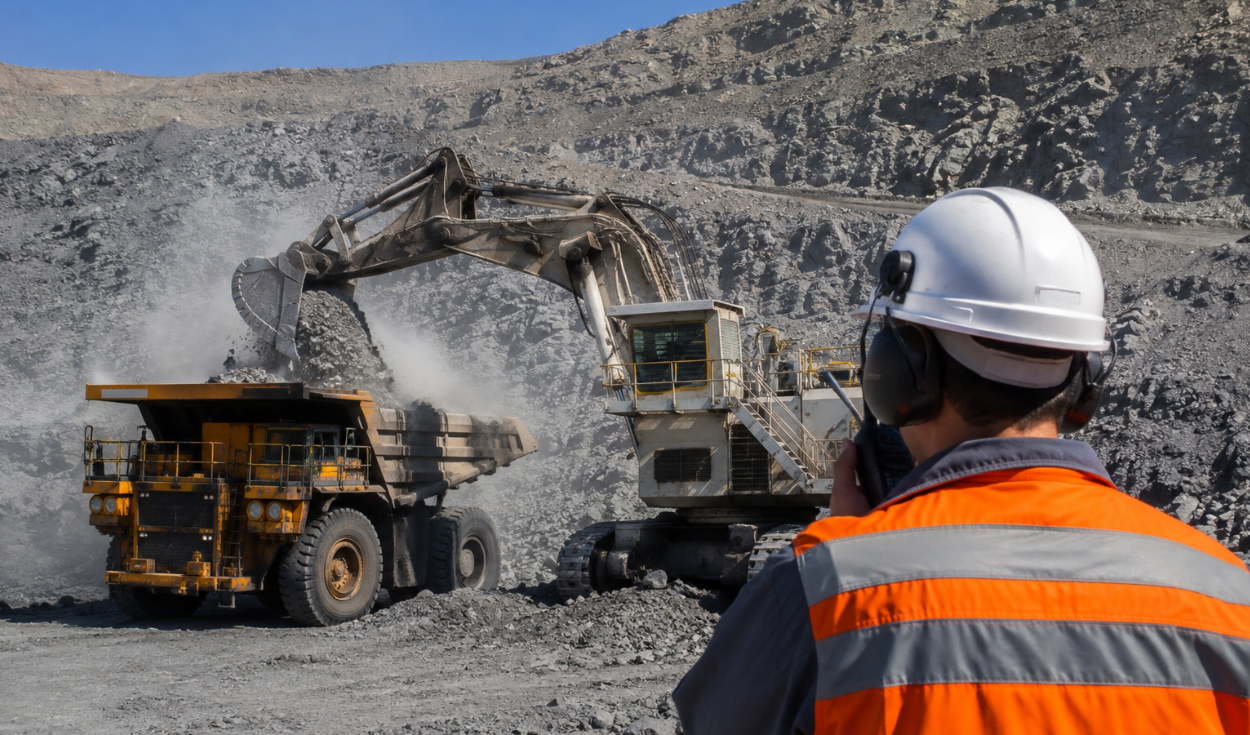
Mining investment in Peru rose 42.7% to $3.304 billion between January and June, driven by infrastructure and development at existing operations.
The Ministry of Energy and Mines reported the figure was an increase on the same period last year. The rise was not solely due to new deposits, with a significant portion of disbursements related to infrastructure, expansions, the preparation of new areas and improvements to existing operations.
In June alone, investment reached $662 million, the highest monthly amount of 2026. The June figure was 39.1% higher than in June 2025, and 10.6% higher than in May 2026.
Peru is one of the world's largest producers of copper, silver and zinc, and mining is a primary driver of its economy.
Year on year, spending on development and preparation increased by 113.5%. Infrastructure spending rose 84.9% and the "others" category increased by 76.6%. Investment in beneficiation plants rose 11.4%, while exploration increased by 2.8%.
The spending composition shows the higher expenditure does not necessarily mean new mines are immediately entering production. Money is directed toward maintaining or expanding existing units, keeping productive capacity steady while larger scale projects move through evaluation, permitting and construction.
Southern Peru leads investment
The Central Reserve Bank of Peru noted the accelerated pace in the first quarter of the year, when mining investment reached $1.5 billion. That was $456 million more than in the first three months of 2025. At the time, Southern Peru, Shougang, Las Bambas and Antamina concentrated the largest disbursements.
The company ranking for the first half of the year showed investment remained highly concentrated among large mining operations.
Southern Peru Copper Corporation, a subsidiary of Grupo Mexico, took first place. Its spending was driven by disbursements at the Toquepala 1 accumulation and the Concentradora de Botiflaca beneficiation plant, alongside investments in infrastructure, development, preparation and equipment.
Shougang Hierro Peru, the Chinese owned iron ore producer, was second. Its investment grew 135.4% year on year, largely due to higher disbursements at the Acumulacion San Nicolas beneficiation plant and the CPS 1 administrative economic unit.
Minera Las Bambas, which operates a major copper mine owned by China's MMG, took third place with investments linked to its Ferrobamba and Chalcobamba units. Las Bambas is particularly relevant because of the size of the disbursements required to maintain and expand an operation of its scale.
The concentration is not new. At the end of the first quarter, Southern Peru had invested $188 million, Shougang $153 million and Las Bambas $144 million. Together with Antamina, a joint venture that operates a major copper and zinc mine, the four companies accounted for 40% of the mining investment executed in that period.
A considerable part of the growth registered during the year depends on investment decisions taken by a relatively small group of companies. The increase in the aggregate figure does not automatically mean a generalized expansion of all mining activity.
Project portfolio
The ministry's 2026 portfolio includes 66 projects distributed across 19 departments, with an estimated combined investment of $64.075 billion. However, that amount represents a portfolio of initiatives in different stages, not money currently being executed.
Several years can pass between a proposal joining a portfolio and an operation beginning to produce. Projects go through exploration, feasibility studies, environmental evaluation, permits, construction and startup. The total portfolio value serves as a reference for future potential, but does not equate to secured investment.
In March, the ministry reported a parallel portfolio of 69 exploration projects worth $757 million. Exploration is the stage that determines how much geological potential can subsequently become new operations.
The central bank anticipates a scenario of higher mining investment for 2026 and 2027, primarily associated with the Tia Maria, Reposicion Antamina and Reposicion Ferrobamba projects. The central bank recorded total mining investment of $6.225 billion in 2025.
Fiscal revenues
The 42.7% growth arrives at a time when the mining sector maintains an important weight in the Peruvian economy, but also faces obstacles to convert projects into effective production.
The increase in infrastructure and development disbursements indicates companies are allocating more resources to their operations. But for that effort to translate into greater production, exports, employment and tax collection, projects must advance beyond the investment stages and sustain their activity over time.
While the project portfolio covers 19 departments, effective execution continues to depend on the location of large operations and the capacity of each project to overcome its administrative, environmental and social stages.
Between January and April 2026, the ministry reported more than 15 billion soles in fiscal revenues from mining activity.
Transfers exceeded 4.121 billion soles for the mining canon, mining royalties, and validity and penalty rights. The canon and royalties are mechanisms Peru uses to distribute mining wealth to regional and local governments.
The investment figure tells only part of the story. The jump to $3.304 billion shows a clear acceleration of disbursements, but the economic outcome of the cycle will depend on how much of that capital ends up expanding production and how much remains destined for sustaining existing operations.
Meanwhile, the companies concentrating the largest investments continue to define much of the sector's rhythm. With $662 million executed in June alone, the market has raised a question beyond the announced amount: how much of this investment will eventually turn into new productive capacity, and in what timeframe.


