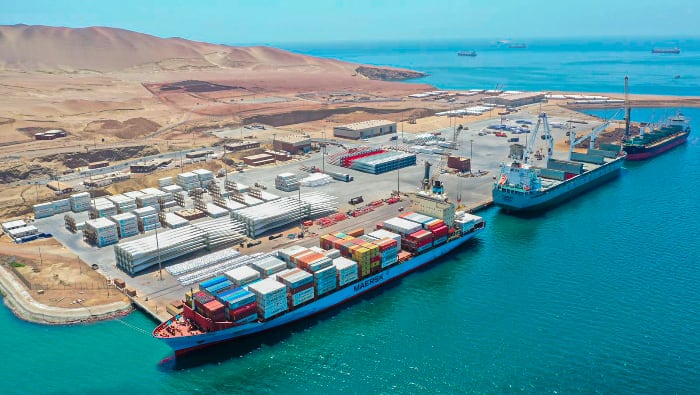
The Port of Paracas, in Pisco, in Peru's Ica region, has installed a new container scanner that will let it move toward inspecting 100% of the import and export cargo passing through the terminal.
The equipment, a Nuctech MT1213LE scanner, is meant to strengthen security at port operations, prevent illegal activity and improve the competitiveness of Peru's foreign trade logistics chain. Its installation cost US$6 million and was carried out through a strategic partnership with Peru's National Superintendency of Customs and Tax Administration, known as Sunat, which was responsible for purchasing the equipment.
The scanner uses dual-energy X-ray technology, which allows officials to see inside containers without having to open them. It has a technical capacity to inspect up to 120 vehicles an hour in driving mode. Its use will be coordinated with the Customs Office of Pisco to optimize how it operates.
Customs official highlights regional impact
Marilu Llerena, Peru's deputy national superintendent of customs, said the upgrade could affect economic activity and cargo movement across the region. She said that when a port improves, everything around it, what is known as its hinterland, improves too, and that strengthening a terminal whose area of influence covers the surrounding region would increase security, generate more cargo movement and boost trade.
Llerena also said the goal was to ensure that lawful commercial operations are not affected by illicit activity, and to give Peruvian exporters greater security conditions.
Paracas handles over a third of Peru's fruit exports
The new technology arrives as the Port of Paracas expands its operations. The terminal has recorded growth of more than 1,000% over the past ten years.
During 2025, it moved 12% of Peru's national refrigerated container exports and accounted for 37% of the country's fruit exports. Among the main products shipped through the port are grapes, blueberries, citrus fruit and pomegranates.
Port executive points to export markets
Cesar Rojas, general manager of the Port of Paracas, said having stronger control tools was important for meeting the requirements of the international markets that Peruvian agricultural exports are shipped to.
Rojas said that because North America and Europe are the port's main destinations, it was essential for the logistics chain to have a tool that gives security to the largest possible number of exporters using the Port of Paracas as their point of departure.
What's next for the Port of Paracas
Looking ahead, the Port of Paracas expects continued growth and aims to strengthen its share of dry cargo movement, mainly standard or dry containers, while also consolidating its refrigerated cargo operations.
Rojas said the company expects even greater momentum than it has seen in recent years, with efforts focused on expanding and strengthening both cargo segments. He said the scanner is part of a broader strategy to modernize infrastructure and technology, strengthen the security of operations and improve logistics conditions for exporters and importers.
What happens next
The Port of Paracas expects to expand its dry cargo and refrigerated cargo segments and aims for greater growth than in recent years.
Test yourself
What is the name of the new scanner installed at the Port of Paracas?
How much did the scanner's installation cost?
What percentage of Peru's fruit exports moved through Paracas in 2025?
Have your say
Do you think full cargo scanning at ports improves export security?
Where it happened
Pisco, Peru