

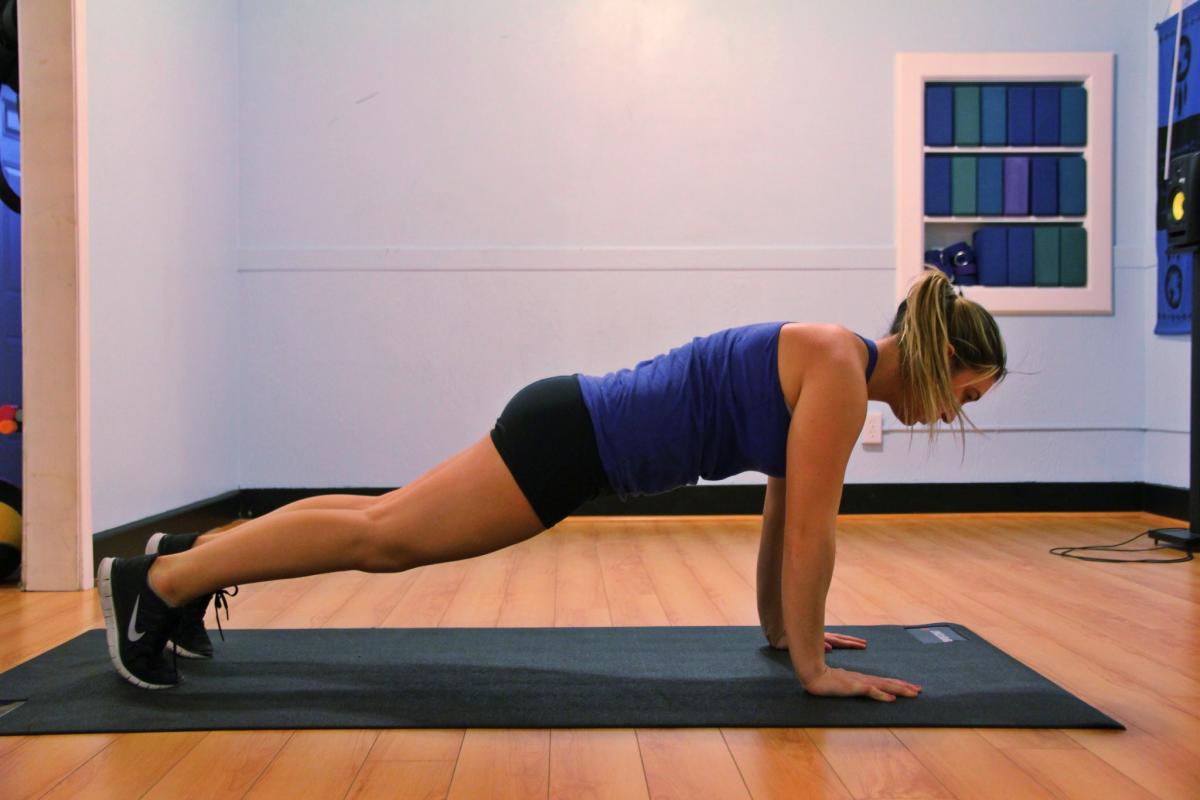
There is no scientifically established length of time a person should be able to hold a plank at any given age, according to Verywell Health. For most healthy adults, holding a plank with correct technique for roughly 30 to 60 seconds is a reasonable benchmark, but the outlet said the exercise is less a race against a stopwatch than a test of a person's ability to keep the body controlled and stable.
Writer and blogger Christopher Bergland, the author of the piece, said a 60-second plank is not necessarily better than a 30-second one, because endurance during the exercise depends on age, sex, body size, prior training experience and overall fitness level.
One study, published in the Journal of Human Kinetics, involved 471 college-age adults and found their average plank hold time was about 124 seconds for men and 83 seconds for women. Athletes were able to hold the position longer than people who did not train. The study's researchers noted that their findings could not be applied to other population groups without further research.
Does age affect how long you can hold a plank
Age can influence muscle mass, strength and physical capability, Bergland said, but people of the same age can have very different physical abilities depending on factors such as activity level and training history. He said there are no widely accepted standards for plank hold times based on age.
A 2026 study published in the journal Frontiers in Sports and Active Living developed reference values for teenage tennis players based on age and sex, but found no significant overall effect of age, weight or sex on plank performance. Because the participants were young athletes, the author said the results could not be used to set norms for the general population.
"A person in good physical shape at 60 can easily hold a plank longer than a 20-year-old who is just starting to exercise," the article said. "Likewise, a person who regularly does strength training may have greater plank endurance than a sedentary person of the same age."
Why technique matters more than time
A shorter plank held with correct body positioning is more beneficial than a longer plank performed with poor technique, Bergland said.
He said the plank works several muscles involved in stabilizing the torso, including the abdominal and back muscles. A review of core exercises published in the International Journal of Environmental Research and Public Health found that muscle activity depends on the specific exercise and the methods used to measure it, but that front and side planks can activate several muscles involved in core stability.
As a person tires, it becomes harder to maintain correct body position, according to the article. Simply pushing to add more seconds at that point can produce the opposite of the intended effect.
"The goal isn't to hold a plank for as long as possible," Bergland said. "The goal is to maintain a stable body position while the torso muscles keep doing their job."
How to do a plank correctly
Verywell Health set out detailed steps for performing a proper plank:
- Start in a position with your forearms on the floor and your elbows directly under your shoulders.
- Extend your legs back and rise onto your toes.
- Keep your body in a straight line from head to heels.
- Engage your abdominal muscles by drawing your navel toward your spine, lightly squeeze your glutes, and don't let your hips sag toward the floor or rise too high.
- Keep breathing. You do not need to hold your breath to create effective tension in the core.
- Treat the plank as a controlled position of the whole body, not an attempt to tense every muscle as hard as possible.
How to build plank endurance
Bergland advised gradually increasing the volume of quality training rather than testing your maximum capacity every day.
"A person who can hold correct form for 20 seconds could do several sets of 15 to 20 seconds, resting in between," he wrote. "As endurance improves, the length of those holds can gradually be increased."
The article also recommended several ways to make the exercise more challenging over time, including doing additional quality sets, gradually increasing hold duration, trying a side plank, progressing to a variation that demands greater stability, and adding controlled movements while maintaining correct torso position.
"The World Health Organization recommends that adults do muscle-strengthening exercises involving all major muscle groups at least two days a week," the outlet added. "Older adults should also include physical activity that helps maintain balance and functional ability."


