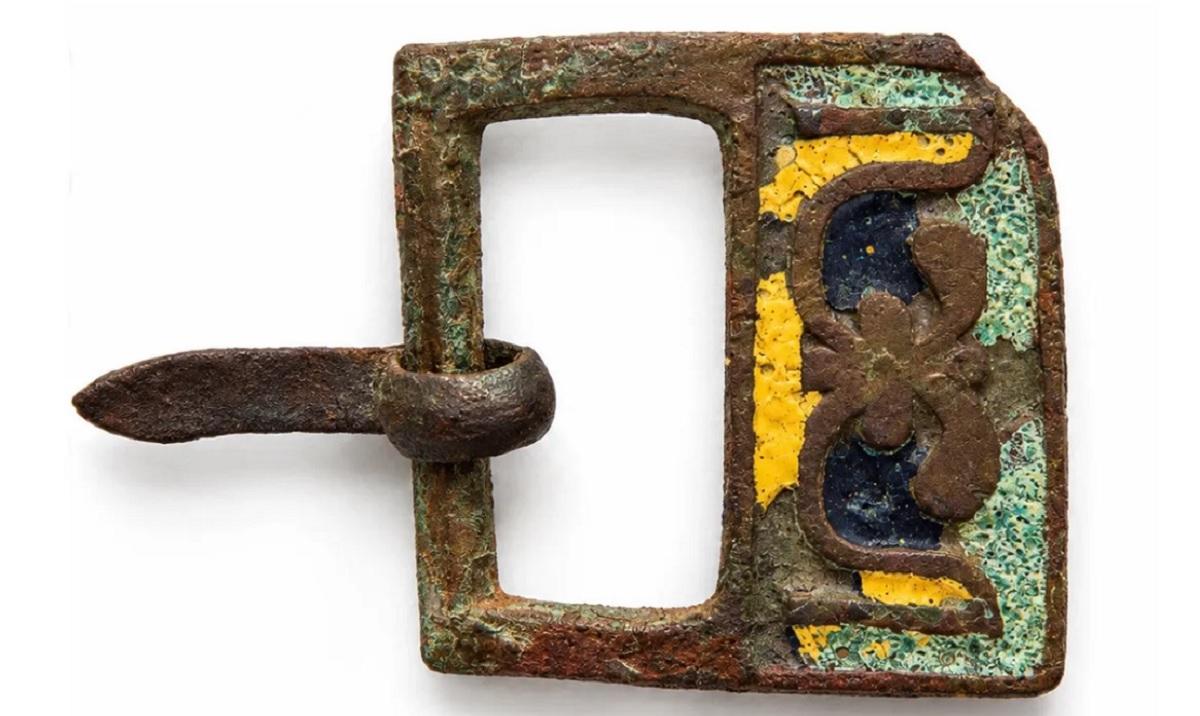
An unusual Roman metal buckle dating back about 1,800 years has been discovered in a forest in south-eastern Ukraine.
The artefact was handed over to Professor Antoniy Moysey of Bukovinian State Medical University, who has undertaken a study of the find, publication Live Science reported.
The buckle has a nearly square shape and measures about 2.1 centimetres on each side. It is decorated with turquoise, blue and yellow enamel. Moysey said the craftsmanship and ornamentation date the object to between the second and third centuries AD.
Alongside the buckle, the researcher collected a decorative belt fitting and three small round metal objects. Moysey said the pieces were likely part of a single accessory, and he prepared a reconstruction of what the belt looked like before it was lost in the forest nearly two millennia ago.
Roman province of Dacia
During that era, the territory where the buckle was uncovered formed part of the Roman province of Dacia. The history of the area is closely tied to the Dacian Wars, waged by the Roman Empire under Emperor Trajan against the Dacian Kingdom and its ruler Decebalus.
The military campaigns took place between 101 and 102 AD, and again from 105 to 106 AD. Roman legions crushed the Dacian armies, and the kingdom was incorporated as an imperial province. Trajan commemorated the victory in Rome with the construction of Trajan's Column, which depicts scenes from the campaigns in spiral carved reliefs.
According to Moysey, the metal items follow the craft traditions of Roman provincial workshops. Roman provinces across Europe and the Danube frontier were known for producing distinctive metal belt fittings and brooches, often decorated using champleve enamelling techniques to create colourful geometric patterns.
Nomadic Sarmatian warriors
The exact owner of the belt remains unconfirmed, but one hypothesis proposed by Moysey suggests it belonged to a Sarmatian horseman. The Sarmatians were nomadic pastoralist tribes renowned as formidable mounted warriors.
The Sarmatians lived outside the borders of the Roman Empire, populating lands across the northern Black Sea region, central Ukraine, southern Russia and the Balkans. Relations between the nomads and Rome were complex, with some Sarmatian groups fighting against imperial forces while others served as paid mercenaries in Roman auxiliary units.
Moysey suggested the metal fittings may have reached a Sarmatian owner through trade across the frontier or as war trophies taken after a clash with Roman forces. Researchers still need to verify whether the items can be definitively linked to the nomadic tribes.
Frontier trade and conflict
Moysey said further examination of the artefact could help scholars better understand contacts between Rome and the populations living on the fringes of the empire. The discovery may also illuminate how Roman soldiers, provincial craftsmen and local inhabitants in Dacia interacted during periods of war.
Bukovinian State Medical University, where Moysey conducts his research, is located in the western Ukrainian city of Chernivtsi. Discoveries of Roman-era metalwork in eastern Europe regularly provide vital evidence of how goods, military equipment and decorative styles moved beyond the formal borders of the Roman world.