


Spanish taxpayers must work seven months and 20 days in 2026 to pay their tax obligations, pushing Tax Freedom Day to August 20.
According to the latest report by the Center for Analysis of the Sustainability of the Economic Model, a department of the Madrid-based Civismo Foundation, workers in Spain must labor 231 days this year to pay all taxes, fees, levies, and social contributions.
This year's Tax Freedom Day arrives two days later than in 2025 and almost two months later than in 2019, which was the first full year of Pedro Sánchez as Spanish Prime Minister. From August 20 onwards, workers finally begin earning income entirely for their own use.
Rising revenue despite budget rollover
The Civismo Foundation calculates Tax Freedom Day by dividing the total taxes and social security contributions paid by households by broad family income, using National Accounts standards. The study concluded that Spain's effective tax pressure has not stabilized, but continues to grow across the country.
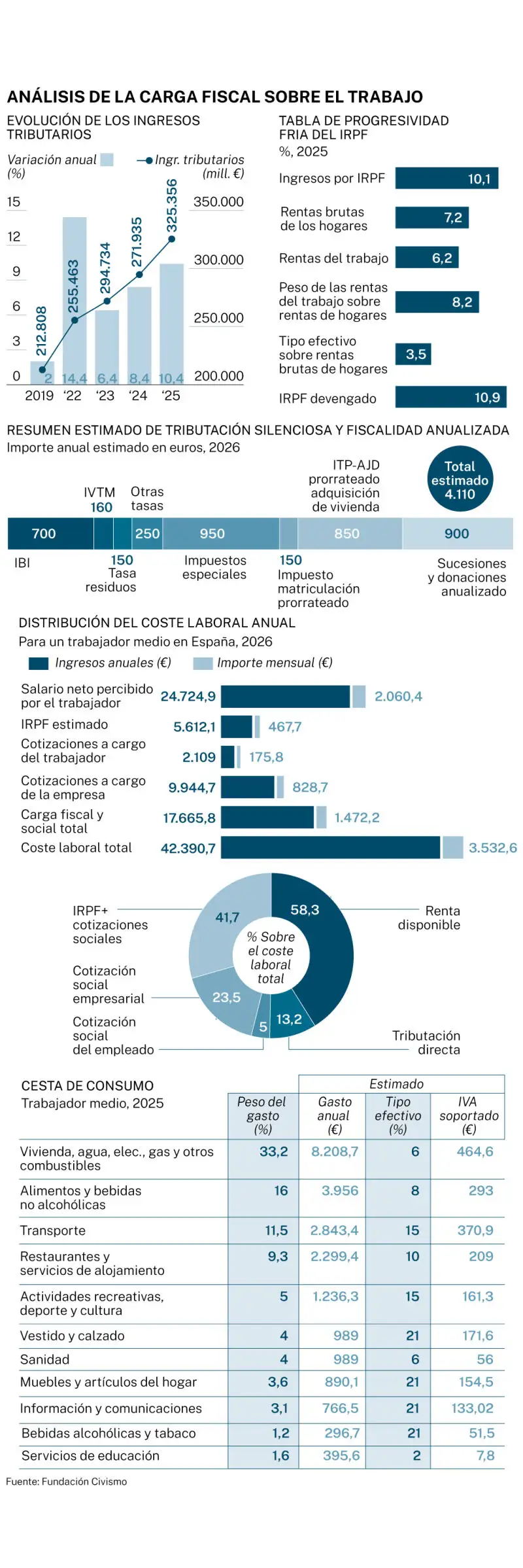
Spanish tax collection expanded even during periods with rolled-over budgets, demonstrating that the lack of a newly passed annual budget did not freeze the real tax burden. Tax revenues managed by Spain's State Tax Administration Agency reached 325,356 million euros in 2025, an increase of 10.4 percent compared to 2024. Over the same period, nominal gross domestic product grew by 5.8 percent.
The 4.6 percentage point gap between tax revenue growth of 10.4 percent and nominal GDP growth of 5.8 percent shows that tax collection grew faster than the nominal economy. The report noted that this difference underscores an expansionary fiscal stance operating without formal legislative rate increases.
Mechanisms driving fiscal inertia
The report highlighted what it described as a fiscal paradox where Spanish taxpayers work until late August to fund a state that collects record revenues without approving new tax laws. Policy has entered a phase of fiscal inertia, meaning explicit tax hikes are unnecessary to raise the effective tax effort borne by families.
A primary driver of this trend is cold progressivity, or hidden fiscal inflation. In a period of high inflation, nominal wage increases do not necessarily reflect an increase in real purchasing power. Because personal income tax brackets have remained frozen without sufficient inflation adjustments, nominal wage gains push workers into higher tax brackets, silently increasing effective tax rates on middle-class households.
Official figures from the State Tax Administration Agency show that tax collection rose from 212,808 million euros in 2019 to 255,463 million euros in 2022, 271,935 million euros in 2023, 294,734 million euros in 2024, and 325,356 million euros in 2025. Over the six years between 2019 and 2025, total tax revenue grew by 112,548 million euros, representing an increase of 52.9 percent.
The tax agency explained that the revenue rise in 2025 was driven by an estimated seven percent increase in tax bases, alongside regulatory and management adjustments that contributed an additional 7,820 million euros.
Payroll levies and indirect taxation
In addition to income tax, social security contributions have expanded the labor tax wedge. In 2026, the Intergenerational Equity Mechanism, an additional payroll contribution introduced to support the pension system, increased employment costs across the economy.
The Civismo Foundation stated that while individual tax adjustments may appear modest on their own, their cumulative impact reduces household capacity for consumption, savings, and investment. Higher payroll costs raise hiring expenses for businesses while shrinking net worker income through a less visible channel than direct taxation.
Consumer spending faces additional pressure as temporary tax relief measures expire. The restoration of standard value-added tax rates on essential foodstuffs has restored the tax's collection capacity, acting as a broad tax on daily household expenses that falls heavily on low- and middle-income families.
Regional disparities across autonomous communities
Local and regional taxation adds a secondary layer of financial pressure. Municipal property tax, vehicle tax, property transfer tax, regional levies, and new waste management fees combine to reduce disposable income without a guaranteed improvement in public services.
The study found that Tax Freedom Day varies significantly across Spain's autonomous communities, with a gap of approximately 12 days between the lowest and highest tax burdens. These differences stem from regional personal income tax scales, localized tax credits, and varying regional levies.
The Basque Country and the Community of Madrid recorded the earliest Tax Freedom Days, requiring fewer working days to satisfy tax obligations. Conversely, Catalonia and Extremadura registered the highest fiscal effort, extending the tax payment requirement into the final week of August.
The Civismo Foundation concluded that these territorial disparities create issues of transparency and horizontal equity, as citizens with identical earning power face different tax burdens depending on where they reside, consume, or acquire property.


