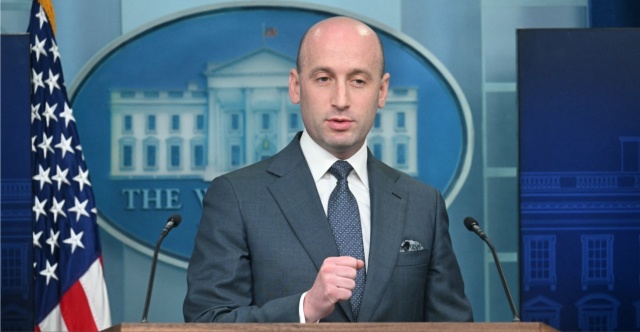
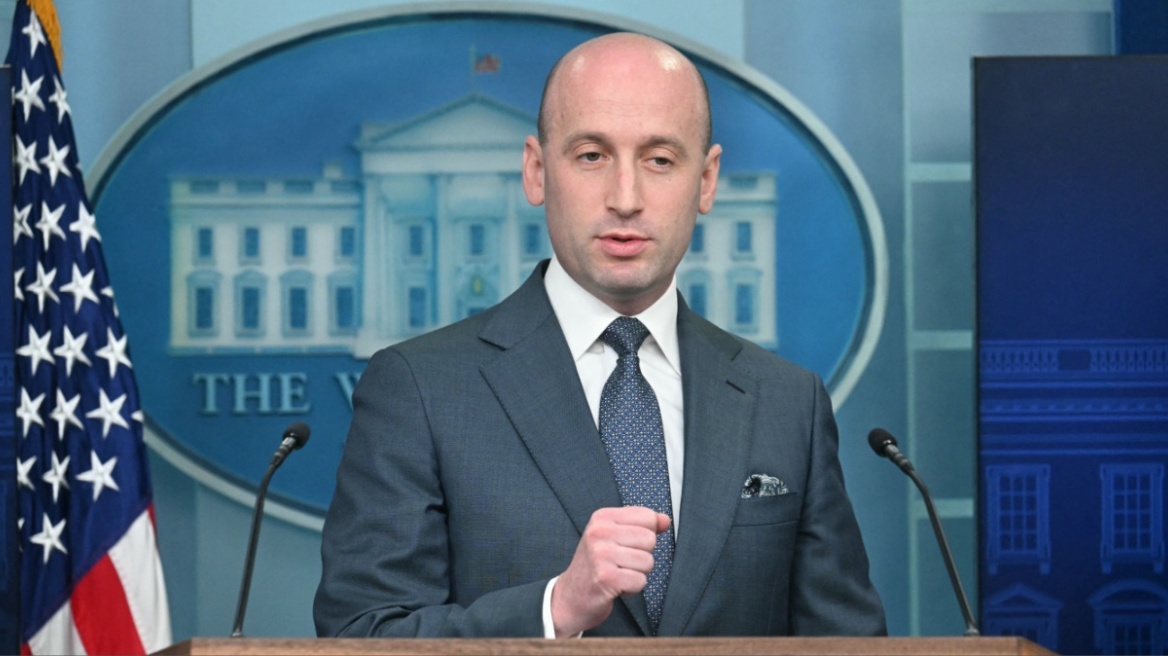
Donald Trump has named his longtime hardline immigration adviser Stephen Miller as the new White House chief of staff, replacing Susie Wiles.
The announcement on Friday, November 6, 2026, came just three days after Republicans suffered heavy defeats in the midterm elections, losing control of both the House of Representatives and the Senate to the Democrats.
The 41-year-old Miller, who previously served as deputy chief of staff and homeland security adviser, will officially take charge of the White House staff on Monday, November 9, 2026.
Susie Wiles, who made history as the first woman to serve as White House chief of staff after leading Trump's 2024 presidential campaign, is stepping down to take a role in his political operation.
Trump described Miller as one of his most trusted advisers and praised Wiles for doing an outstanding job. The promotion elevates one of the president's most devoted and controversial allies just as his administration prepares to face a hostile, Democratic-controlled Congress.
Miller Reaction and Loyalty to Trump
Miller reacted to the appointment in a social media statement, thanking Trump for his confidence and offering effusive praise for the president's political record.
Miller wrote that Trump was the most transformative political leader in American history and asserted that the president had single-handedly saved the nation from those who would destroy it.
Expressing gratitude for his decade of collaboration with Trump, Miller said serving on the team from day one had been the greatest privilege of his life, adding that becoming chief of staff was an honor beyond words.
Miller also thanked Wiles, describing her as incomparable and praising her years of dedicated service to the president and the country, as well as her personal friendship.
Looking ahead, Miller pledged to maintain an uncompromising course, stating that the mission was now clearer than ever to fight with all their soul to support the president and defend the republic.
Architect of Hardline Immigration Policies
Miller stands among the most influential figures on the radical wing of the American conservative movement. He served as the primary architect of Trump's agenda of mass deportations and strict immigration curbs, which formed the central priority of the administration.
A regular presence on television news programs, Miller has built a reputation for combative public appearances, aggressively championing the president's agenda while engaging in sharp exchanges with journalists.
Always appearing in a tailored suit, Miller consistently frames immigration as an existential danger to Western society. He has adopted hard-right arguments about the decline of the West caused by an alleged migrant invasion, portraying the issue as a civilizational challenge for the United States.
In a broadcast appearance, Miller declared that the borders of the United States were closed fully to asylum seekers, describing the policy as a simple, elegant, and complete solution.
Miller's extensive authority across the executive branch was highlighted in the book Regime Change. The book described him as an exceptionally demanding and confrontational official who regularly launched harsh attacks against administration colleagues to enforce presidential directives.
Clashes Over ICE and Troop Deployments
Miller's close relationship with the president has repeatedly drawn national scrutiny. In January 2025, shortly before Trump's second inauguration, former House Speaker Kevin McCarthy told The New York Times that Miller functioned as Trump's brain.
That influence was demonstrated in May 2025, when Miller intervened directly in the operations of Immigration and Customs Enforcement, commonly known as ICE.
According to The Wall Street Journal, Miller ordered ICE leadership to ramp up deportation operations substantially. He voiced sharp dissatisfaction that daily deportation figures remained lower than those recorded during the final year of Joe Biden's presidency.
The aggressive enforcement drive led to federal raids across the country, including an operation at a retail store in Los Angeles, California, that sparked public protests and clashes with law enforcement.
The unrest prompted Trump to deploy military troops to California, over the vehement objections of California Governor Gavin Newsom, a Democrat who condemned the military deployment on American streets.
California Roots and Voldemort Moniker
Miller, who grew up in the coastal city of Santa Monica, California, forcefully defended the decision to deploy military forces to his home state. Rejecting accusations of authoritarianism, he insisted publicly that the administration was engaged in a battle to save civilization.
His hardline approach and aggressive political persona have provoked fierce hostility from political opponents. Aides to Governor Newsom gave Miller the nickname Voldemort, referencing the dark wizard from the Harry Potter novels.
Miller showed no inclination to moderate his rhetoric, even when his statements triggered fierce public backlash. In January 2026, he labeled Alex Pretty, an American citizen killed by federal agents during anti-ICE demonstrations in Minneapolis, Minnesota, a terrorist. The characterization provoked widespread outrage, and Miller was later forced to retract the statement.
Rise Through Conservative Circles
Miller's political career began long before his arrival in the White House. Born in California to a Jewish family with university-educated parents, he grew up in Santa Monica, a background that seemed unlikely to produce a far-right ideologue.
Even as a secondary school student, Miller was known for championing hard-right political arguments. He continued his political activism while studying at Duke University in North Carolina, where he gained national attention for aggressive public speeches and writings.
During his university years, the influential conservative ideologue David Horowitz helped bring Miller into ultra-conservative circles, introducing him to prominent right-wing figures including Steve Bannon and Tucker Carlson.
In 2016, at age 30, Miller joined Trump's first presidential campaign, beginning an association that would eventually propel him to the highest levels of the federal government.
Travel Bans and Capitol Attack Loyalty
During Trump's first presidency from 2017 to 2021, Miller's policy positions were considered extreme even by many conservative lawmakers. He played a central role in drafting controversial travel bans targeting nationals from several Muslim-majority nations, measures that triggered nationwide demonstrations and prolonged legal battles in federal courts.
His loyalty to Trump remained steadfast following the 2020 election defeat. On January 6, 2021, when Trump supporters attacked the United States Capitol to disrupt the certification of Biden's victory, Miller stood unreservedly behind the president. That loyalty cemented his status within the small circle of advisers who remained at Trump's side after he left office.
When Trump returned to the presidency in January 2025, Miller's influence expanded significantly. Operating as deputy chief of staff and homeland security adviser, he spearheaded immigration and domestic security policies while steadily widening his authority across the administration.
Rather than selecting a moderate chief of staff who might build bridges with a Democratic-controlled Congress after the midterm defeats of November 3, 2026, Trump chose to empower one of the primary architects of his hardline agenda.
Karoline Leavitt, who served as White House press secretary until stepping down in August 2026, praised the appointment on Friday. She said nobody was more loyal, hardworking, or closely connected to the America First movement than Miller.
As chief of staff, Miller will oversee White House personnel and coordinate policy priorities as the administration faces intense political pressure and incoming congressional investigations.