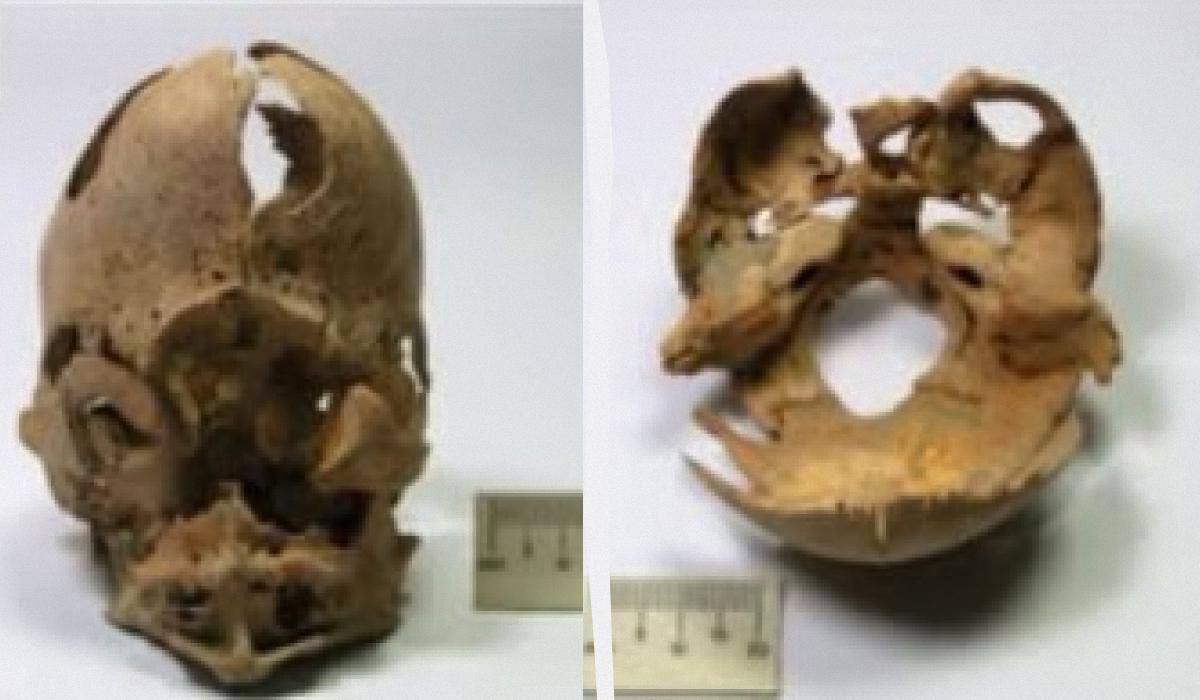
Archaeologists in Peru have discovered the skull of an infant, roughly 1,200 years old, with a single eye socket in the centre of its forehead, The Independent reported. The find has given researchers rare physical evidence of cyclopia, a severe genetic disorder that also appeared in ancient populations.
Cyclopia is a severe developmental defect caused by a failure of the brain to divide properly into two hemispheres. Most infants with the condition die before birth or shortly afterwards, and the disorder is so rare that physical evidence of it is difficult to find even in the modern world.
Researchers determined that the affected infant lived during the Middle Nasca period in southern Peru. While excavating an ancient cemetery at Huaranza, archaeologists found the well-preserved skeletons of two infants buried together inside a single ceramic vessel.
One of the infants showed no skeletal abnormalities. The other had an unusually small skull with a single eye socket in the middle of its forehead, along with other signs of a severe developmental disorder. It had no nasal bones or nostrils, its upper jaw had not separated into two parts, and its optic nerves had likely fused together.
Genetic analysis
DNA analysis showed that both infants were girls. The one with cyclopia carried an extra copy of chromosome 13, a condition known as trisomy 13. A human cell normally contains 23 pairs of chromosomes, and an extra chromosome can cause serious developmental disorders.
Trisomy 13 causes Patau syndrome, which is marked by severe defects of the brain and nervous system, facial anomalies including cyclopia, heart defects, and extra fingers or toes.
Burial practice
DNA testing also showed that the two infants were not related through their mothers. They were buried in a cemetery of the Middle Nasca period dated to roughly between 325 and 440 AD.
Their bones were preserved in their natural position rather than scattered, which the researchers said indicates both children were buried according to the same funerary rite. Placing dead children inside ceramic vessels is a burial method well documented in Nasca culture, and the study authors noted that the practice has been recorded in about a quarter of all child burials studied in the region.
Unanswered questions
The researchers said the discovery cannot establish whether the infant's physical differences affected its social standing, how it was regarded by its community, or how it was cared for during its life.