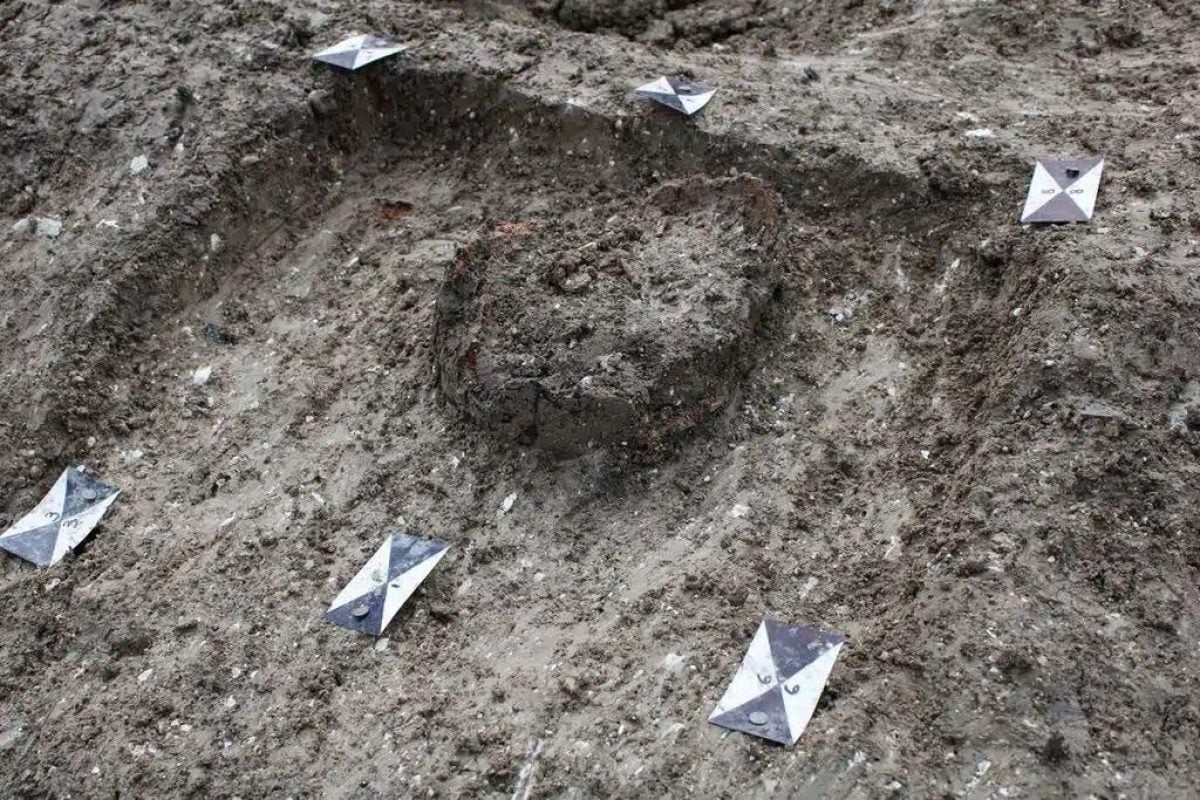
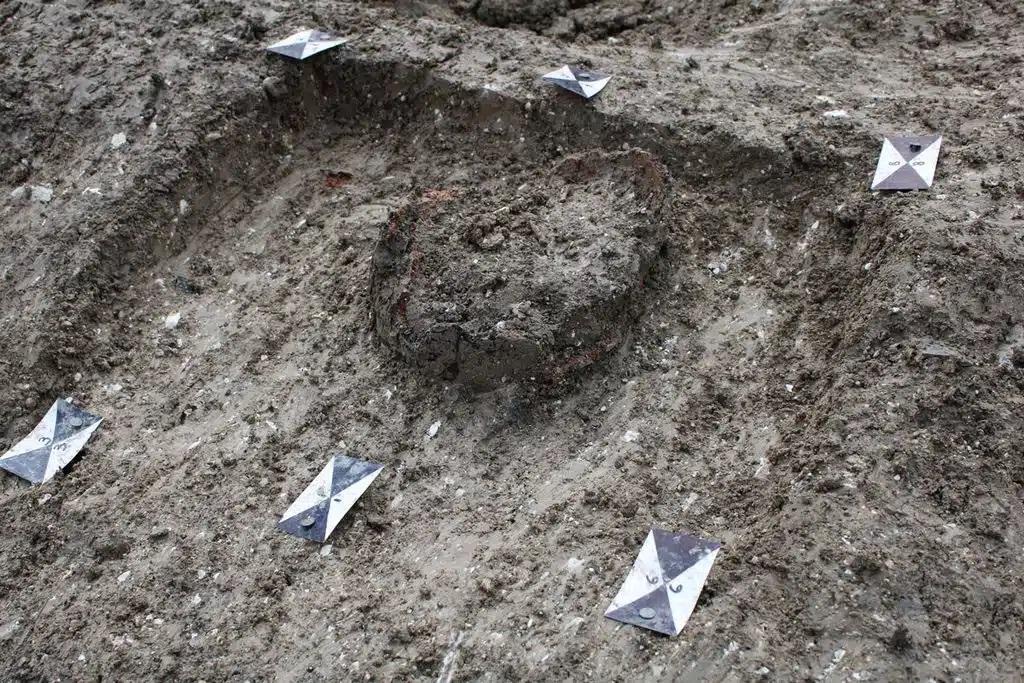
Archaeologists clearing a site for a new cricket pitch in Wendover, Buckinghamshire, have uncovered the burial of a Roman-era infant placed inside a ceramic pot that had been turned upside down and buried in the ground, The Daily Galaxy reported.
The remains inside belonged to a baby around nine months old. Next to the mouth of the vessel, archaeologists found the bones of an adult chicken and a small songbird.
Radiocarbon analysis dated the burial to the period of Roman rule in Britain, roughly between the early 3rd and early 4th centuries AD. Specialists from Cotswold Archaeology, the organisation that carried out the excavation, said this method of burying a child may have been recorded in Britain for the first time. The burial was one of nine Roman-era graves found on the edge of a small farming settlement.
An upturned pot
The vessel is a ceramic pot with an outward-flared rim, made from clay mixed with crushed shells. The infant was placed inside before the pot was turned upside down and buried. Because the pot was inverted, the child's remains ended up in the uppermost part of the grave, which left them exposed to outside conditions and only partially preserved. The base of the vessel had also been cut off.
Two birds, an adult chicken and a small songbird from the passerine order, lay near the opening of the vessel. An earlier report on the dig had mentioned only the wings of the small bird.
Radiocarbon dating placed the chicken's remains between 237 and 346 AD, and the infant's remains between 131 and 329 AD. Taken together, the results point to a window running from the early 3rd to the early 4th century AD, placing the burial in the later part of Roman rule in Britain.
Chickens appear fairly often in Roman burials across Britain, in both graves and cremation sites, and were likely placed there as food for the dead or as votive offerings. In Roman Britain, chickens were still considered something of a luxury, since the species had been introduced to the island relatively recently.
A Mediterranean custom in Buckinghamshire
Burying infants inside ceramic vessels was far more common elsewhere in the Roman Empire, particularly around the Mediterranean, where amphorae, the large two-handled jars used to transport wine and olive oil, were most often used for the purpose.
Cotswold Archaeology specialists suggested that amphorae and jugs may have served as a symbol of the maternal womb. Sharon Clough, the company's senior human remains consultant, wrote the report on the burials.
Because the practice is rare in Britain, the researchers raised the possibility that the parents may have come from the Mediterranean region. They stressed this remains a hypothesis rather than an established fact, noting there is no direct evidence of the family's origin and no data linking the remains to any specific place.
The settlement itself had connections reaching well beyond Buckinghamshire. It stood north of the Upper Icknield Way, a route thought to date back to prehistoric times, and a Roman cemetery lies around 2 kilometres away at Halton. Most of the pottery found at the site was made locally, but some pieces came from Oxfordshire, Verulamium (modern St Albans), the Nene Valley, Dorset and Bedfordshire. Archaeologists also found amphorae from southern Spain and samian ware tableware brought from Gaul.
Children buried beside grain dryers
The jar burial was not the only one found at the site. In total, archaeologists uncovered nine Roman-era burials: five of children, including infants, and four adults whose cremated remains had been placed in ceramic urns.
The researchers described this group as unusual for a Roman settlement. Infants under a year old were more often buried near houses, in boundary ditches or close to outbuildings rather than in cemeteries during that period.
A newborn was buried in a separate grave right next to the inverted jar, while a six-month-old child was buried about 3 metres away. Another child, roughly three to four years old, was buried with a thick-walled white clay bowl made in Oxfordshire in the 4th century. One of the adult burials included a cup with a red slip finish, likely made in Oxfordshire in the 3rd or 4th century.
The settlement's residents lived by growing grain crops. Archaeologists found wells, traces of a possible structure, and three stone grain dryers, kilns in which fire in a furnace sent hot air through a channel into a chamber where grain was dried for winter storage. Two of the dryers had an unusual curved, J-shaped channel, which researchers suggested may have been designed to let the airflow cool before reaching the drying chamber.
All of the infant burials lay close to these grain dryers. The researchers said infant burials and grain dryers turn up together too often at Roman-era sites for it to be a coincidence, and raised the possibility that rituals tied to harvest, threshing and fermentation may have been closely linked to ideas of fertility.
Test yourself
Where was the Roman infant burial discovered?
What two animals were found near the mouth of the burial vessel?
What did archaeologists find clustered near all the infant burials at the site?
Where it happened
Wendover, United Kingdom