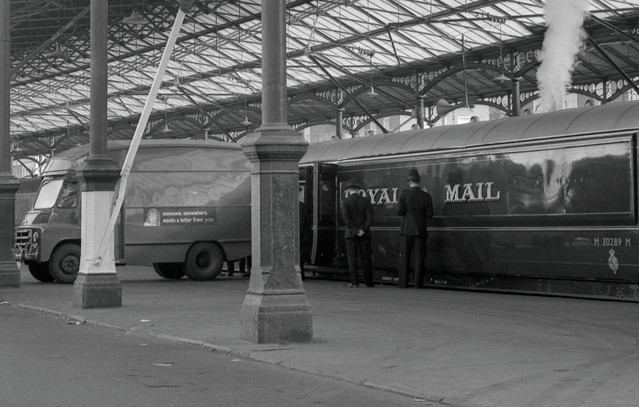
On August 8, 1963, a gang carried out the Great Train Robbery in Buckinghamshire, stealing 2.6 million pounds from a London-bound postal train. Train driver Jack Mills stopped the Glasgow to London mail train shortly after 3 a.m. near Sears Crossing when he spotted a red signal on the line.
The signal was fake, created by 15 men hiding nearby to trap the train. Over the next 30 minutes, the group carried out one of the most famous robberies of the 20th century, taking banknotes worth tens of millions of pounds in modern terms.
Central organizer Bruce Reynolds had planned the operation with great detail, knowing the train carried an unusually large sum of money to London. To stop the train, the robbers covered the normal green signal with a glove and powered a red light using a six-volt battery. They also cut the telephone wires alongside the tracks.
Assistant driver David Whitby stepped down from the locomotive to call the signalman but found the line dead. Members of the gang attacked Whitby as he returned to the train.
At the same time, other robbers entered the engine cab. Mills resisted and was hit on the head, leaving him bleeding and semi-conscious. Mills never returned to work and died of leukemia in 1970, though British authorities did not officially connect his death to his injuries from the robbery.
The robbers uncoupled most of the train and forced the injured driver to move the front carriages to Bridego Bridge, where their getaway vehicles waited. Forming a human chain, the gang unloaded about 120 mail bags containing over two and a half tons of banknotes. Many of the notes were old one-pound and five-pound bills being transported to London for withdrawal from circulation.
Before leaving, the robbers ordered the train staff not to contact anyone for 30 minutes. Investigators later realized this instruction indicated the gang's hideout was within a 30-minute drive of the scene.
Monopoly Money and Prison Sentences
The gang fled to Leatherslade Farm, an isolated farmhouse in Buckinghamshire. There they divided part of the cash and reportedly played Monopoly using real banknotes from the heist.
Police discovered the hideout a few days later after the robbers left in a hurry. The gang left behind food, mail bags, money wrappers, and fingerprints on both the Monopoly board and a ketchup bottle. These fingerprints proved decisive for the investigation.
Most of the robbers were caught and tried. In 1964, 12 convicted men received sentences totaling 307 years, with several handed 30-year terms.
Ronnie Biggs became the most famous member of the gang. Sentenced to 30 years, Biggs escaped from Wandsworth Prison in 1965 and spent decades as a fugitive in Australia and Brazil before returning voluntarily to Britain in 2001. Main organizer Bruce Reynolds avoided capture for five years before his arrest.
Most of the stolen money was never recovered. According to Guinness World Records, authorities recovered only 343,448 pounds of the 2.63 million pounds taken.
Earthquake, Space Flight and Diplomatic Shifts
August 8 also marks major political, military, and natural events across history. In 1303, a powerful earthquake hit Crete and triggered a destructive tsunami across the eastern Mediterranean. The Lighthouse of Alexandria, one of the seven wonders of the ancient world, suffered severe damage and stopped operating.
In 1963, the Beatles version of the Mikis Theodorakis song Honeymoon Song aired on radio for the first time. Known in Greek as An thymithis t' oneiro mou, the song was translated into English and gained international success, showcasing the global reach of Greek music.
In 1967, representatives founded the Association of Southeast Asian Nations in Bangkok to promote political, economic, and social cooperation. In 1989, the Space Shuttle Columbia launched on mission STS-28, a five-day spaceflight dedicated to the U.S. Department of Defense that remained largely secret.
In 1990, Iraq announced the annexation of Kuwait days after invading the country. On the same day, President George Bush announced the deployment of U.S. forces to Saudi Arabia, setting the stage for the Gulf War.
In 2008, the 29th Olympic Games opened at the Bird's Nest stadium in Beijing. The Games brought together 10,942 athletes representing 204 National Olympic Committees.
Historical Births from Zapata to Federer
Several influential figures in politics, theatre, and sports were born on August 8. Mexican revolutionary Emiliano Zapata was born on August 8, 1879. Zapata led the agrarian movement in Morelos, championed the Plan of Ayala for land redistribution to peasants, and gave his name to Zapatismo before his assassination on April 10, 1919.
Greek actor and director Alexis Minotis was born in Chania on August 8, 1900. Minotis became a central figure of 20th-century Greek theatre, known for his portrayal of Oedipus, his collaboration with Katina Paxinou, his work in Hollywood, and his leadership as director of the National Theatre before his death on November 11, 1990.
Greek actress Rika Dialyna was born in Heraklion, Crete, on August 8, 1934. Dialyna studied painting and acting, won the Star Hellas title in 1954, placed fifth in Miss Universe, and built a long career in 1960s and 1970s cinema and theatre.
American actor Dustin Hoffman was born in Los Angeles on August 8, 1937. Hoffman rose to fame with The Graduate, starred in Midnight Cowboy and Tootsie, and won two Best Actor Oscars for Kramer vs. Kramer and Rain Man.
Swiss tennis legend Roger Federer was born in Basel on August 8, 1981. Federer won 20 Grand Slam titles, including eight at Wimbledon, six at the Australian Open, five at the US Open, and one at Roland Garros. He spent 310 weeks at number one, including a record 237 consecutive weeks, and retired in 2022 as part of tennis's Big Three alongside Rafael Nadal and Novak Djokovic.
Deaths of Writers, Actors and Leaders
August 8 is also the date of death for notable leaders, writers, and artists. British politician George Canning died on August 8, 1827. Canning, who was born on April 11, 1770, served as Foreign Secretary and Prime Minister, supported the Greek Revolution, and contributed to the St. Petersburg Protocol and Treaty of London before being honored with Kaningos Square in Athens.
Greek writer Antonis Samarakis died on August 8, 2003. Born on August 16, 1919, Samarakis wrote the short story collection Hope Wanted and the internationally translated novel The Flaw, while also serving as a UNICEF Goodwill Ambassador and inspiring the Youth Parliament.
Greek actor Dimitris Papamichael died on August 8, 2004. Born on August 29, 1934, Papamichael starred in Greek stage and screen productions such as The Flirting Teacher, The Lady and the Tramp, and Papaflessas, with his artistic partnership with Aliki Vougiouklaki defining an era of Greek entertainment.
Greek singer and painter Arleta died on August 8, 2017. Born on March 3, 1945, Arleta emerged from the 1960s New Wave and Athens music clubs, recording popular songs including Mia fora thymamai, Ta mikra paidia, Serenata, and Bar to Navagio.
American singer-songwriter Sixto Rodriguez died on August 8, 2023. Born on July 10, 1942, Rodriguez recorded Cold Fact and Coming from Reality, gained widespread popularity in South Africa with Sugar Man, and saw his career revived by the 2012 Oscar-winning documentary Searching for Sugar Man.