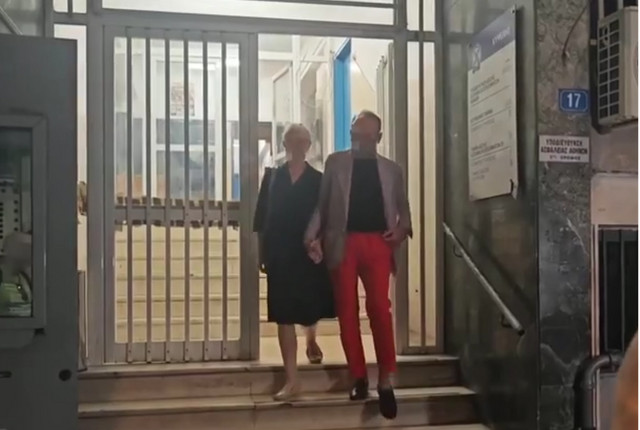
Two doctors were released from police custody late Wednesday night following preliminary questioning into the death of popular Greek singer Giorgos Mazonakis, who suffered cardiac arrest during a medical procedure at a private clinic in central Athens.
The married couple, who operate the clinic in the upscale Kolonaki neighborhood, departed the Kypseli Police Station at approximately 11:40 p.m. after delivering formal statements to investigating authorities regarding the circumstances surrounding the 54-year-old artist's death.
Attorney Nikos Agapinos, who represents one of the physicians, confirmed that the investigation remains at a preliminary stage. He stated that upcoming forensic and post-mortem findings will be decisive in determining the trajectory of the inquiry.
Police officers requested that both doctors provide a comprehensive account of the events preceding the singer's collapse. Investigators are examining the medical treatment provided to Mazonakis prior to his cardiac arrest, specifically assessing whether any prior medical intervention was linked to the rapid deterioration of his health.
According to source information, the male doctor clarified to police officers that he did not personally perform the plasmapheresis procedure on the singer. In his testimony, he stated that his wife was solely responsible for conducting the procedure and monitoring the patient throughout the treatment. The female doctor also submitted a detailed statement to the authorities.
Medical negligence and legal defense
Speaking outside the Kypseli Police Station, Agapinos urged public restraint and emphasized the importance of awaiting concrete medical evidence before drawing conclusions. He stressed that the presumption of innocence must be respected in practice, noting that just as no one should exonerate individuals prematurely, no one should incriminate professionals with established scientific careers prior to official findings.
The attorney disclosed that authorities plan to conduct an on-site inspection of the Kolonaki clinic premises. He added that the doctors were permitted to leave once preliminary proceedings concluded, while police were finalizing witness statements from two clinic employees.
Plasmapheresis is a therapeutic medical process in which blood is removed from the body, separated into cells and plasma, and treated or filtered before being returned. The procedure requires specialized equipment and careful monitoring by trained medical professionals.
Agapinos asserted that the doctors maintain there is no causal connection between the medical procedure performed and the death of the performer. He stated that if forensic examinations confirm the absence of a link, no criminal liability or cause for further criminal investigation will exist.
The defense attorney clarified that only the wife is an internist physician who was treating Mazonakis as a patient. Addressing potential civil liability, he explained that establishing negligence requires proof that a medical act was performed incorrectly, which the defense denies.
Clinic authorization and equipment status
Addressing public comments from government officials, Agapinos refuted claims of illegal operations or undisclosed medical devices. He stated that all equipment utilized at the premises had been formally declared to the Athens Medical Association through his law firm upon the doctors' explicit instructions.
Agapinos further clarified the operational structure of the facility, stating that it does not operate as a single corporate entity. Instead, the facility houses two co-locating medical practitioners who, despite being married, maintain independent individual professional practices.
Describing the emotional state of the practitioners, Agapinos stated that both doctors were deeply shocked by the fatal incident occurring within their facility. He called on the public and media to refrain from hasty judgments, warning against turning the investigation into a Roman Colosseum. He added that if responsibility is established it should be assigned, but questioned what outcome would follow if no fault is found.
Agapinos noted that his presence at the Kypseli Security Subdirectorate was in a personal capacity as a long-time friend and patient of the doctor. He emphasized that neither physician has been charged with an offense, as both were summoned strictly as witnesses, a status under which legal counsel does not attend the formal questioning session.
Criticism of early statements
The attorney expressed concern over early public remarks by state officials and government ministers, urging authorities to avoid making grandiloquent statements at such a preliminary stage. He reiterated that the medical facility is completely legal and properly registered with competent regulatory bodies.
Regarding the administrative investigation launched by the Athens Medical Association, Agapinos voiced support for a thorough official inquiry. He stated that when a human life is lost an exhaustive investigation is necessary, but insisted that conclusions must rely strictly on scientific data rather than premature condemnation or acquittal.
Giorgos Mazonakis, born in 1972, was one of Greece's most prominent contemporary singers. Over a career spanning more than three decades, he earned widespread popularity across the country for his distinctive vocal style and contributions to modern Greek music.
The fatal sequence of events began on Wednesday afternoon, September 9, 2026, when Mazonakis arrived at the private Stem Cell clinic in central Athens for a scheduled plasmapheresis treatment. According to preliminary reports, the singer suffered cardiac arrest during the insertion of a venous catheter.
Emergency response and official confirmation
Medical staff immediately contacted the National Center for Emergency Care, known as EKAB. Paramedics initiated cardiopulmonary resuscitation at the clinic and continued resuscitation attempts while transporting the 54-year-old artist to Elpis Hospital in central Athens.
Mazonakis arrived at the hospital emergency department in critical condition. Hospital physicians immediately implemented standard resuscitation protocols, but were unable to restore a heartbeat or spontaneous breathing.
The Ministry of Health officially confirmed the singer's death at 5:40 p.m. In a formal statement, the administration of Elpis Hospital reported that Georgios Mazonakis was brought in by EKAB ambulance at 4:45 p.m. without pulse or spontaneous respiration. The hospital confirmed that CPR protocols failed to revive him, officially recording his time of death at 17:40 and expressing sincere condolences to his family and relatives.
Investigators and health authorities are now awaiting the final post-mortem and forensic toxicology reports to establish the exact cause of cardiac arrest and determine whether further legal action will be pursued.