

The Dominican Republic continues to face a medium-high risk of threat and vulnerability to money laundering, driven by internal weaknesses including public corruption, drug trafficking and smuggling, according to a national risk assessment.
Results from the latest 2024 National Risk Assessment of Money Laundering and Terrorist Financing showed that while domestic vulnerabilities persist, the overall threat level of external danger from illicit financial activity decreased compared to the previous evaluation covering 2010 to 2014, when it was rated high.
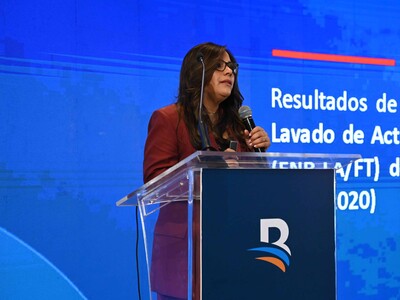
Aileen Guzman Coste, director of the Financial Analysis Unit, presented the findings on Tuesday during the fourth Congress Against Money Laundering and Terrorist Financing, an event organized by state-owned commercial bank Banreservas.
Guzman Coste highlighted public corruption as a high-level threat that compromises ethical, economic and business standards across the nation. She noted that between 2015 and 2020, Dominican authorities investigated 616 money laundering cases, leading to the seizure of 4,965.8 million pesos.
Out of those seized funds, judicial sentences ordered the final confiscation of 1,860 million pesos, while courts handed down 123 convictions during the five-year period. Guzman Coste said the most frequent schemes in corruption cases involved payments without supporting documentation, overvalued or fictitious contracts, front men placed on payrolls, and non-profit associations used as structural fronts.
The evaluation warned that such bad practices have become normalized within public administration, distorting market competition and creating significant reputational risks for state relations.
Main threats and financial sectors
Drug trafficking emerged as the single largest primary threat identified in the evaluation, accounting for 47.1 percent of all investigated cases. Other major threat vectors included public corruption through the structural diversion of funds, as well as tax crimes involving evasion and fiscal simulation.
Unregulated fintech platforms and crypto assets were also flagged as prominent hazards, alongside traditional high-risk sectors such as gambling, cooperatives and vehicle dealerships.
The Financial Analysis Unit is the specialized central government agency in the Dominican Republic responsible for receiving and analyzing financial intelligence to combat money laundering and terrorist financing. As a major Caribbean economy, the nation regularly conducts comprehensive risk evaluations to strengthen its financial intelligence safeguards against domestic and transnational criminal networks.
Banking leader warns against over regulation
Addressing the conference, Leonardo Aguilera, executive president of Banreservas, criticized financial institutions for harassing established business owners who possess transparent track records.
Aguilera said that preventing money laundering should not mean annoying clients, acknowledging that while financial entities must safeguard regulatory compliance and system security, they should not reach extremes where they are viewed as foolish or overly burdensome.
He pointed to instances where reputable business figures face immediate scrutiny simply for transferring money or making bank deposits between recognized financial institutions.
Aguilera questioned why institutions feel compelled to demand personal appearances or open investigations when funds move between established companies and recognized individuals, emphasizing that compliance efforts should focus strictly on determining the legitimate origin of funds.
Banreservas, formally known as Banco de Reservas de la Republica Dominicana, is the largest financial institution in the country. National authorities and banking leaders expect the updated risk evaluation findings to guide future regulatory measures and enforcement priorities across the Dominican financial system.


