
Early humans living around 500,000 years ago may have kept small stones and tools as personal mementos, holding onto objects tied to specific places or experiences in much the same way people collect keepsakes today, according to a new study from Tel Aviv University.
The research, published in the journal Evolutionary Anthropology, draws on archaeological evidence alongside findings from psychology, neuroscience and evolutionary biology to explain why some early human groups held onto stones and tools that had no obvious practical use. The authors argue that these objects functioned as a form of external memory, helping people hold onto experiences, places and events from their own lives. External memory is a term used in cognitive science for any tool outside the brain that helps store and retrieve information, a role that keepsakes, photographs and written records play in modern life.
Tel Aviv University is one of Israel's leading research institutions, and Evolutionary Anthropology is a peer-reviewed journal that covers human evolution and prehistory.

One of the main pieces of evidence comes from Qesem Cave in Israel, where archaeologists found small, colourful pebbles that had been brought in from different locations. Researchers were struck by the fact that the pebbles had been carefully kept despite having no identifiable practical function.
Qesem Cave is a well-known prehistoric site south-east of Tel Aviv that has previously yielded evidence about the daily lives, diet and tool-making habits of early humans in the region. The cave is also known for an early, well-preserved hearth and evidence that its inhabitants gathered and shared food in groups, making it an important site for research into the social lives of early humans.
Stones and Tools Early Humans Kept
In the Sakhnin Valley, researchers also found hand axes made from flint that contained fossils or other unusual geological features. In some of these tools, the unusual markings sat at the centre of the stone, in a spot that was easy to see and to touch.
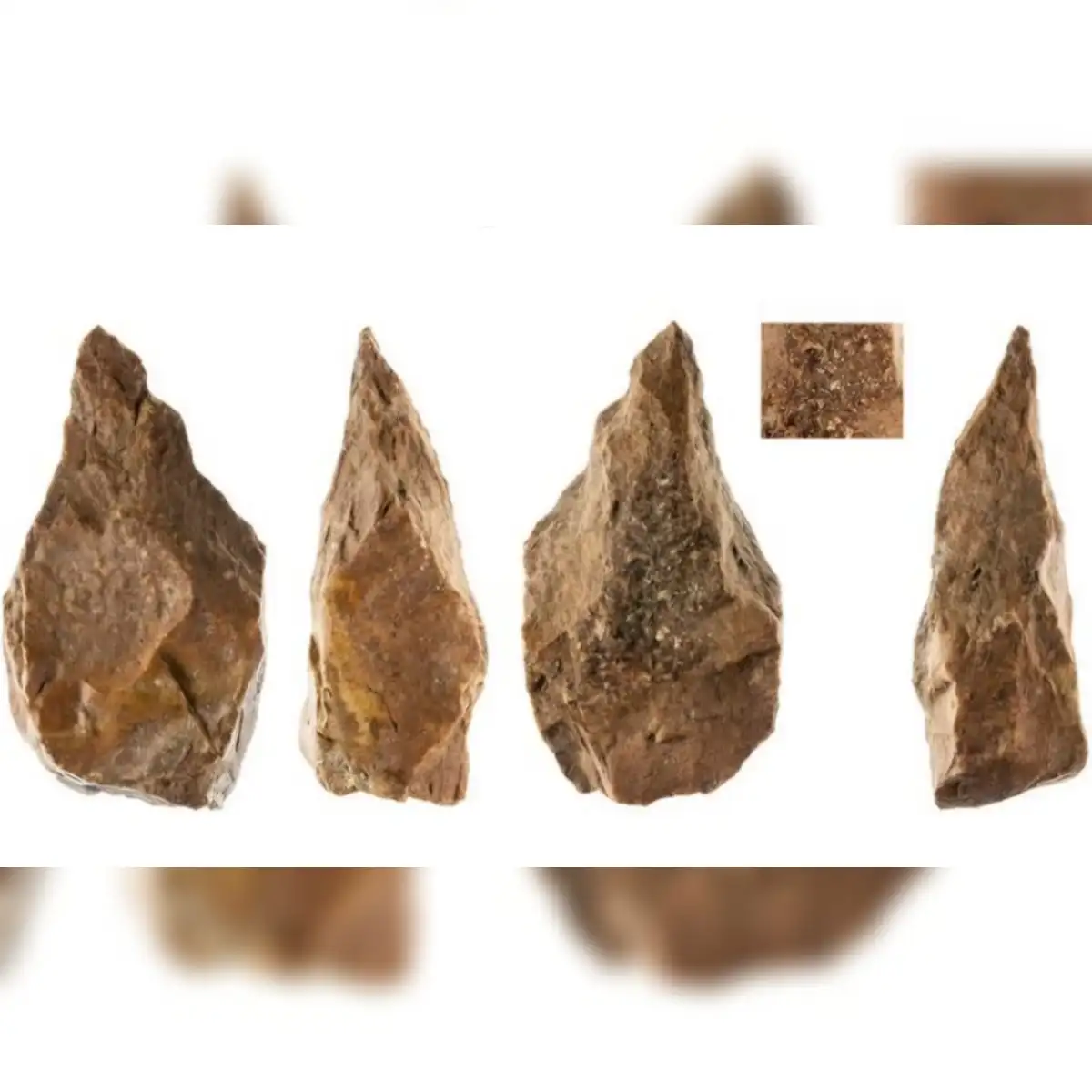
Hand axes are among the oldest stone tools used by early humans, typically shaped for cutting and butchering, and flint was widely favoured by early toolmakers because it is hard, breaks predictably and can be shaped into sharp edges. The Lower Palaeolithic, the period these tools belong to, is the earliest part of the Stone Age, when early human populations in Africa, Asia and Europe first produced tools such as hand axes.
Revadim and Jaljulia are additional archaeological sites in Israel that, like Qesem, have produced flint tools and animal remains from the Lower Palaeolithic period.
There, archaeologists uncovered ancient flint tools with worn surfaces and marks left by earlier use. Some of the tools had been given new retouching, but most kept their original appearance. According to the study's authors, these worn features may have carried value precisely because they preserved the object's history and its link to past experiences.
Objects and the Roots of Personal Memory
The researchers propose that these items worked as external memory devices. A stone that came from a distant territory could bring back a lived experience and help a person tell it apart from a story they had only heard or imagined. Psychologists call this ability source monitoring, the process the brain uses to identify where a particular memory came from, distinguishing things that were directly experienced from things that were merely heard or imagined.
The study's authors link this practice to the evolution of autobiographical memory, the capacity that allows people to organise their experiences into a coherent personal life story rather than simply storing isolated facts or skills. They said that keeping objects and sharing them with others may have helped build trust within early human groups, whose survival often depended on cooperation.
The researchers cautioned, however, that not every unusual stone found at these sites was necessarily a personal keepsake. They said the hypothesis still needs further archaeological and experimental evidence before it can be confirmed.