

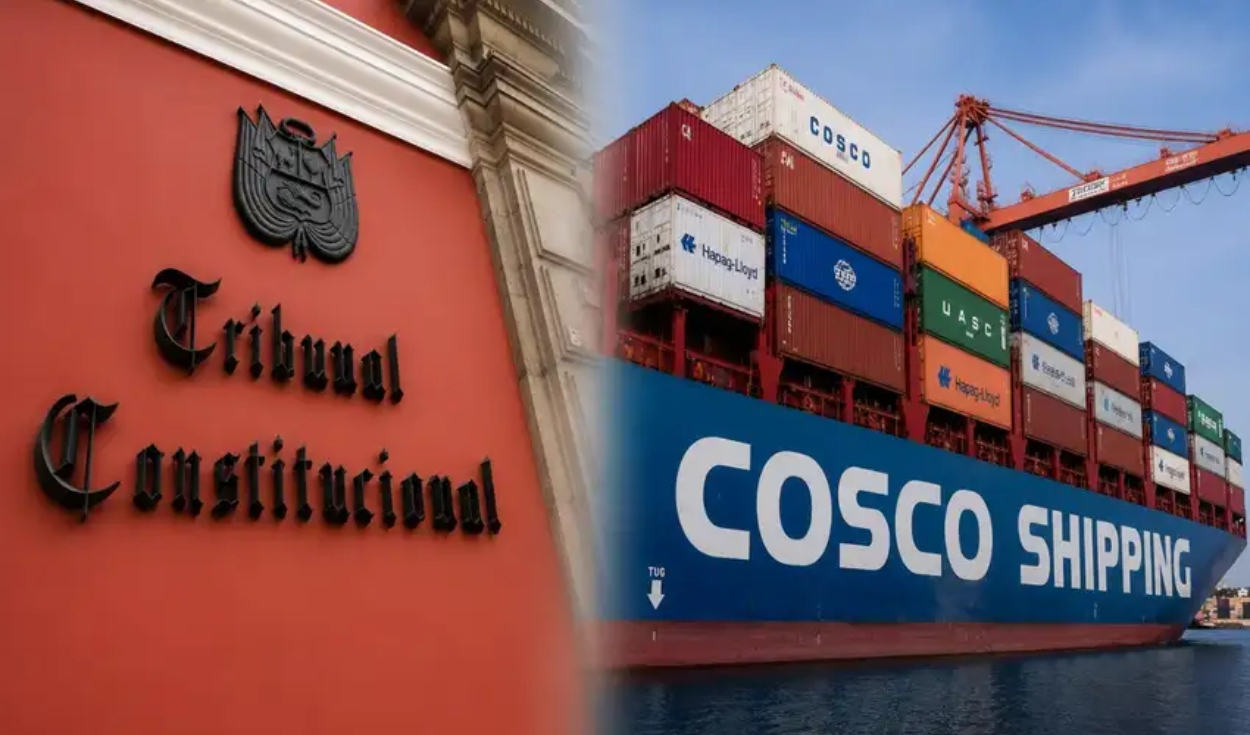
Peru's Constitutional Court will decide whether the transport regulator Ositran has full authority to supervise the Chancay Multipurpose Port Terminal, after admitting an appeal filed by operator Cosco Shipping Ports Chancay Peru.
The appeal's admission does not change Ositran's current powers or amount to a ruling on the merits of the case, but it opens a constitutional stage that will help define the limits of state oversight over infrastructure built through private investment that serves a public and strategically important role in Peru's foreign trade.
Two competing legal arguments
Cosco argues the port was built under a private investment scheme rather than a state concession, and therefore should not fall under the same regulatory regime applied to other port infrastructure run under concession.
Ositran, the Supervisory Body for Investment in Public Transport Infrastructure, counters that its authority does not depend on who owns the infrastructure but on the service it provides. Under that reasoning, the Chancay terminal forms part of public-use transport infrastructure because of its role in the logistics system and foreign trade, meaning Ositran should be able to supervise it to ensure compliance with regulations.
What the Constitutional Court must decide
The dispute goes beyond whether Ositran can supervise the Chancay port. The Constitutional Court must establish which principle prevails when private investment rights and the state's regulatory powers over services considered to be in the public interest come into conflict.
Cosco maintains that applying certain regulatory powers could alter the conditions under which the project was developed and affect constitutional principles such as freedom of enterprise, legal certainty and property rights. In the company's view, the regime applied to privately built infrastructure should not be equated with that of a project awarded under concession.
The state, for its part, argues that the project's private nature does not remove the public interest in the service it provides. According to Ositran, the goal of its supervision is to guarantee adequate operating conditions, protect users and ensure the port system functions in line with current regulations.
The ruling that triggered the constitutional review
The dispute reached this stage after the Second Constitutional Chamber of the Superior Court of Justice of Lima overturned a ruling that had favored Cosco and declared inadmissible the amparo lawsuit the company had filed against Ositran.
The chamber found that disagreements over the exercise of regulatory powers should be resolved through the administrative and judicial channels set out in law, unless there is a direct violation of constitutional rights. It also found that the terminal's private character does not automatically exclude state supervision when the infrastructure provides a public-use service.
Following that ruling, Cosco filed a constitutional grievance appeal, which has now been admitted, allowing the Constitutional Court to examine the arguments the company has raised.
A separate case before Indecopi
The Chancay port also faces another institutional dispute. Peru's antitrust authority, Indecopi, continues to evaluate competition conditions across various port services, after the judiciary dismissed a separate lawsuit Cosco had filed against the agency's actions.
That review covers services related to container loading and unloading, servicing of container ships, handling of empty containers and transshipment operations. Its aim is to determine whether any of these markets show a lack of competition and whether regulatory measures should be applied.
Although the two proceedings are independent of each other, both reflect the broader debate over which institutional framework should apply to the first megaport built entirely through private investment in Peru.
A precedent for infrastructure investment
The Chancay port case has become one of the leading regulatory disputes tied to foreign investment in infrastructure in Peru. The terminal is operated by Cosco Shipping Ports Chancay Peru, a joint venture between China's Cosco Shipping Ports and Peru's Volcan, and is intended to serve as a strategic link connecting South America with Asian markets.
Beyond the outcome of the litigation itself, the Constitutional Court's eventual ruling could set a precedent for future infrastructure projects developed with private capital. The standard it establishes will help determine when the strategic nature of a service justifies state regulatory intervention, and what the constitutional limits of that oversight are.
While the constitutional process continues, Ositran retains its current powers over the terminal. The final decision will not only resolve the dispute between the two parties but will also serve as a reference point for future private investment in the country's regulated sectors.


