

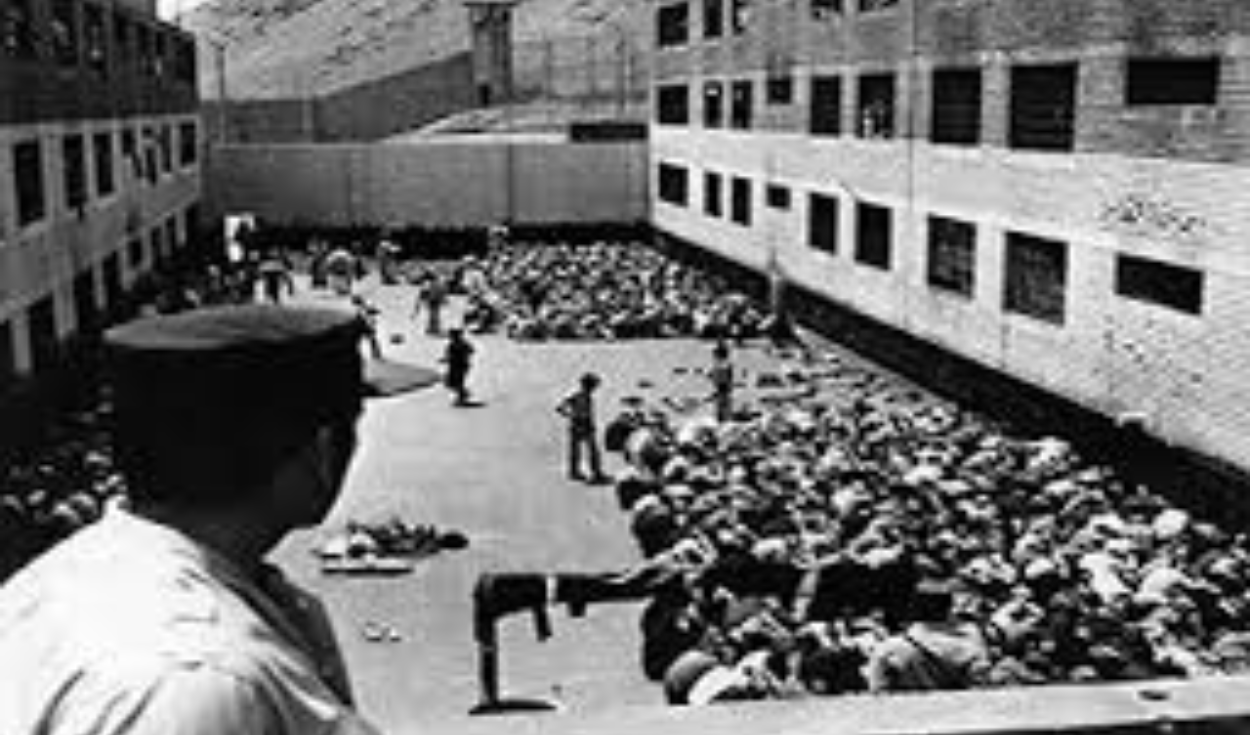
Lawyers representing victims of the El Frontón prison killings have asked a Peruvian court to reject the application of Law No. 32735.
The request for diffuse constitutional control comes after 35 former members of the Peruvian Navy, accused of extrajudicially executing more than 130 inmates at El Frontón prison, petitioned on August 5 to have their case transferred to military courts under the Fujimorist legislation.
Legal defense teams for the victims submitted their motion on August 14 to the Third Liquidating National Superior Criminal Bench, urging judges to declare the law's application inadmissible in the proceeding.
The court will address the recusal request during a scheduled hearing on August 24 at 4:00 p.m.
Legal arguments against military jurisdiction
David Velazco Rondón, a defense attorney for the victims, told La República that the homicides committed in the El Frontón case do not fall under military jurisdiction.
Velazco Rondón explained that military courts exist to judge offenses that violate assets of a military nature, whereas human life is a common legal good. He added that even if a homicide occurs inside a military facility between a sergeant and a colonel, it cannot be tried by a military tribunal because life remains a common legal asset.
Because of this distinction, the defense petitioned the court to exercise diffuse constitutional control and conventionality control. Velazco Rondón stated that applying the law would violate Articles 8 and 25 of the American Convention on Human Rights, which guarantee the right to a hearing by an independent tribunal and judicial protection.
Constitutional Court and Inter-American standards
The defense based its motion on binding legal criteria established by the Inter-American Court of Human Rights and Peru's Constitutional Court. Velazco Rondón cited precedent from the Constitutional Court, including judgment File No. 0017-2003-AI/TC and subsequent rulings in Files No. 2101-2004-HC/TC and No. 3546-2004-HC/TC.
Those rulings established that service-related crimes are exceptional and must be strictly linked to military or police functions. To qualify, unlawful conduct must directly affect legal assets specific to the institution's discipline, organization, or operations.
The jurisprudence further specifies that military jurisdiction is not a personal privilege granted to military or police personnel. It is restricted to professional duty infractions connected to service, explicitly excluding retired personnel and leaving common crimes such as aggravated homicide or bribery under ordinary criminal courts.
Concerns over political retaliation
Velazco Rondón highlighted that the Inter-American Court of Human Rights requires Peru to maintain a restrictive scope for military courts, which cannot extend to human rights violations or crimes against civilians.
Article 51 of the Peruvian Constitution establishes that constitutional provisions prevail over lower-ranking laws, while Article 8 of the American Convention on Human Rights protects the right to a fair trial. Velazco Rondón warned that the new law severely undermines these principles and risks creating impunity.
The attorney also pointed to recent political retaliation against the judiciary by political figures such as lawmaker Fernando Rospigliosi, who filed complaints with the National Board of Justice against judges who applied diffuse control in similar cases.


