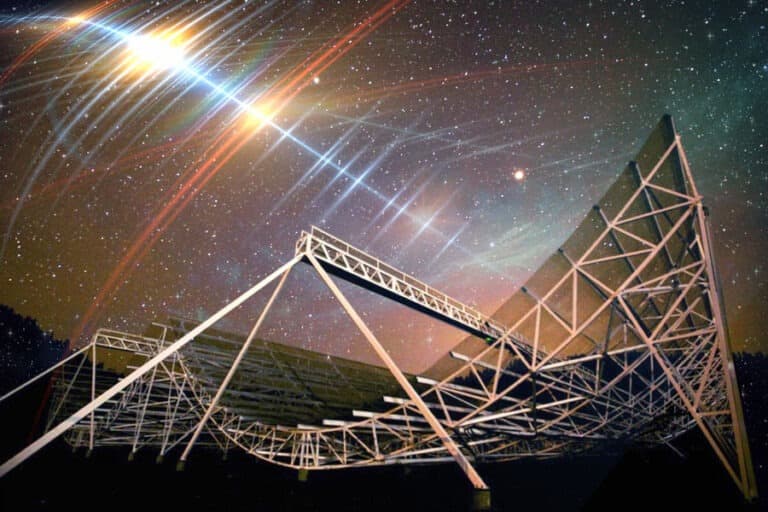
Astronomers have used fast radio bursts (FRBs) for the first time to map intergalactic gas, offering a new explanation for the long-standing "missing baryons" problem, the search for the ordinary matter that makes up stars, planets and people.
The research found that a significant portion of this matter sits far farther from galaxies than current models of the universe predict.
For years, observations have failed to detect roughly half of the baryonic matter that cosmological calculations say should exist. Intergalactic gas is extremely thin and hot, making it very difficult to observe directly.
Fast radio bursts helped solve the problem because their radio signals are slightly delayed as they pass through plasma, with lower frequencies lagging behind higher ones. By measuring that delay, scientists can calculate how much matter the signal passed through on its way from a distant galaxy to Earth.
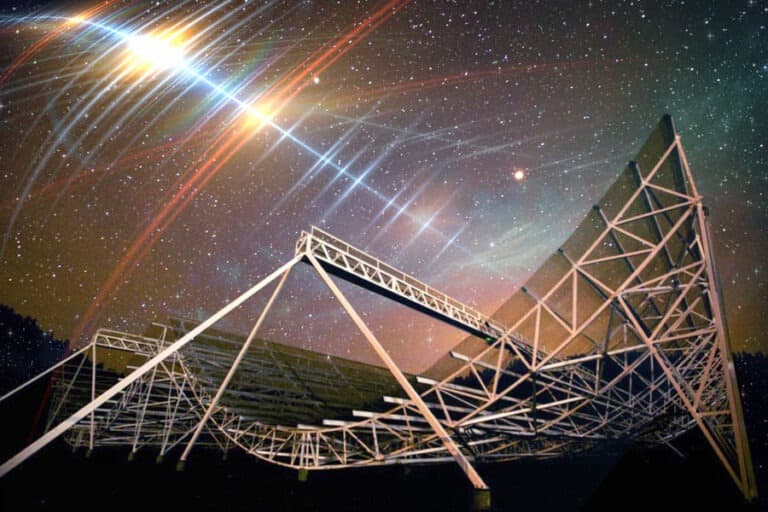
A team led by Haochen Wang of MIT analyzed data on 2,873 fast radio bursts from a new catalog produced by the CHIME (Canadian Hydrogen Intensity Mapping Experiment) radio telescope. The team compared that data with a map of nearly 6 million galaxies built from the DESI (Dark Energy Spectroscopic Instrument) project at Kitt Peak National Observatory, allowing them to pinpoint where gas sits between galaxies.
Gas pushed farther than expected
Baryonic matter turned out to be distributed much farther from galaxies than expected. According to the study's authors, gravity alone cannot explain this distribution. The gas was likely pushed outward by powerful flows from supermassive black holes or by explosions from dying stars, processes that appear more effective than existing computer models assumed.
The findings match earlier X-ray observations, which also pointed to an unexpectedly small amount of ordinary matter near galaxies. Fast radio bursts, however, are the first method to directly map the distribution of intergalactic gas this way. As more FRBs are recorded, the technique is expected to allow far more precise study of the universe's structure and its ordinary matter.