

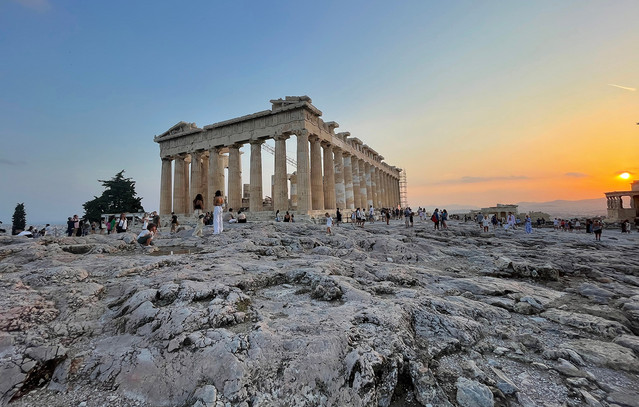
Greece's Ministry of Culture has defended the maintenance of the accessibility elevator at the Acropolis in Athens, saying upkeep of the lift is essential for user safety and rejecting criticism over its operation.
In a statement responding to media reports and commentary about the elevator, the ministry said accessibility at the Sacred Rock is a continuous and demanding effort requiring technical responsibility, constant oversight and strict adherence to safety rules. It credited staff of the Ephorate of Antiquities of the City of Athens, the specialised contractor and support from the Onassis Foundation for keeping the system running, and said the real picture of the elevator's operation cannot be captured through isolated incidents and simplistic comparisons.
A complex technical challenge
The ministry said accessibility at the Acropolis archaeological site is one of the most complex technical issues in managing a unique monumental complex, citing the site's difficult natural terrain, large elevation changes and the absolute requirement that any technical work be carried out without damaging the monuments or archaeological remains. It said those who exploit the real difficulties and strict safety conditions of the incline elevator either ignore or deliberately forget this principle. The elevator is part of a broader intervention for genuine accessibility at the site, which also includes accessible routes across the plateau so visitors reaching the Rock can tour its most significant monuments.
The lift was designed specifically for the Acropolis's demanding conditions and installed in 2020, with both installation and operating costs covered by the Onassis Foundation. The ministry described it as a specialised electromechanical installation that moves along a route with a steep and variable incline, in places approaching a vertical slope, and said it should not be judged by the standards of an ordinary building elevator.
Who the elevator serves
According to the ministry, the elevator is intended as a priority for people with disabilities and their companions where required, people with mobility difficulties who use aids such as crutches or walkers, elderly visitors and others with limited mobility, pregnant women at their own responsibility, and a parent travelling alone with two or more infants or toddlers.
The lift has a payload capacity of 1,300 kilograms and can carry two wheelchairs with their companions, or an ambulance stretcher with an attendant. A single trip takes about 32 seconds, and the installation has multiple safety systems to handle power cuts or other emergencies.
Why maintenance is needed
The ministry said an installation of this technical complexity, operating under such demanding conditions and serving large numbers of visitors daily, requires systematic preventive and emergency maintenance. It said maintenance is not a sign of weakness and should not be presented as a "malfunction," as it said opposition circles have done, but is a necessary condition for reliability and, above all, for user safety.
The elevator's operation is halted when wind speed exceeds the permitted safety limit of 5 on the Beaufort scale, when extreme weather such as heavy rainfall occurs, or when conditions such as sustained high temperatures could affect the system's safe operation. Decisions to suspend service are based on readings from installed monitoring systems, the manufacturer's instructions and technical specifications, and decisions by the ministry's operating and security personnel.
Exposure to wind on the north slope
The ministry said anyone with basic familiarity with the Acropolis site knows that the north slope, at the height where the elevator operates, is especially exposed to weather conditions and strong winds. When weather conditions exceed safe operating limits, it said, the elevator cannot and must not operate, and a temporary pause in service in such cases is not a technical fault but the application of established safety rules. No demand for uninterrupted operation, it said, can outweigh the protection of users.
New maintenance contractor and usage figures
Since the end of 2025, maintenance and oversight of the elevator's operation has been handled by KLEEMANN GREECE ΜΟΝΟΠΡΟΣΩΠΗ ΑΕ, a subsidiary of the Greek lift manufacturer, with support from the Onassis Foundation, providing continuous technical support and immediate intervention when needed. The ministry said any issue arising in such a complex installation is addressed through established inspection and repair procedures carried out by specialised personnel, and that running such an installation without maintenance, technical checks or adherence to safety limits would be contrary to safe operating rules and would raise safety concerns for users.
From the start of the 2026 tourist season in April through August 20, the elevator completed 14,710 trips, the ministry said, figures it called clearly indicative of the installation's usefulness and intensive use, reflecting its daily contribution to ensuring access to the Sacred Rock for visitors with mobility difficulties.
The ministry said the effort to ensure safe and equal access continues, with absolute priority given to protecting users and respecting the Acropolis's unique monumental environment, adding that this remains its core obligation and priority. The statement was reported by the Athens-Macedonian News Agency (ΑΠΕ-ΜΠΕ).


