

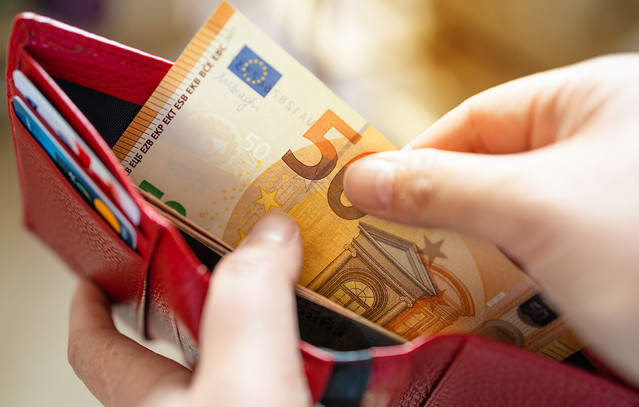
Greek small and medium enterprises lead the Eurozone in cash acceptance alongside Italy, with 99 percent of small businesses in Greece still accepting physical money, a new survey by the European Central Bank shows.
Cash acceptance in the Greek retail sector reaches 100 percent, matching Slovenia, while mobile phone payments across Eurozone merchants have nearly doubled over the past two years. The study, conducted by research firm Ipsos for the Frankfurt-based central bank, surveyed business payment options across the 21 member nations of the single currency area.
Across the Eurozone as a whole, 92 percent of businesses with physical points of sale continue to accept banknotes and coins, up from 90 percent in 2024. The figures indicate that the gradual decline in cash usage, which accelerated during the coronavirus pandemic, has halted for the time being. The survey measured the payment options offered by merchants rather than the final transaction methods chosen by individual shoppers.
National differences in cash acceptance
Significant divergence remains between member states across the currency bloc. While Greece and Italy top the Eurozone with 99 percent cash acceptance among small and medium enterprises, Cyprus sits at the bottom of the table, with just 76 percent of small firms reporting that they accept physical currency.
Merchant acceptance of physical money also remains low in Belgium, where 81 percent of businesses take cash. However, Cyprus and Slovakia recorded the largest positive shifts since 2024, with each country seeing a nine percentage point increase in cash acceptance. In contrast, Belgium experienced a 10 point drop over the same period, while Ireland recorded a nine point decline.
Looking ahead over the next five years, 92 percent of Eurozone businesses currently accepting cash expect to maintain that policy. In Greece, however, almost one in four small and medium enterprises, or 23 percent, left open the possibility that they may stop accepting physical money in the future. That figure rises to 51 percent of businesses in Cyprus, compared to 18 percent in Bulgaria.
Rapid growth in mobile payments
While physical money maintains a firm foothold, digital transactions conducted via mobile phones have surged across the Eurozone. Traditional payment cards are accepted by 88 percent of businesses in 2026, up slightly from 87 percent in 2024. Mobile payments have seen a far steeper trajectory, rising from 36 percent acceptance in 2024 to 68 percent in 2026, representing a 32 percentage point jump in two years.
Instant bank transfers and digital wallets represent the most widely adopted forms of mobile payment among merchants. In online commerce, payment cards remain the dominant mechanism, accepted by 82 percent of businesses conducting internet sales, followed by direct bank transfers at 74 percent.
By contrast, cryptocurrency assets remain virtually excluded from everyday commercial trade despite extensive public discussion surrounding digital currencies. Crypto payments are accepted by only 0.2 percent of Eurozone businesses engaged in online sales.
Merchant preferences and operational concerns
Business owners themselves hold nuanced views regarding payment options. Approximately one in three merchants reported having no specific preference for how customers settle their bills. Among businesses that expressed a preference, 24 percent preferred debit cards, 21 percent preferred cash, and 14 percent preferred credit cards. Larger corporations proved less positive toward cash than small and medium enterprises.
Consumer demand remains the primary factor governing which payment methods merchants offer, cited as the main driver by 26 percent of businesses. Security was named by 22 percent of merchants, while ease of administrative management was cited by 15 percent.
Merchants continue to view physical cash as superior in two critical operational areas: privacy protection and reliability. Across all six evaluation parameters in the study, which included cost, transaction speed, ease of management, reliability, security, and privacy, digital payments failed to establish a decisive advantage over physical money.
Handling physical currency presents distinct operational drawbacks for merchants. The survey found that 32 percent of businesses expressed concern over errors when giving change to customers, 29 percent reported security issues, and 20 percent cited risks associated with internal staff fraud.
Among merchants that refuse cash entirely, 36 percent stated that customers simply do not use physical money enough to justify accepting it. Furthermore, 35 percent cited difficulties in withdrawing or depositing physical currency at bank branches, a figure that has increased significantly from 22 percent in 2024.
Automation and self-checkout terminals
The wider adoption of automated checkouts is altering how physical currency is handled on retail shop floors. Self-checkout facilities are now present in 13 percent of businesses, yet only 52 percent of automated stores provide options to pay with cash, even on selected terminals. In practice, nearly half of all self-checkout installations operate on an exclusively electronic basis.
In addition, 25 percent of all surveyed businesses have introduced specific measures to encourage digital payments or restrict physical currency usage. Of those firms taking action, 37 percent installed dedicated electronic payment registers or reduced cash points, while 30 percent actively promoted cashless transaction options to shoppers.
The European Central Bank highlighted this shift as a key operational factor, noting that while a merchant may technically register as accepting cash, increasing workplace automation often renders physical money more difficult for consumers to use in practice. The Ipsos survey gathered responses from 8,205 businesses across all 21 Eurozone member countries between February and April 2026.


