

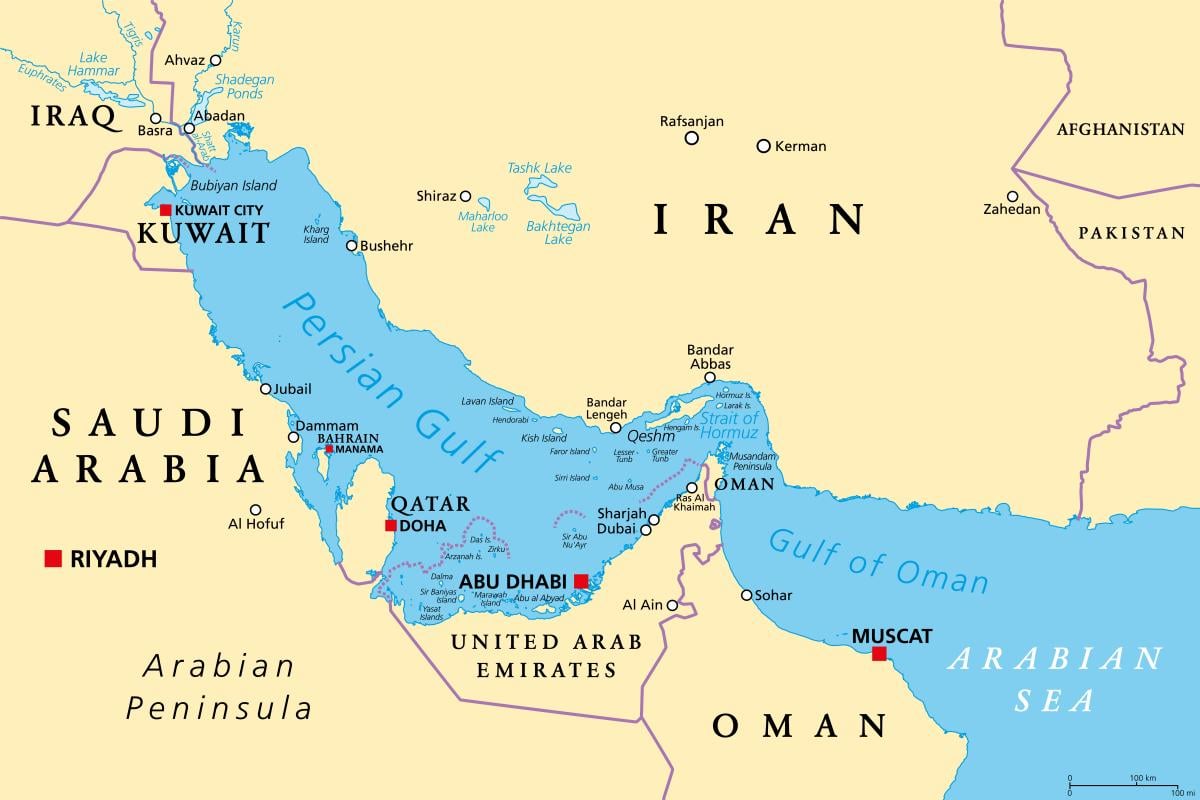
Iran and Oman have reached an agreement to divide the Strait of Hormuz and share revenue generated from the strategic shipping passage, Reuters reported on Wednesday, citing the Islamic Revolutionary Guard Corps.
Speaking for the Islamic Revolutionary Guard Corps, spokesman Hossein Mohebbi said the two nations had conducted periodic negotiations for about a month. He confirmed that talks yielded mutually acceptable terms regarding each country's share of the territorial waters and the division of usage revenues.
Prior to the outbreak of war in February, approximately one fifth of global supplies of crude oil and liquefied natural gas passed through the narrow waterway. Hostilities subsequently halted most commercial shipping through the area, triggering a sharp rise in global energy prices.
The Strait of Hormuz serves as a critical maritime choke point between Iran to the north and Oman to the south, connecting the Persian Gulf with the Gulf of Oman and the Arabian Sea. Control over the passage is monitored closely by the Islamic Revolutionary Guard Corps, a major branch of the Iranian Armed Forces established following the 1979 revolution.
United States interference allegations
The Islamic Revolutionary Guard Corps accused the United States of attempting to interfere in the bilateral talks between Tehran and Muscat, claiming American intervention had delayed the final agreement.
Mohebbi said that if the United States ceased its interference and returned to the agreement, Iran would be prepared to open the Strait of Hormuz under the agreed parameters. He warned that if Washington failed to accept Iranian conditions, the waterway would remain closed under all circumstances.
Although active fighting between American and Iranian forces has largely subsided in recent weeks, broader diplomatic negotiations toward a formal peace agreement remain deadlocked. Transit through the strait continues to pose severe risks for commercial vessels.
Shipping blacklist and economic pressure
To enforce its blockade, Iran published a blacklist of 45 ships on August 23. Iranian authorities introduced the measure to prevent ship-to-ship oil transfers used by Persian Gulf energy producers seeking to circumvent Iranian restrictions. Industry sources indicated that several maritime companies now plan to stop utilizing the blacklisted vessels.
In an effort to intensify economic pressure on Tehran, the United States threatened earlier this week to penalize foreign countries that continue doing business with Iran, though American officials stated sanctions would not take effect immediately. The sanctions list notably omitted Chinese financial institutions that facilitate Iranian oil exports. Iran condemned the American campaign as gross lawlessness and expressed confidence that many nations would refuse to participate.
Global energy market reaction
News of the negotiations between Iran and Oman prompted a decline in global oil benchmarks on August 26, as traders anticipated a potential resumption of commercial maritime traffic. Worldwide crude prices fell by more than $2 per barrel during trading.
Brent crude futures dropped $2.30, or 2.6 percent, to settle at $86.28 per barrel. West Texas Intermediate futures, the primary benchmark for US crude oil, fell $2.08, or 2.53 percent, to $80.29 per barrel. Prices had reached their highest levels since early August just a week prior due to prolonged negotiations, when October Brent contracts reached $94.06 per barrel and WTI rose to $86.80 per barrel.


