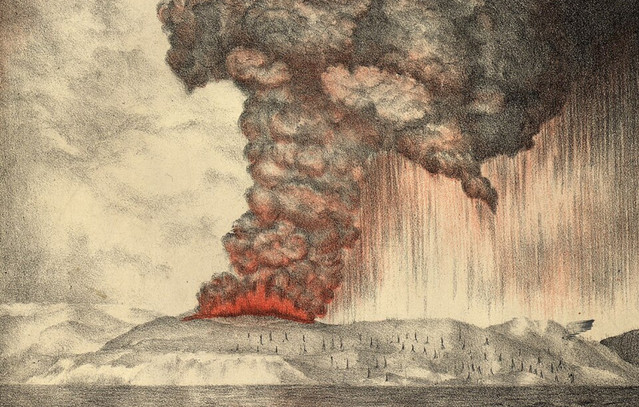
The cataclysmic eruption of the Krakatoa volcano reached its peak in the Sunda Strait on August 26, 1883, unleashing the loudest sound in recorded history. Located between the islands of Java and Sumatra in modern-day Indonesia, the volcanic island suffered a series of devastating explosions that generated immense pressure waves and altered the global climate.
Volcanic activity had been building for months before taking a dramatic turn on August 26 and 27. On the morning of August 27, a catastrophic sequence of detonations took place. The largest blast, occurring shortly after 10:00 local time, was identified by the Royal Society as the loudest sound ever recorded in human history. Reports of the deafening roar arrived from locations in Australia and across the Indian Ocean, between 4,500 and 4,600 kilometers away.
The energy output of the eruption was estimated at roughly 200 megatons of TNT, a force approximately 13,000 times greater than the atomic bomb dropped on Hiroshima. This calculation is cited in historical collections, including the Harvard map collection. Eyewitness accounts from vessels navigating the Sunda Strait described extreme violence. The captain of the British ship Norham Castle recorded that more than half of his crew suffered eardrum injuries from the blast and wrote that he believed Judgment Day had arrived.
Deadly Tsunamis and Geographical Collapse
While the noise echoed across oceans, the most lethal impact stemmed from physical destruction. The violent collapse of the volcanic island into the sea generated massive tsunamis that swept through the coastal zones of Java and Sumatra. In the Banten region, waves reached an estimated height of 41 meters. The disaster claimed approximately 36,000 lives, with more than 34,000 of those deaths directly caused by the incoming tsunamis. Hundreds of coastal villages were completely destroyed or severely damaged.
The cataclysm fundamentally altered regional geography. Approximately 70 percent of Krakatoa was destroyed as the island collapsed into a newly formed underwater caldera. Volcanologists classified the event at level 6 on the Volcanic Explosivity Index, a logarithmic scale used to measure the relative magnitude and explosive power of volcanic eruptions.
Global Climate Consequences and Scientific Legacy
The atmospheric repercussions extended far beyond the East Indies. Enormous quantities of volcanic ash and sulfurous gases were thrust high into the stratosphere, circulating across the globe. Over the subsequent months, vivid red sunsets and unusual optical phenomena were observed thousands of kilometers from the eruption site as sunlight filtered through airborne particles.
Solar radiation reaching the Earth was temporarily reduced by the blanket of volcanic dust. Data cited by the United States National Oceanic and Atmospheric Administration indicates that average global temperatures dropped by up to 0.5 degrees Celsius the following year. It took several years for global climate patterns to return to baseline levels. The disaster also marked a milestone in Earth science. The Royal Society gathered atmospheric pressure readings, ocean wave measurements, and visual reports from around the globe, creating one of the earliest systematic international documentations of a natural disaster.
Centuries of Military and Political Milestones
Beyond the 1883 volcanic disaster, August 26 marks several pivotal historical events across centuries of global history. In 1071, Byzantine Emperor Romanos IV Diogenes was defeated by the Seljuk forces of Alp Arslan at the Battle of Manzikert, an outcome that accelerated the decline of Byzantine power across Asia Minor. In 1346, English forces led by King Edward III decisively defeated the French at the Battle of Crécy during the Hundred Years War. That engagement is historically noted as one of the first European battles involving field artillery, though scholars continue to debate the claim.
In 1821, during the Greek War of Independence, Greek fighters under the command of Panourgias, Giannis Gouras, and Dyo Vouniotis defeated the army of Bayram Pasha at the Battle of Vasilika in Phthiotis, successfully blocking the Ottoman military advance into southern Greece. In 1920, the 19th Amendment to the United States Constitution was officially certified, guaranteeing that voting rights could not be denied on the basis of sex. The landmark amendment had completed state ratification on August 18.
Post-War Innovations and Modern History
Automotive and political history also intersects with this date. In 1959, the British Motor Corporation introduced the Mini, designed by Greek-British engineer Alec Issigonis. The sportier Mini Cooper variant followed later in 1961. In 1983, the Greek Parliament voted through its Recess Section to establish the National Health System, known as ESY, representing one of the defining social reforms of Greece's post-junta democratic era.
In sports history, Greek windsurfer Nikos Kaklamanakis secured victory at the Mistral World Championship in Varkiza on August 26, 2001, earning his third career world championship title.
Notable Births Across Humanitarianism and Culture
August 26 is also the anniversary of notable births across religion, arts, and athletics. Catholic missionary Mother Teresa, born Agnes Gonxha Bojaxhiu to an Albanian family in Skopje in 1910, devoted her life to assisting the impoverished in Kolkata, India. She established the Missionaries of Charity, also known as the Order of Sisters of Mercy, in 1950. The organization expanded across 100 countries to care for orphans, the terminally ill, drug addicts, and AIDS patients. Mother Teresa received the Nobel Peace Prize in 1979, died in Kolkata in 1997, and was canonized as a saint by the Catholic Church in 2016.
Greek pop singer Dakis, born Vrasidas Charalampidis in Alexandria, Egypt, in 1943, moved to Greece in 1963. Fluent in six languages, he earned acclaim for both Greek and foreign-language songs. Hits such as Tosa Kalokairia and Ekeino To Proi Stin Kifisia established his reputation, featuring collaborations with prominent composers Mimis Plessas and Kostas Xenakis. In cinema, American actor Macaulay Culkin was born in 1980. He rose to international fame as child character Kevin McCallister in Home Alone and Home Alone 2, later starring in My Girl, Richie Rich, and Uncle Buck.
In athletics, American basketball star James Harden was born in 1989. The 2018 NBA Most Valuable Player became famous for his signature dribble and scoring ability while playing for the Houston Rockets, Philadelphia 76ers, and Brooklyn Nets. Among notable deaths recorded on this day is American aviator Charles Lindbergh, listed in records for 1902, who achieved national fame in 1927 by completing the first solo nonstop transatlantic flight from New York to Paris aboard the Spirit of St. Louis. Finally, August 26 marks the traditional name days for Adrianos, Adriani, and Natalia.