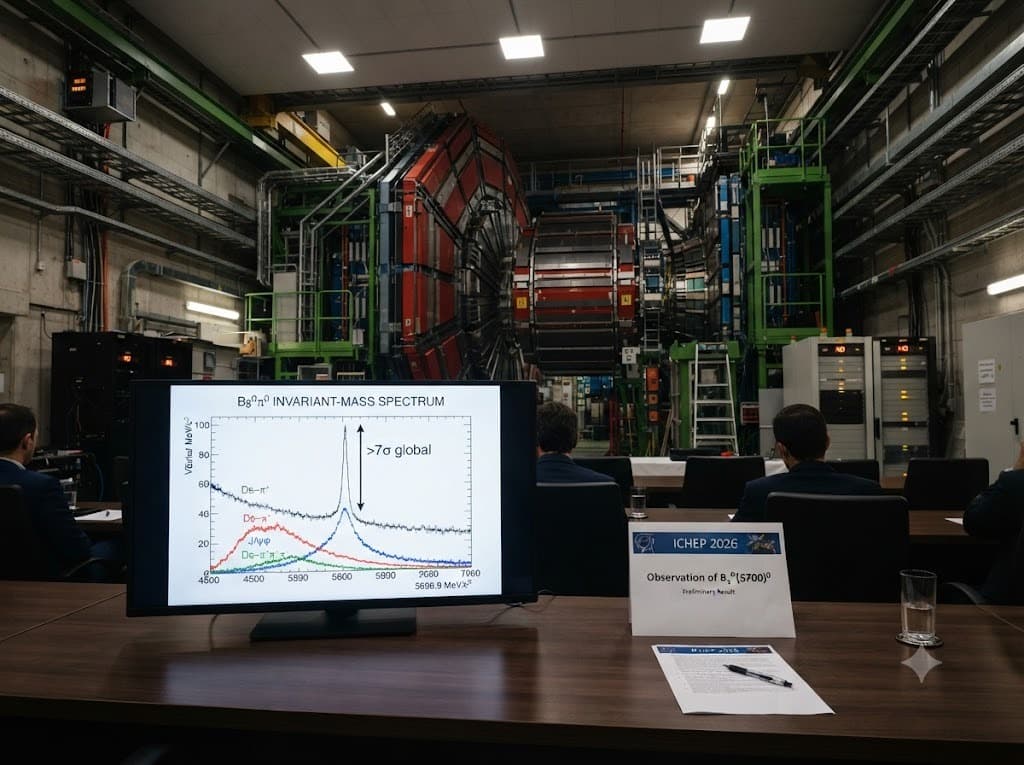
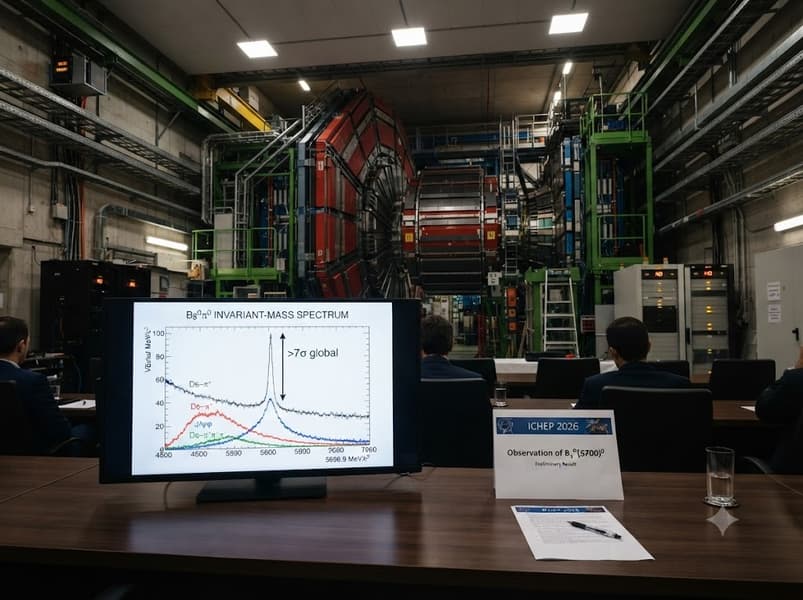
The LHCb collaboration has discovered a new particle called Bs0*(5700)0, announcing the finding at the ICHEP 2026 conference in Brazil on August 4, 2026. The statistical significance of the discovery exceeds 7 standard deviations, meaning the chance the signal is a random fluctuation is vanishingly small.
Researchers detected the particle in the invariant mass spectrum of a system made up of a Bs0 meson and a neutral pion. The Bs0 meson was reconstructed through three independent decay channels, and the same narrow resonance showed up in all three, with a mass of 5698.9 ± 1.5 MeV/c², about 130 MeV/c² below what the standard quark model predicts. The particle's width came in under 9.8 MeV at a 90% confidence level, meaning it lives longer and decays more slowly than typical hadrons.
That combination, an unexpectedly low mass paired with an unnaturally narrow peak, makes the observation a genuine puzzle. A simple quark-antiquark picture predicted a considerably higher mass for the lowest scalar Bs0 meson, and the newly observed particle falls outside that framework.
LHCb has proposed two possible explanations. One is that the particle is a chiral partner of the ordinary Bs0 meson, a long-sought state tied to the spontaneous breaking of chiral symmetry. The other is that it is the first exotic hadron built from a single beauty quark in a structure more complex than a simple quark-antiquark pair.
A parallel in the charm sector
The chiral-partner idea is backed by a near-exact parallel from the charm sector. In 2003, physicists discovered a particle called Ds0*(2317)+ with the same traits, a mass deficit and an unnaturally narrow width, later interpreted as a chiral partner of the Ds meson. The mass difference between Bs0*(5700)0 and the ordinary Bs0 meson is 332 MeV/c², close to the roughly 349 MeV/c² splitting seen in the charm family.
According to LHCb, this repeated anomaly across two independent quark sectors is a strong argument that physicists may be observing a direct manifestation of the mechanism that generates more than 98% of the mass of visible matter, since chiral symmetry breaking in the vacuum is what gives light quarks their effective mass.
Or a new kind of exotic hadron
The alternative interpretation matters just as much. Every reliably identified exotic hadron containing heavy quarks found so far has held either a pair of charm quarks or a combination of charm and beauty quarks; no particle with a single b-quark arranged in a structure more complex than an ordinary meson has ever been confirmed. With a mass below the threshold for strong decay and an anomalously small width, Bs0*(5700)0 is a candidate for a hadronic molecule or tetraquark, held together by residual nuclear force rather than gluon exchange. Confirming that nature would mean discovering an entirely new family of exotic particles.
Built on years of collider data
The analysis draws on the full statistics of the Large Hadron Collider's Run 1 and Run 2 data-taking periods. A key methodological step was the use of "fast" neutral pions, reconstructed without being tied to the B meson's decay vertex, which let LHCb reach states decaying into Bs0 and π0 for the first time.
According to LHCb, whether or not Bs0*(5700)0 turns out to have a counterpart in another decay channel, the repetition of the same anomaly in both the charm and beauty sectors points to a systematic deviation from the predictions of the constituent quark model.