


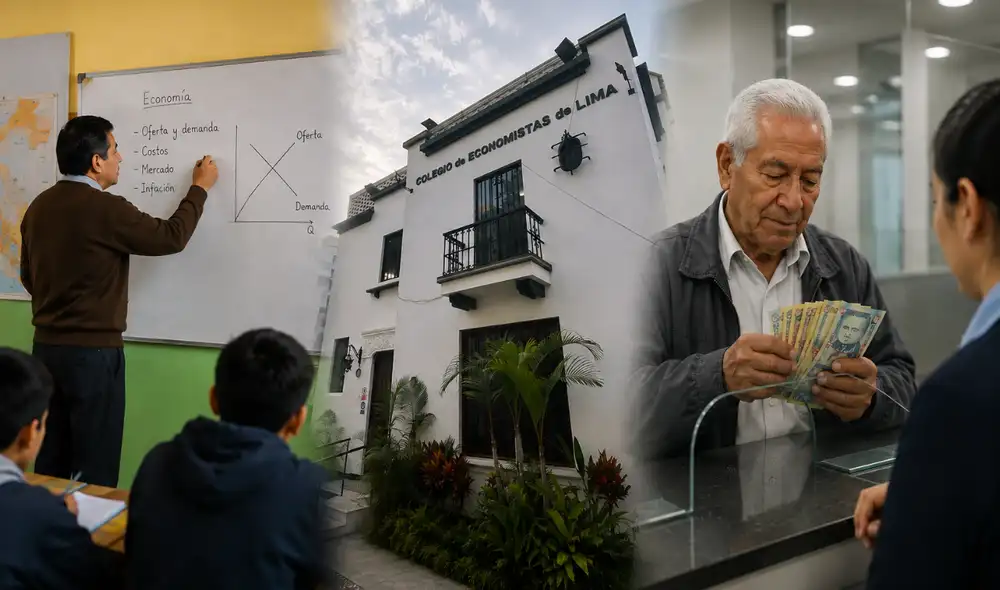
The Lima College of Economists has filed an unconstitutionality lawsuit before Peru's Constitutional Court against Law 32581, warning that applying the measure could cost up to 13.4 billion soles annually within five years.
The legislation, approved by Congress in March and published in April, raises pension payouts for retired and former teachers to match the full monthly remuneration of active educators in the first scale of the public teaching career.
Currently, active teachers in the first scale earn a full monthly remuneration of 3,500.70 soles for a 30-hour work week and 4,667.60 soles for a 40-hour work week. Under the new statute, pensions for retired teachers are directly linked to these active salary scales rather than fixed as isolated amounts.
An economic analysis by the Directorate of Macrofiscal Studies of Peru's Fiscal Council calculated that the law would initially generate an additional annual pension expenditure of approximately 8.018 billion soles.
The Fiscal Council cautioned that the 8.018 billion sol figure represents only a baseline reference scenario rather than the definitive cost. The initial calculation excludes pensioners in the Private Pension System, new generations of retirees, and other potential beneficiaries who might be incorporated later.
Because pension amounts will rise whenever active teachers receive pay increases, the annual incremental cost is projected to reach up to 13.4 billion soles over a five-year horizon. That higher projection assumes salary increases for active teachers while continuing to exclude the effect of future retiree generations.
The Fiscal Council, an independent technical advisory body that evaluates Peruvian public policy and macrofiscal sustainability, published its analysis on August 13 in Discussion Note 01-2026, which was dedicated specifically to examining the budgetary and pension implications of Law 32581.
Concerns over funding and budget balance
In its legal challenge before the tribunal, the Lima College of Economists argued that the core economic issue extends beyond the pension amounts set for retired educators. A central objection raised by the professional guild is that Congress enacted the statute without establishing a specific funding source to cover the resulting financial obligations.
The guild also contended that the law distorts the relationship between contributions made during a worker's active career and the benefit received upon retirement. In its petition, the organization noted that a teacher who received a monthly pension of around 650 soles under previous rules would now receive 3,500 soles without making any equivalent additional contribution.
From a constitutional perspective, the economists asserted that the law violates principles governing budgetary balance, pension sustainability, and equality before the law. They also argued that the enactment exceeds constitutional limits placed on the authority of the Peruvian Congress to create public expenditure.
The petition asks the Constitutional Court to declare Law 32581 unconstitutional in its entirety. As an alternative, the College of Economists proposed that any measure to improve teacher pensions must be grounded in actuarial studies, clear beneficiary criteria, and a permanent, dedicated revenue source.
Scope of the teacher pension law
Law 32581 applies to retired and former teachers across regular basic education, alternative basic education, special basic education, and technical-productive education.
The scope of the law covers educators enrolled under Decree Laws 19990 and 20530, as well as Law 29944, which represent the primary public pension and teaching frameworks in Peru. Under Article 3 of the statute, affiliates of the Private Pension System are also included under specified conditions.
The legislation directs the Ministry of Economy and Finance, in coordination with the Ministry of Education, to determine pension amounts based on the full monthly remuneration of the first teacher scale. It also mandates that the Executive Branch approve the corresponding administrative regulations within 90 calendar days of the law taking effect.
This requirement means the national debate encompasses not only the immediate financial benefit for retired teachers, but also how the Peruvian state will absorb a pension commitment that expands automatically as active teacher salaries increase.
Next steps for the Constitutional Court
Following the submission of the lawsuit, Peru's Constitutional Court must now process the case and rule on the constitutional arguments presented by the College of Economists. The filing of the petition does not suspend or strike down Law 32581, which remains in full legal force until the court issues a decision.
The legal challenge highlights ongoing friction between Congress and fiscal authorities over parliamentary initiatives that impose permanent financial obligations on the national government. For the College of Economists, any expansion of pension benefits must be accompanied by multi-year cost assessments and clear funding mechanisms.
The dispute carries long-term implications for Peru's public finances. Because pension calculations are permanently tied to active teaching salaries, any future pay increase granted to working teachers will automatically increase state pension liabilities.
Peru's highest constitutional court must now weigh the challenge to a law that Congress enacted by insistence four months ago, against detailed fiscal evaluations showing annual commitments ranging from 8.018 billion to 13.4 billion soles.


