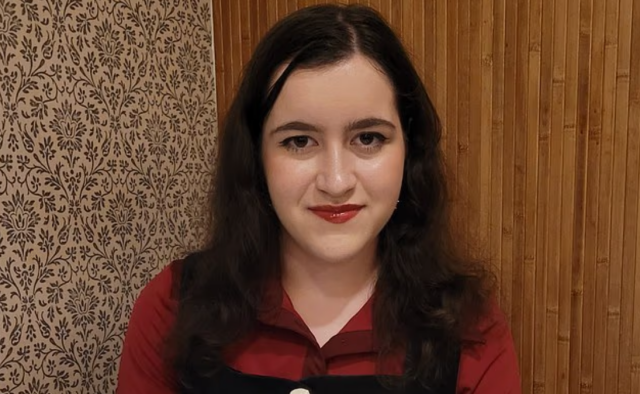
Prosecutors in Massachusetts have not decided whether to retry Lindsay Clancy after a judge declared a mistrial in her murder case.
The 36-year-old former labor and delivery nurse returned to Plymouth County Superior Court on Tuesday for her first appearance since Judge William Sullivan declared a mistrial earlier this month. Clancy, who has remained in a psychiatric hospital since the proceedings halted, wore a short-sleeve blouse with her hair in loose waves as her defense attorneys sparred with state prosecutors over how to handle the high-profile case.
The hearing ended without any immediate rulings from Judge Sullivan. Instead, he ordered both parties to return to court on November 2 to set a potential trial date and discuss several unresolved motions stemming from the initial trial.

Plymouth County District Attorney Tim Cruz told CBS Boston that his office has not made a final determination on whether to seek a second trial against the mother of three for the strangling deaths of five-year-old Cora, three-year-old Dawson, and eight-month-old Callan. However, Cruz emphasized that prosecutors are continuing their preparations as if a new trial is imminent.
"We're doing a very thorough review right now," Cruz said. "And we're going to continue to do our job and make sure we do what's best for the interest of justice and the interest of the three children."
Cruz explained that his office is waiting to see how the pending legal motions play out before taking their next formal step in the prosecution.

Statements From the Holdout Juror
District Attorney Cruz spoke just hours after Michael Desronvil, the lone juror who refused to find Clancy not guilty of murder or manslaughter by reason of insanity, broke his silence in a televised video statement. The segment aired on the Fox News program Hannity on Monday night.
Desronvil asked the public to shift their attention away from his role in the mistrial and back to the young victims. "I know the whole focus has been on me but we want to reel everything back and put the focus on the three angels, the ones that cannot speak for themselves, the ones that can't defend themselves, and the ones that cannot fight the battles," Desronvil said. "And those are Cora, Dawson and Callan."

Desronvil also expressed personal gratitude to members of the public who supported him during the high-stress deliberations. "Your prayers, your emotional support, your psychological support, is tremendous to my heart, that I feel, that I sense, that I know," Desronvil said, adding that he thanked God for blessing him with the ability to love his own daughter.
The trial in Plymouth County involved allegations that Clancy strangled her three children at their home in 2023. Under Massachusetts law, first-degree murder carries a mandatory sentence of life imprisonment without the possibility of parole upon conviction.

Defense Motion to Dismiss the Case
Desronvil became the focus of intense debate during Tuesday's proceedings after lead defense attorney Kevin Reddington filed a formal motion to dismiss all charges. Reddington claimed that Judge Sullivan failed to conduct a proper inquiry into the holdout juror and the claims made by the jury foreperson before declaring a mistrial, arguing that a thorough inquiry might have avoided a mistrial altogether.
Prior to the mistrial declaration, the jury foreperson sent two messages to Judge Sullivan accusing the then-unidentified holdout of expressing reasonable doubt while refusing to apply the law as instructed. Reddington had requested that the judge remove the juror or question him further, but Judge Sullivan declined. Hours later, when the jury returned deadlocked again, the judge declared a mistrial.
Reddington argued in court that putting Clancy on trial a second time would violate the constitutional protection against double jeopardy, which prevents defendants from being prosecuted multiple times for the same offense after a trial ends without legal justification.

Desronvil previously stated through his attorney Edward Paltzik that he held zero doubt regarding Clancy's guilt, citing what he described as mountains of evidence presented by the prosecution during the trial.
Outside the courthouse on Tuesday, Desronvil's newly appointed attorney, Heather O'Connor, strongly opposed defense attempts to further investigate her client. The defense had requested access to Desronvil's mobile phone records to verify whether he used the device during jury deliberations, according to report details published by The New York Times.
O'Connor also addressed questions regarding Desronvil's initial jury questionnaire. Although Desronvil was charged with a misdemeanor in 2021 after his wife alleged he grabbed her throat and threw her against a dresser, the charge was later dismissed. O'Connor stated the prior charge was disclosed truthfully and did not legally disqualify him from jury service.
"He's the only one being targeted here because his decision and his vote was different than everyone else's," O'Connor told reporters. "People should not have to worry, just as the commonwealth said, jurors should not have to worry about coming in and having them outed because they take a stance different than everyone else." She added that Desronvil seeks privacy for himself and justice for Clancy's three children.
Arguments Over Cause and Criminal Responsibility
Judge Sullivan elected to table several motions on Tuesday, including the defense request to investigate Desronvil, the defense motion to dismiss on double jeopardy grounds, and a newly filed motion from prosecutors requesting a gag order to prevent Reddington from speaking publicly about the case.
However, Judge Sullivan took under advisement a new argument presented by Reddington asserting that the state failed to produce evidence proving Clancy killed her children. "This entire case is based on speculation," Reddington argued in court. "Where is the admission? Where did she say that she did this?"
Reddington pointed out that investigators found no blood on Clancy's socks after she reportedly cut herself and jumped from a bedroom window. He argued that when Clancy woke from a coma following the fall, she had no memory of killing her children and was simply told by police officers that she had done so, despite issues with the investigation timeline.

"It wasn't even a horrendous investigation," Reddington told the court. "There was no investigation." He asserted that law enforcement lacked probable cause to establish Clancy as the perpetrator of the crime.
Prosecutor Shanan Buckingham rejected the defense claim, characterizing it in court as laughable and noting that Reddington had never raised this theory prior to Tuesday's hearing.
During the original trial, the defense acknowledged that Clancy killed the children but argued she was not guilty of murder or manslaughter by reason of insanity. The defense presented medical testimony asserting she suffered from postpartum psychosis, a severe psychiatric condition that can cause hallucinations, delusions, and paranoia in mothers following childbirth.
Speaking outside the courtroom, Reddington maintained that questioning the evidence of Clancy's actions was not a new concept, insisting the prosecution fundamentally failed to establish probable cause or satisfy legal standards of criminal responsibility.
Under Massachusetts law, when an insanity defense is raised, the prosecution must prove criminal responsibility beyond a reasonable doubt through two points: whether the person suffered from a mental disease or defect at the time, and, if so, whether they could still control their actions or conform to the law. Reddington argued that because the state failed to meet this burden, Judge Sullivan must enter a finding of not guilty on all charges.
Prosecutor Buckingham countered that a mental health condition does not automatically preclude criminal responsibility, arguing that individuals experiencing mental illness can still commit crimes and be held legally accountable.