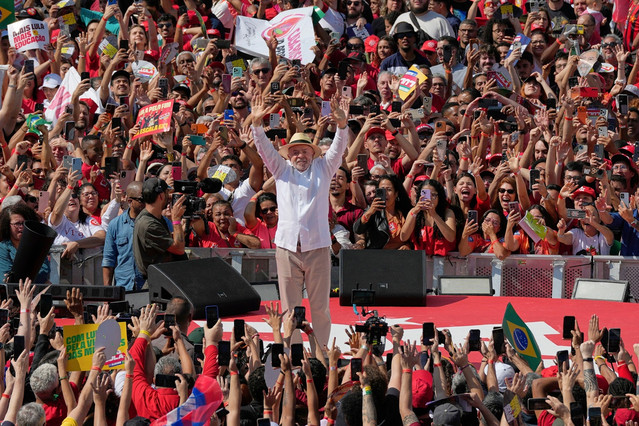
Brazilian President Luiz Inacio Lula da Silva officially launched his campaign for a fourth presidential term in Sao Paulo, promising to combat organized crime and gender-based violence while protecting social welfare programs.
Addressing thousands of supporters gathered at the Vila Euclides municipal stadium two months ahead of the October 4 election, the veteran Brazilian leader pledged to resolve major national dilemmas during another term.
The venue holds historic significance for the president, a former metalworker and trade union leader who organized major labor strikes at the stadium during Brazil's military dictatorship before serving as president from 2003 to 2010 and returning to office in 2023.
Accompanied by his wife, Rosangela Zanja da Silva, the president called for a cultural shift to protect women from domestic abuse. He said it was unacceptable for the nation not to stop gender violence, urging men to treat their partners as companions rather than servants or slaves.
Economic track record and mineral sovereignty
Reviewing the achievements of his current term, Lula highlighted economic progress over the past three and a half years, pointing to the creation of 10 million jobs and the expansion of key social welfare programs.
He also mounted a firm defense of Brazilian national sovereignty against external pressures, focusing on the country's strategic natural resources. He reaffirmed that Brazil must retain full capability to extract, process, and export its own critical minerals independently.
Refusing to align with major international powers, he stated that Brazil would not answer to the United States, Russia, China, or any other foreign nation, emphasizing that domestic mineral wealth must serve the Brazilian people.
Competitive presidential race
The launch comes as the country prepares for a tightly contested election campaign in South America's largest democracy and economy.
The most recent opinion polls show Lula in a technical tie with rival candidate Flavio Bolsonaro, a federal senator. The surveys place the incumbent president at 43 percent support among respondents, with Bolsonaro trailing closely at 40 percent.