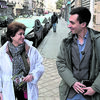
Lurdes Fonseca, spokesperson for a national network of Portuguese concierges in Paris, is spearheading a political campaign to safeguard women's rights across France.
Fonseca, who has worked as a residential concierge in the French capital for nearly 40 years, holds an elected role in local district government comparable to a Portuguese parish council representative.

While working in her Paris neighborhood, Fonseca coordinates daily with fellow Portuguese women who manage residential buildings across the city. Calling another local concierge during her shift, she checked whether her colleague was at home so she could stop by her door, reflecting the close ties among dozens or even hundreds of Portuguese women working in the profession.
Portuguese concierges, known locally as porteiras, have long played a central role in Parisian residential life. Following large-scale migration from Portugal to France in the mid-20th century, thousands of Portuguese families settled in the Paris region, where building caretaking became a widespread occupation for women.
History of Portuguese migration to France
Fonseca explained that when Portuguese men arrived in France during the 1960s, most found employment in civil construction. Over time, word-of-mouth recommendations among immigrant families led Portuguese women to take up residential concierge positions across Parisian apartment blocks.
Recalling her own arrival in Paris during the previous century, Fonseca said she originally traveled to France to care for a child for a French family while living without official immigration documents. Crossing international borders at the time was extremely difficult, she noted, adding that immigrants lived at high expense, communicated with families back home strictly by letter, and returned to Portugal only once a year at Christmas.
Walking through her neighborhood to a local Portuguese community club on a Sunday, Fonseca greeted fellow residents along the streets. She observed that Sunday routines for many Portuguese families in Paris center on attending church mass, taking children to catechism classes, and gathering for coffee afterwards.
Political organizing and women's rights
Focusing on her political work, Fonseca emphasized that her primary challenge is preserving established rights. She said numerous women had fought to secure existing protections and opportunities, adding with a smile that current generations must maintain those achievements for their daughters.
Upon entering the local Portuguese club, Fonseca noted how social dynamics within the diaspora have evolved over recent decades. She explained that such clubs were once exclusively male environments, but women now regularly gather there, particularly during major sporting events.
A former football player herself, Fonseca retained her passion for the sport over the years. She regularly visits the community club to watch matches whenever the Portuguese national football team, known as the Seleção, plays international fixtures.
Diaspora size and broader legislative developments
The Portuguese community remains one of the largest foreign populations in France. Demographics indicate that nearly 500,000 people of Portuguese origin reside within the Paris metropolitan area alone.
The campaign for women's rights comes amid broader international discussions on maternal welfare and gender equality. In related legislative developments, former Portuguese leader António José Seguro promulgated a diploma on pregnancy rights that removed explicit reference to obstetric violence from the text.
In another major milestone for female representation cited in international reports, a transgender woman was elected president of Brazil's parliamentary commission on women's rights.