Mayor José Luis Martínez-Almeida has set dates for a major urban transformation across Madrid as traffic returns for the end of the summer season.
The Directorate-General for Traffic expects 1.2 million journeys across the Community of Madrid during the end of summer return operation. As the capital returns to work, the municipal government is rolling out project completions designed to improve traffic flow and expand pedestrian areas.
Martínez-Almeida described the citywide overhaul in June during the State of the City Debate as the largest urban transformation process in Madrid history. He named 2026 as the year of major progress, making urban redevelopment and housing key pillars of his strategy to secure an absolute majority ahead of regional and municipal elections at the end of his term.
Road reopenings on Calle de Alcalá and M-30
The initial phase of reopenings begins on Monday on Calle de Alcalá. The section between Plaza de Cibeles and Puerta de Alcalá at Plaza de la Independencia will regain two general traffic lanes and one dedicated bus lane in each direction.
The reconfiguration maintains a 3.8-metre-wide central promenade, a segregated cycle lane, and a wider northern sidewalk. It also restores a double alignment of trees that vanished when motor traffic expanded, planting 57 trees alongside shrub vegetation, new granite paving, and LED lighting. Works on the section and roundabout are scheduled to finish in November to allow pedestrian access under Puerta de Alcalá, while the full remodeling of Calle de Alcalá will continue through 2027.
Also on Monday, the M-30 ring road will reopen all lanes at Puente de Vallecas following summer rehabilitation. Crews worked on the bridge deck, piers, and abutments, replaced expansion joints, and renewed 12,500 square metres of pavement with sound-absorbing asphalt. The reopening restores capacity as Madrid population surpasses 3.5 million residents.
A-5 highway undergrounding and green promenade
The undergrounding of the former Extremadura highway, the A-5, is moving into its next phase to redirect heavy traffic into a new tunnel. More than 80,000 vehicles daily used the surface stretch before summer works began, when traffic dropped by 25 percent.
Civil engineering works on the A-5 tunnel will conclude in September, with full traffic opening planned for late 2026. Martínez-Almeida stated that the project overcomes the barrier effect created by the highway since 1968 across neighborhoods in the Latina district.
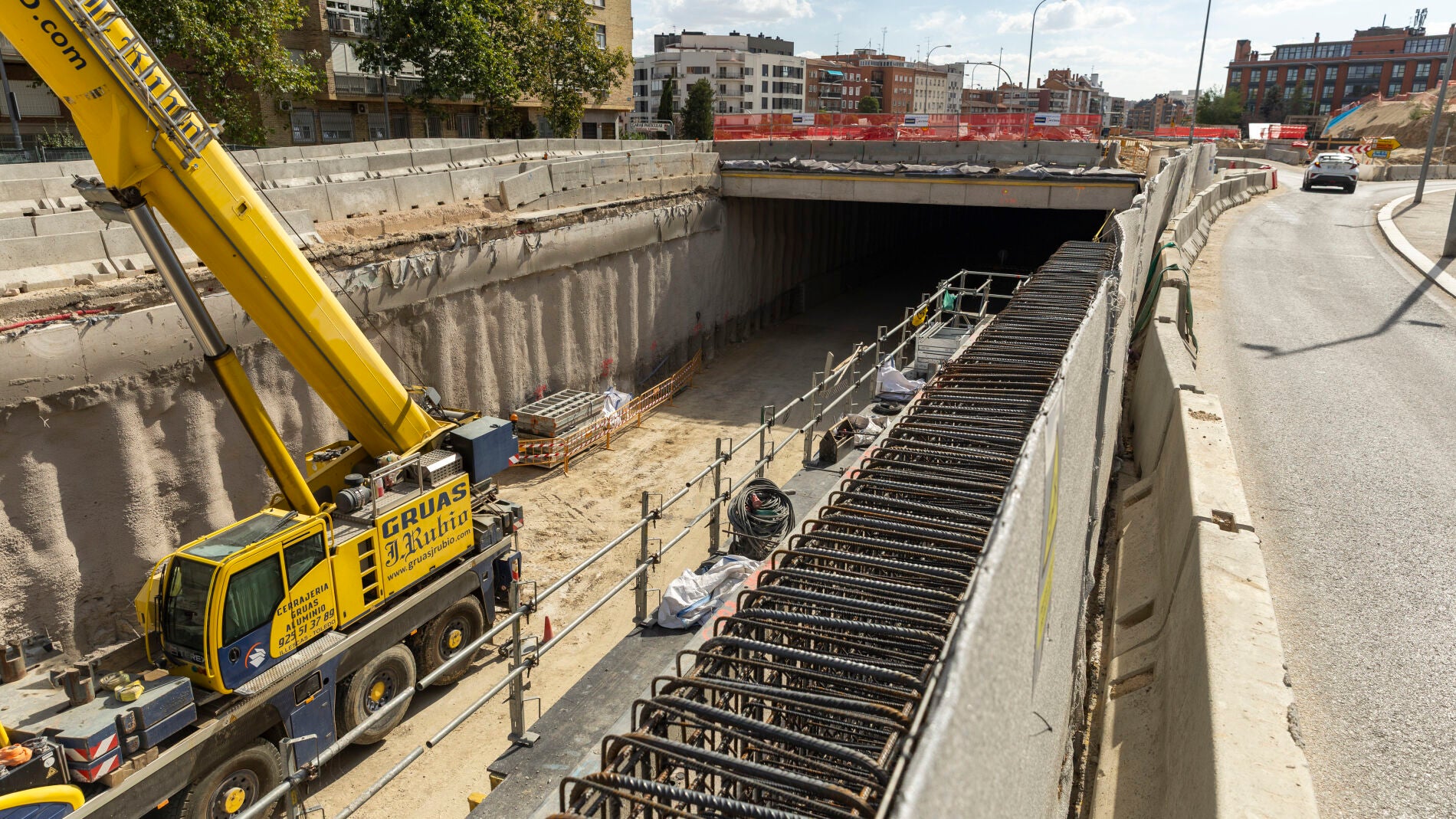
Surface construction on the 3.2-kilometre Paseo Verde del Suroeste between Avenida de Portugal and Avenida del Padre Piquer begins this month under a 75 million euro contract with an 18-month timeline. The project frees over 100,000 square metres to connect Madrid Río, Casa de Campo, and Cuña Verde.
The green promenade includes more than 7,000 trees, a two-way segregated cycle lane, new pedestrian walkways, permeable pavements, sustainable drainage systems, geothermal solutions, and eight photovoltaic pergolas. Soil excavated from the tunnel will build three artificial hills on a 20,000-square-metre site of a former electrical substation, creating spaces for recreation, viewpoints, and biodiversity. The tunnel will also feature a high-occupancy vehicle bus lane that municipal estimates indicate will save commuters up to 11 minutes.
Paseo de la Castellana tunnel and Madrid Nuevo Norte
On Paseo de la Castellana, the council plans to recover approximately 70,000 square metres of surface space by placing traffic inside a 675-metre tunnel between Plaza de Lima and Plaza de Cuzco. Above the tunnel, the city will build pedestrian routes, sports areas, children play zones, a cycle lane, and tree-lined areas, with infrastructure opening set for December.
Martínez-Almeida described the Castellana project as the finishing touch to the main axis of the capital and the entrance to the future Madrid Nuevo Norte development. That broader development spans 3.4 million square metres and will feature a new financial district, nearly 10,500 homes, office spaces, public facilities, and green networks.
Madrid Nuevo Norte will cover railway tracks at Chamartín station to unite neighborhoods previously separated by the rail yards. Across one of its development sectors, municipal authorities are processing more than 7,100 homes and reserving over 160,000 square metres for parks and open public spaces.
AZCA financial district park and pedestrian links
The financial area of AZCA will undergo a comprehensive remodeling across 132,895 square metres, comprising 82,755 square metres of public land and 50,140 square metres of privately owned space open to public use. The project will add new pedestrian routes, accessibility features between ground levels, upgraded perimeter sidewalks, and a redesigned central area.
A central park in AZCA will feature over 1,000 trees from more than 40 species, rest zones, grandstand seating, and five pedestrian footbridges. The infrastructure is designed to serve nearly 100,000 daily visitors and approximately 50,000 people who work in the district. During the project presentation, Martínez-Almeida said the redevelopment would define Madrid's best future while creating economic opportunities and improving quality of life.
Opposition criticism and environmental strategy
Opposition political parties have raised concerns about the scope and distribution of the city investments. Más Madrid spokesperson Rita Maestre questioned directing municipal funds to major northern development hubs while requested projects in other city neighborhoods remain pending.
Spanish Socialist Workers Party councillor Antonio Giraldo criticized the focus on undergrounding traffic, stating that the city council buries roadways in locations where residents did not request it.
City officials defended the undergrounding strategy as a core method to reclaim surface land over heavy infrastructure, smooth vehicular movement, and improve air quality. Municipal data shows Madrid has met European air quality limits for three consecutive years.
Environmental initiatives are further supported by the expanding Bosque Metropolitano project. Recent actions have added new land in Valdebebas, while urban developments in the southeast of the city are incorporating parks, green corridors, and direct connections to the metropolitan forest network.