Researchers at the Max Planck Institute for the Science of Light in Erlangen, Germany, have produced polarization-entangled photon pairs directly from sunlight without using lasers or electricity. The findings, published in the journal Optica, disprove the long-held belief that coherent laser light is required to generate quantum entanglement.
Entangled photons are traditionally born through spontaneous parametric down-conversion, where a laser pump photon splits inside a nonlinear crystal into two correlated photons. Conventional setups require powerful, stable lasers that consume substantial energy and face limited operational lifespans in space. Scientists at the institute tested whether natural solar radiation could replace lasers despite being considered too weak and incoherent for such tasks.
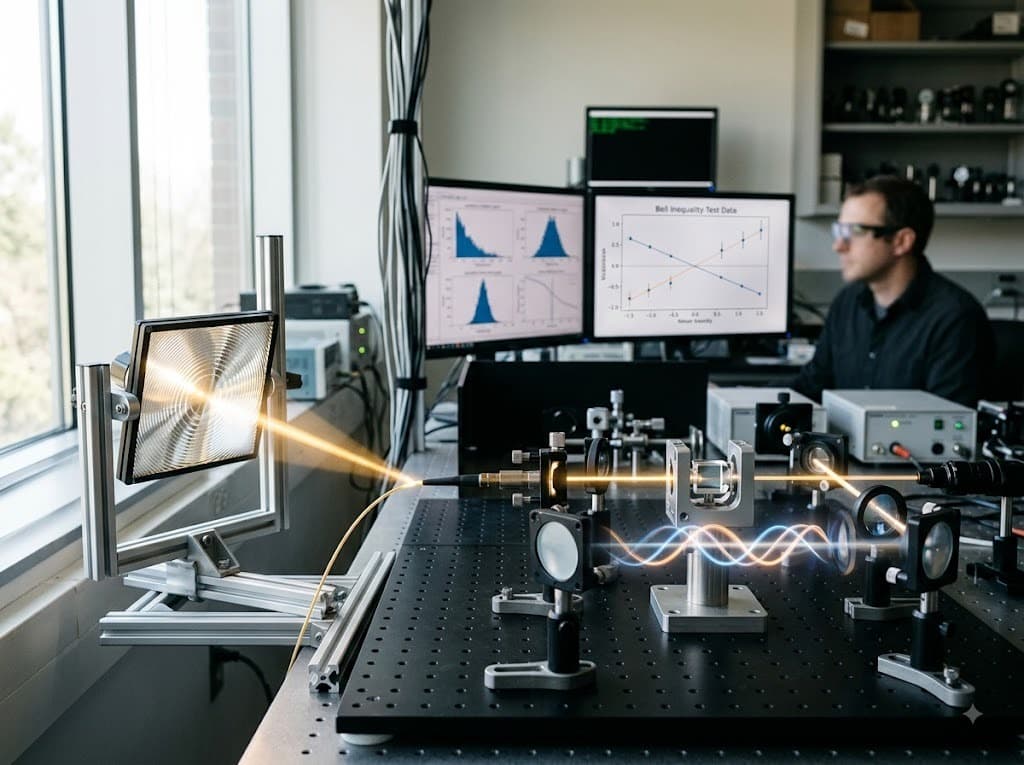
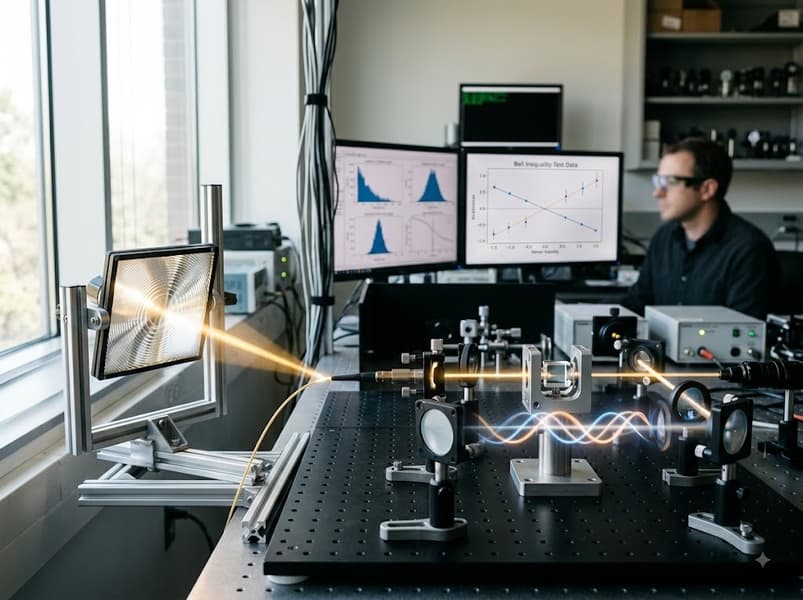
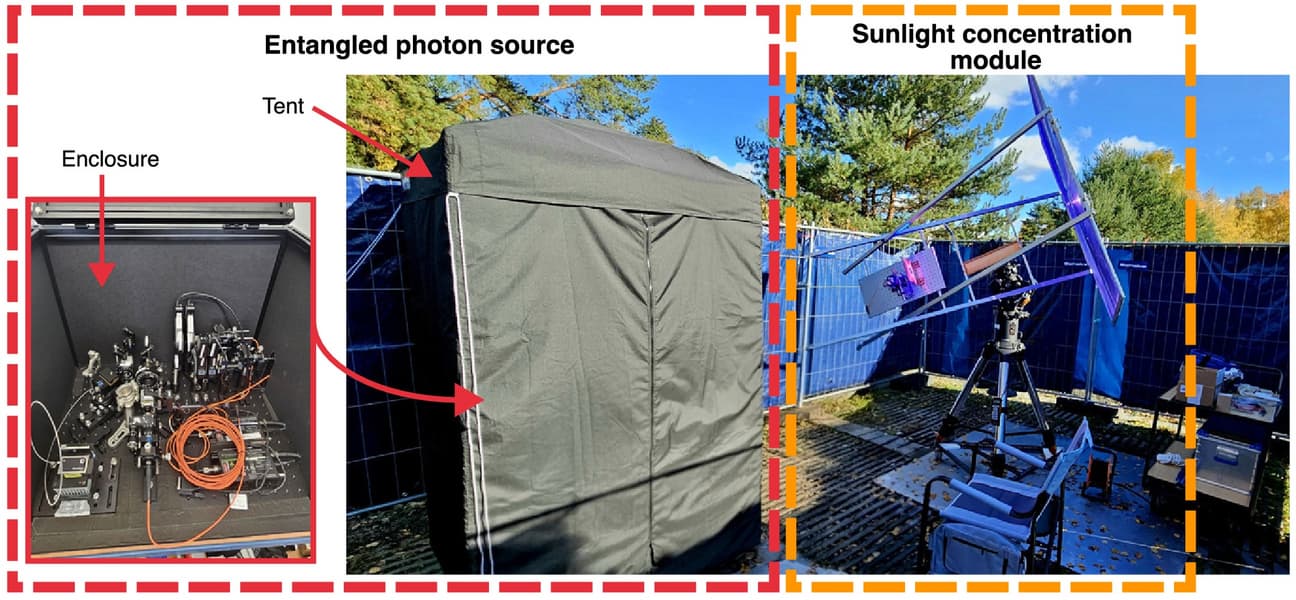
To gather and compress natural sunlight, the physicists built an optical system featuring a 1.4-square-meter Fresnel lens, spectral filters, and a conical concentrator. The system compressed solar rays and directed them into a thin optical fiber, which delivered the light to a Sagnac interferometer. Inside the interferometer, a periodically poled potassium titanyl phosphate crystal converted incoming photons into entangled pairs.
Optical setup and quantum coherence
The primary obstacle was the low coherence of sunlight, characterized by a lack of strict frequency and phase consistency found in lasers. Although chaotic sunlight was previously believed incapable of driving spontaneous parametric down-conversion, the focused solar flux proved sufficient to generate stable quantum pairs.
Measurements recorded a concordance index of 0.905 and a fidelity to the reference Bell state of 0.939. The team confirmed the non-local quantum nature of the light by violating the Bell-CHSH inequality with a recorded value of 2.54, well above the classical limit of 2.
Satellite communication and future research
The system generated approximately 1,600 photon pairs per second per milliwatt of pump power, achieving performance comparable to laser sources after spectral bandwidth normalization. Operating without converting electricity into light eliminates major failure points and heat losses.
The authors noted that the quality of solar-generated entanglement matches laser sources, with minor performance reductions stemming from optical component imperfections rather than fundamental physical limits. Partially coherent photons from the sun may also offer greater resistance to atmospheric turbulence in ground-based quantum channels.
The technology offers potential applications for autonomous quantum satellites in Sun-synchronous orbits by eliminating heavy laser equipment and expensive solar panels. Future developments will focus on miniaturizing concentrators, implementing passive solar tracking, and expanding wavelength ranges through other nonlinear processes.