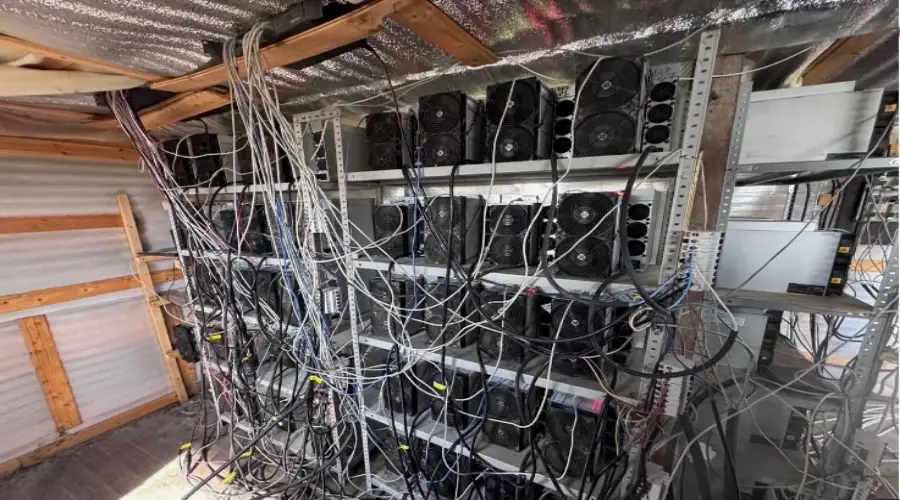
Investment firm Mintvest Capital has filed a lawsuit in the District Court for the District of Puerto Rico against bitcoin mining company Energy & Compute, formerly known as Coinmint, accusing chief executive officer Ashton Soniat of misappropriating 448.7193 bitcoin.
According to the lawsuit, Soniat repeatedly provided investors with delayed launch dates for new bitcoin mining equipment while secretly operating the hardware. Mintvest Capital alleged that Soniat claimed the machinery was still undergoing testing when it was already fully operational.
The filing states that Soniat transferred all bitcoin mined between the actual operational start dates and the delayed official launch dates directly to his personal cryptocurrency address. Mintvest Capital claimed the chief executive extended testing periods by several months to maximize his personal profits by withholding revenue that belonged to investors.
Mintvest Capital also alleged that Coinmint intentionally withheld financial statements from investors, concealed corporate transactions, and obstructed external audits. Based on these allegations, the plaintiff accused the company of committing securities fraud and violating the United States Racketeer Influenced and Corrupt Organizations Act, commonly known as RICO.

Merger Disputes and Monetary Demands
The legal complaint names New York Digital Investment Group, known as NYDIG, as a second defendant. Mintvest Capital, which holds an 18.2 percent equity stake in Coinmint, stated that NYDIG acquired Coinmint but failed to deliver the financial compensation specified in the merger agreement.
Mintvest Capital alleged that NYDIG acted intentionally to strip the investment firm of its ownership share in Coinmint. Stating that the defendant generated profits exceeding $570 million, Mintvest Capital asked the court to award $104 million as its share of those earnings, along with $47.1 million in compensation for the bitcoins mined prior to official launches, as well as court-imposed fines against Coinmint.

Corporate Background and Legal Context
Bitcoin mining relies on high-powered computer systems that solve complex mathematical problems to secure the digital asset network, earning newly minted coins in return. In commercial operations, corporate management and investment groups typically share revenues based on equity agreements and external financial reporting. Federal civil RICO claims allow investors to seek damages when corporate entities engage in patterns of financial fraud.
The legal dispute in Puerto Rico follows earlier courtroom battles involving Coinmint. The company previously launched legal proceedings against hardware vendors Katena Computing and DX Corr regarding a $150 million mining equipment purchase agreement signed in 2021.
In that earlier case, Coinmint paid an advance of $23 million to Katena but never received the mining equipment, leading Coinmint to accuse Katena and DX Corr of conspiracy and fraud. However, the American Arbitration Association ruled in 2024 that Coinmint had breached the contract itself after failing to make an initial payment of $37.5 million.

Wider Industry Enforcement
The filing against Energy & Compute arrives alongside broader legal scrutiny across the cryptocurrency mining sector. Recently, the United States District Court for the District of Nevada found Brent Kovar, the founder of mining company Profit Connect, guilty of running a fraudulent mining operation.
In the Nevada case, more than 400 investors lost approximately $24 million after placing funds with the fake mining business. Kovar now faces up to 280 years in prison following his conviction in federal court.

The lawsuit filed by Mintvest Capital against Energy & Compute, Soniat, and NYDIG remains pending in federal court in Puerto Rico, where judges will evaluate the demands for financial compensation and statutory penalties.