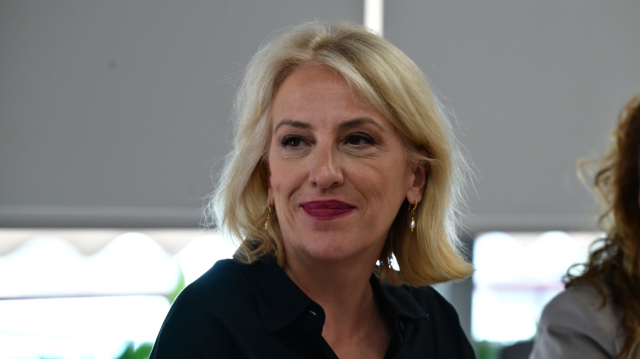
Rena Douru, the leader of the parliamentary group of Greece's SYRIZA party, published a deeply personal post about menopause, describing her own experience with the condition and criticizing the stigma she said still surrounds women as they grow older.
Douru wrote that August had been a hard month, filled with images of destruction, loss and wounds to places, people and the natural environment, a weight she said had followed everyone. Some of the losses, she added, were personal, and as a result her usual Sunday reading had been set aside for a time.
When she returned to books, she said, she picked one she would hardly have imagined reaching for a few years earlier. Douru recalled that as a student of the political theorists Chantal Mouffe, Ernesto Laclau and Menelaos Givalos, she never expected to one day hold a book by the American actress Brooke Shields without any embarrassment.
A book that inspired the post
The book in question, known in English as "Brooke Shields Is Not Allowed to Get Old," was released in Greek translation by Antzi Kounadi through the publisher Bell. It explores ageing, women's health and the pressure on women to stay quiet about the changes they experience later in life.
Douru said she began reading with curiosity and quickly found herself underlining passages. She cited one line from the book stating that women become invisible as they age because society trains them to link their worth to youth, beauty and their ability to meet other people's expectations. She said she did not find the claim hard to believe.
She also quoted a passage arguing that women are taught from childhood to treat their bodies as a permanent work in progress under correction, and that it was paradoxical to be asked to defeat time while also being criticized for trying to do so. Another passage she highlighted said that when a man shows confidence he is seen as a leader, while a woman doing the same is often called difficult or arrogant.
A further passage she quoted stated that study after study has found a gender bias in medicine that causes women's pain to be taken less seriously and, as a result, left untreated. Douru called it one of the oldest prejudices against women, one that has shifted in form since pain in women was once dismissed as "hysteria" but has not disappeared as much as it should have.
Her own experience with menopause
Citing the book, Douru noted that only one in five obstetrician-gynaecologists has been trained in menopause, even though half the population will go through it at some point in their lives.
She said she had realized lately how fortunate she was. She described going through menopause with relatively mild symptoms, saying she had not even needed a fan so far, and said she had a partner beside her who understood what the transition meant. She also credited her friend Olga Petsoglou, whom she described as someone who knows everything about menopause and never leaves a question unanswered.
Douru is a Greek politician who previously served as regional governor of Attica and currently leads SYRIZA's parliamentary group.
Why she decided to speak publicly
Douru wrote that she felt an obligation to speak out for women who go through menopause under far harder circumstances: those struggling financially, without a supportive partner or environment, without easy access to information and care, and who are still told their symptoms are "in their head" or simply "their age."
She said she had decided some time ago to talk about menopause publicly and privately whenever the opportunity arose, and welcomed the fact that a growing number of prominent women, including actresses, singers and journalists, had begun doing the same. She said such voices mattered because they were opening up a conversation that had stayed on the margins for decades.
The real goal, she added, was for no woman to have to stay silent, and for every woman, particularly those without public visibility, financial security or a supportive environment, to be able to speak without fear or shame. She urged readers to enjoy such conversations freely and without guilt.
Postscripts on the book and the photo
Douru closed the post with several postscripts. In the first, she said she hoped that such self-evident matters would one day become part of public discussion without needing a famous woman to pave the way.
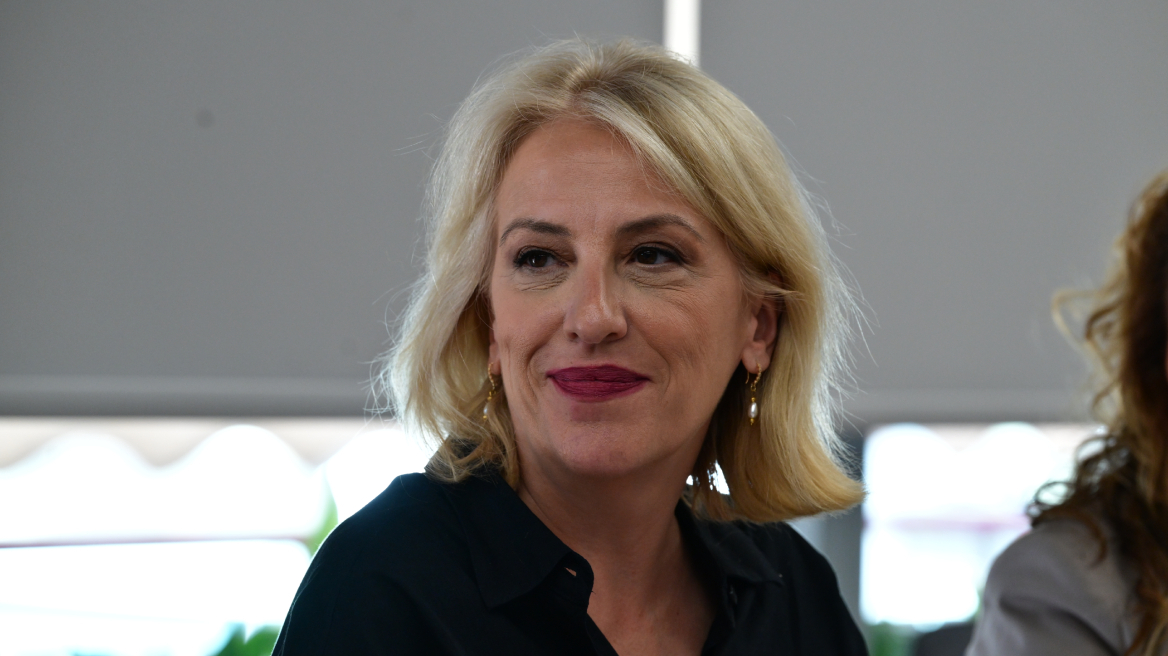
In the second, she explained that the photograph accompanying her post was taken in front of a painting by Faidra Kazantzaki depicting a market scene, with people, movement and colour capturing the everyday life of the city. She described Kazantzaki as a young artist she had followed since Kazantzaki was young, saying she took great pleasure in watching her grow and create, even if she did not see her as often as she would like.
In a final postscript, Douru said that, thinking about it, she could already imagine what she was going to hear from friends and "friends" about the... menopausal party leader.