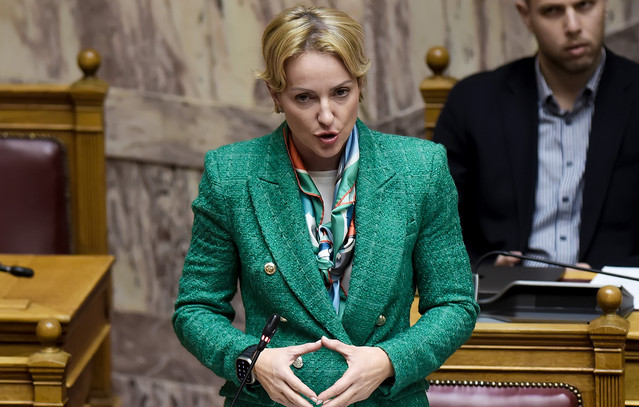
Alexandra Sdoukou, press spokesperson for Greece's ruling New Democracy party, said the country is carrying out its largest forest fire prevention programme in recent years, funded largely through the European Union's Recovery Fund. Speaking on ALPHA Radio 98.9, she thanked the men and women of Greece's Fire Service and the thousands of volunteers who worked to tackle recent wildfires.
Sdoukou said forest management policies, measures taken in previous years, and the enlarged and modernised firefighting fleet all worked to complement one another as part of a coordinated strategy.
Decades of neglected forests
Sdoukou said the core problem was that for decades much of Greece's forests had effectively been left to their own devices. She said almost half of the country's forests, mainly in southern Greece, lacked modern management studies, meaning there was no practical plan setting out what should be done in each area: where clearing was needed, where forest roads should be opened or maintained, where firebreaks were required, and where dry material acting as kindling should be removed.
She said the government inherited this gap and was gradually filling it. New management studies had begun in Attica and the Peloponnese, she said, with a new generation of studies to follow for most of the rest of the country. Each study came paired with a fire prevention plan setting out specific interventions, at specific locations, on a specific timetable.
Sdoukou said that since 2022, using about 1 billion euros from the Recovery Fund, Greece had been carrying out the largest organised intervention ever undertaken in its forests. Almost 920,000 stremmata, a Greek land unit equal to roughly a tenth of a hectare, had been cleared, firebreaks opened and the forest road network improved.
Shifting from neglect to active forest care
Sdoukou said the key was changing the underlying mindset, since for years the assumption had been that protecting a forest meant not touching it. She said a forest left completely alone fills with dry branches, fallen trunks and dense vegetation, and that when a fire breaks out, all of that material becomes fuel.
She said forests instead need active care, scientific management and people who know them and work in them throughout the year. That is why, she said, the government is again drawing on forest cooperatives made up of people who know how to remove biomass and intervene without destroying the forest. At the same time, she said the Forest Service is being reinforced with new staff, vehicles, drones, sensors, satellite internet and modern equipment. She argued there is no serious forest protection with a neglected service, and said Greece now has a forestry policy with a long-term horizon.
Fire Service numbers up sharply since 2019
Sdoukou said Greece's firefighting capacity has grown substantially since 2019. She said Fire Service personnel now stand at 18,804, up from no more than 13,257 a few years earlier. Volunteer firefighters rose from 1,909 in 2019 to 4,694, she said, while Fire Service vehicles increased from 3,327 to 4,299, aircraft from 61 to 84, and vessels from 8 to 15.
She added that more than 100 drone bases and three mobile operational centres are now in use, allowing a fire to be spotted while it is still a small outbreak. She said the result is an overall stronger Fire Service, with more personnel, better equipment, training and technology.
Extreme winds and the climate crisis
Asked about the conditions during the wildfires, Sdoukou said Attica and Boeotia had recorded extreme wind gusts reaching as much as 150 kilometres per hour, far beyond an ordinary strong wind. At that intensity, she said, fire spreads at terrifying speed, constantly changes direction and creates new fronts within minutes. She said a large fire also generates its own microclimate, making its behaviour still harder to predict, and that during the strongest winds there were hours when aircraft could not fly safely.
She said this is the new reality Greece must confront, with more extreme weather, faster-moving fires and much harder firefighting conditions, a pattern not confined to Greece. She pointed to France and Spain, countries with extensive experience, strong services and modern equipment, where fires had burned for many days and caused huge damage.
Undergrounding cables starts with highest-risk areas
Asked about placing the electricity network underground, Sdoukou said that wherever possible, especially in sensitive areas near forests or settlements, undergrounding should go ahead. But she said it was not realistic to tell people that the entire national electricity grid could be buried overnight.
She said Greece's medium-voltage network runs to 120,000 kilometres, and that fully undergrounding it would cost about 35 billion euros. She said priorities were needed, starting with the highest-risk points. She said that until 2019 about 200 kilometres of cable were being placed underground, compared with about 2,000 kilometres today, with the share of the network underground rising from 9% to 14%, funded through the Recovery Fund. She described it as a difficult, multi-year process that is already under way.