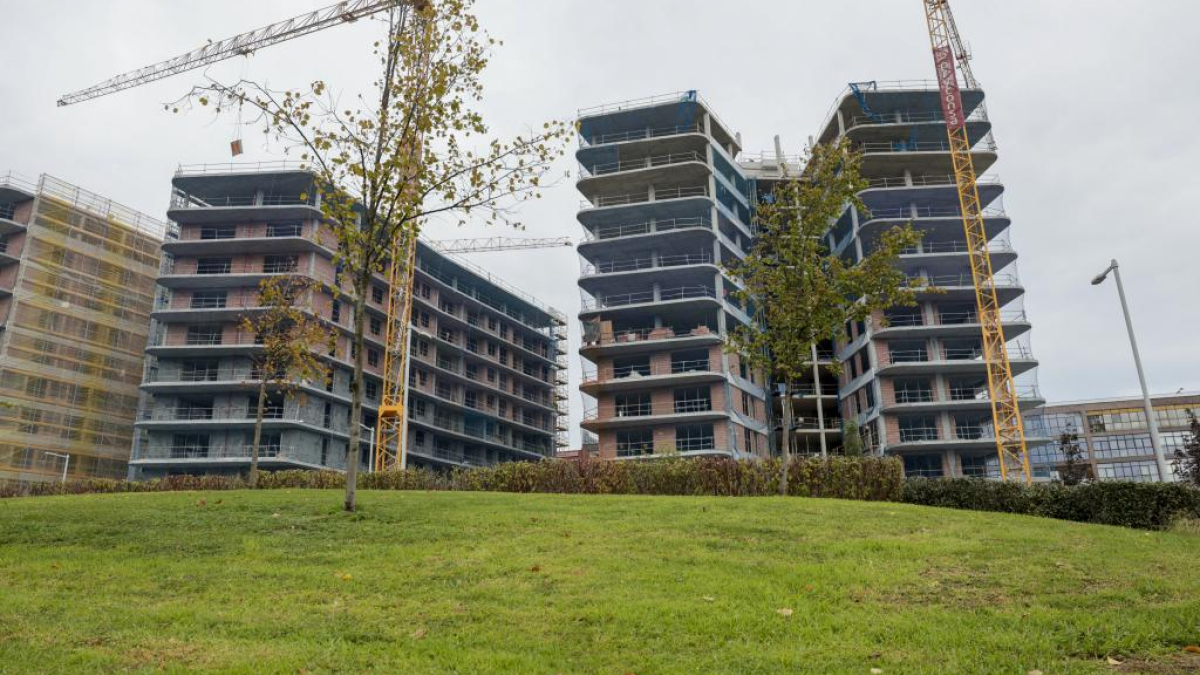
House prices in Spain rose 15.6% in October compared with a year earlier, reaching 2,582 euros per square metre, even as home sales extended a decline that has now lasted ten consecutive months, according to data from Spain's General Council of Notaries.
If the pace of increase holds through the end of the year, 2026 could become the year with the steepest annual rise in house prices since 2013, when Spain's property market began recovering from the collapse of the construction boom. Since then, prices have climbed 91.3%, compared with a 50.1% rise in household income, according to the Notarial Housing Observatory.
Alberto Martinez Lacambra, director of the Notariat's Technology Centre, presented the preliminary October figures on Thursday at an event organised by the Council of Notaries. He said the increase confirms the strong pressure demand continues to put on the market even as the number of signed sales slows, and that 2026 will end well below the 750,119 sales completed in 2025, the sector's best year since 2007.
Regional differences
Price gains have been uneven across Spain's regions, concentrated mostly in areas with large population centres or heavy exposure to sun-and-beach tourism, where foreign buyers play a bigger role.
Since 2013, the Balearic Islands have led with a 151.4% increase, followed by the Community of Madrid (138.1%), the Canary Islands (113.3%) and the Valencian Community (103.5%). Catalonia has grown 92.1%, roughly in line with the national average.
Below the average sit Andalusia (85.9%), Murcia (79.2%), Cantabria (76.8%), Navarre (72.3%), Aragon (71.1%), Galicia (70.3%), Castilla-La Mancha (69.9%), La Rioja (60%) and Castilla y Leon (50.8%). Only Extremadura (48.6%), the Basque Country (46.1%) and Asturias (43.1%) stayed below 50%.
Call for more housing supply
Martinez Lacambra said the current market situation reinforces the need to act on supply, which he said means building more residential property and developing the rental market. He said it is essential to improve legal certainty for rentals following the approval of the so-called "Maricarmen" decree, which has again changed the rules for landlords and tenants.
He said the main disruptive factor behind rising prices is the gap between the growing number of new households and the small number of homes being built. He said the deficit began in 2011 but was absorbed for several years by surplus housing left over from the construction crisis.
He said problems resurfaced from 2022, once the worst of the pandemic had passed, as annual population growth exceeded 500,000 people, driving the formation of about 200,000 new households a year against roughly 90,000 homes built, a figure he called clearly insufficient.
Housing deficit could widen to 2030
The Bank of Spain puts the accumulated housing deficit between 2021 and 2025 at 750,000 homes. The Council of Notaries warned the figure could grow by a further 670,000 homes by 2030, pushing the need for new residential units to 1.4 million, almost double current levels.
Martinez Lacambra said this imbalance is a structural problem that cannot be solved in two or three years, and that a sustained effort of at least a decade will be needed, with consequences that could affect several generations. He also called on public administrations to pair housing policy with a substantial improvement in public transport, especially in large metropolitan areas, saying better connectivity lets people search for homes across a wider area and reach more affordable prices, pointing to the metropolitan areas around Madrid and Barcelona, where buying in towns near the capitals can cost 50% less.
Economist Jose Carlos Diez, also speaking at the event, said the main obstacle to building more homes is the availability of land, which he said depends largely on decisions made by public administrations.
Sales fall for a tenth straight month
The housing shortage is already affecting the market, where sales have fallen for ten consecutive months, according to the same Notaries data, based on public deeds signed before a notary. October's decline was the sharpest so far this year, down 15.4%, with 54,823 transactions signed compared with 64,821 in October 2025.
The fall was widespread, recorded in 16 of Spain's 17 regions, with the steepest declines in the Balearic Islands (-19.5%), Catalonia (-19.2%) and Galicia (-19.0%). Only La Rioja saw a rise, up 20%.
Mortgage loans for home purchases fell 12.6% to 28,807, the biggest drop since November 2023, with declines recorded in every Spanish region.
Economists point to rapid price rises
Jose Garcia Montalvo, professor of applied economics at Pompeu Fabra University, said the market correction is being driven by the rapid rise in prices, which is making it harder for buyers to enter the market, even though fundamentals such as job creation and household income remain positive.
He said the shift began at the start of 2026, as average sale times started to lengthen and the market grew more polarised. He said homes listed at adjusted prices sell quickly, while owners under no pressure to sell are holding out for price gains of 20%, 25% or even 30%.
Despite October's rise, Garcia Montalvo said prices are starting to moderate, which he said suggests the market may be nearing the limit of how fast it can keep growing.
Prices per square metre rose in all 17 regions in October, with the largest increases in Castilla-La Mancha (+32.8%), the Balearic Islands (+32.5%) and La Rioja (+32%), roughly double the rate in Catalonia (+16.8%) and four times the rate in the Community of Madrid (+8.5%).
Seville leads among big cities
Among Spain's six cities with more than 500,000 residents, Seville recorded the largest price increase over the year to October, reaching 2,931 euros per square metre, up 29.2%. Malaga followed at 3,894 euros per square metre, up 28.4%, and Valencia at 3,077 euros per square metre, up 21.3%.
In Barcelona, prices have passed 5,000 euros per square metre, rising 12.1% over the year to 5,130 euros. Madrid is approaching 6,000 euros per square metre, at 5,705 euros, up 11.7%. Zaragoza showed a more moderate trend, at 2,248 euros per square metre, up 6.5% year-on-year.
What happens next
The Council of Notaries warned that without action, Spain's housing deficit could grow by a further 670,000 homes by 2030, pushing the need for new residential units to 1.4 million.
Test yourself
By how much did Spanish house prices rise in October compared with a year earlier?
Which region has recorded the largest cumulative price increase since 2013?
How many consecutive months have home sales declined, according to the Notaries?
Have your say
What do you think would do most to ease Spain's housing shortage?