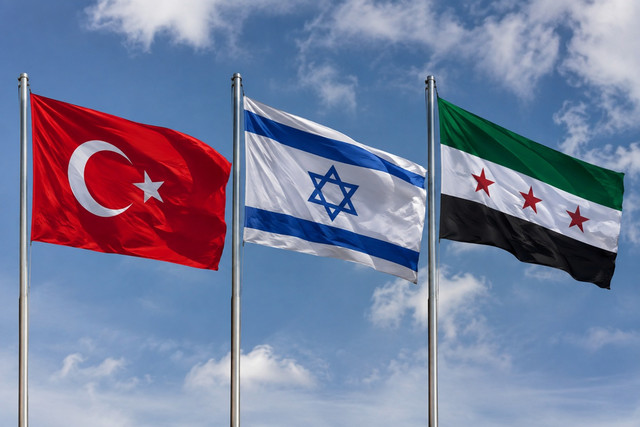
The United States is working to establish a military deconfliction mechanism between Israel, Turkey and Syria following overnight Israeli airstrikes on a Syrian airbase near the Turkish border.
Tom Barak, the US Special Envoy for Syria and US Ambassador to Turkey, confirmed the diplomatic initiative after Israeli warplanes struck the Abu al-Duhur military airfield in northwestern Syria.
Barak stated that Ankara had not been informed in advance of the Israeli strikes. When Turkish military authorities detected aircraft moving north towards Turkish airspace, they could reasonably have prepared a military response to defend their territory, according to Barak.
Speaking to Reuters in a telephone interview, Barak said that cool heads had fortunately prevailed and prevented a further deterioration of the security situation. Turkey condemned the strikes on the Abu al-Duhur facility, located near Aleppo, but did not offer further official comment on the incident or on the proposed deconfliction channel.
A deconfliction mechanism acts as a direct communication link between military or civilian officials, establishing dedicated channels to prevent misunderstandings, miscalculations and accidental military clashes when forces operate in close proximity.
Israeli allegations of Turkish troop deployment
Israel confirmed that it carried out the overnight airstrikes on the Syrian military airfield, claiming that Turkey planned to deploy forces to the facility. The office of Israeli Prime Minister Benjamin Netanyahu said in a statement that Israel and Syria had agreed to maintain a security status quo, which Syria was about to violate by permitting Turkish troops to deploy at the airbase near Aleppo.
Netanyahu's office said Israel had repeatedly warned Syrian authorities that such a troop deployment would pose a direct threat to Israeli security. The statement added that Syria chose to ignore those warnings, emphasizing that Israel will not tolerate security threats and would welcome a return to the previous security regime.
However, a Turkish official speaking to The Times of Israel denied that Ankara was seeking to establish a military presence at the base. The overnight strikes caused material damage to the airfield infrastructure, with no casualties reported.
Diplomatic push for regional de-escalation
According to Barak, the Israeli strikes reflected a perception, whether correct or incorrect, that Turkey might reinforce its presence at the Abu al-Duhur base in the immediate future.
Barak said the incident highlighted the urgent necessity of a trilateral deconfliction mechanism involving Israel, Syria and Turkey. He noted that Washington is actively working to set up the channel to prevent communication breakdowns in the future, adding that the immediate priority is de-escalating tensions and creating space for a more measured diplomatic approach.
Turkey commands the second-largest military in the North Atlantic Treaty Organisation, behind only the United States, and signed a mutual defence agreement this month with Pakistan and Saudi Arabia. Ankara has emerged as a key international ally of Syrian President Ahmed al-Sharaa, whose rebel forces ousted long-time leader Bashar al-Assad. Diplomatic relations between Ankara and Israel collapsed following the October 7, 2023 attack by Hamas on Israel and the subsequent war in the Gaza Strip.
Syria and Israel have held several rounds of talks on de-escalation and border security issues following Assad's removal, though no formal agreement has been reached so far. Barak concluded that an incident like the airbase strike demonstrates the clear need to intensify those diplomatic efforts and broaden the overall negotiation process.