

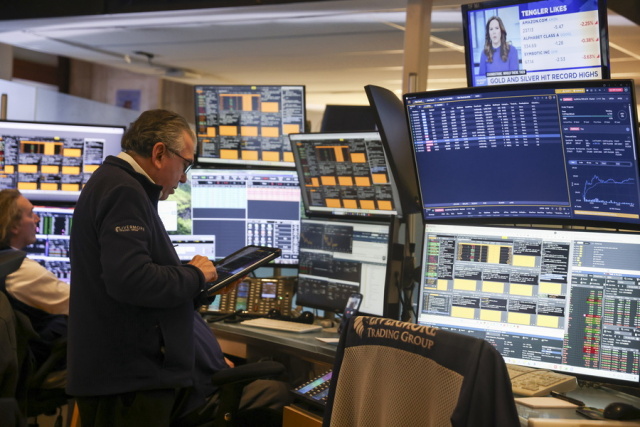
Wall Street stocks ended higher on Friday as strong economic data, surging raw material shares, and a rally in cryptocurrency assets helped major indexes recover from earlier losses. However, persistent volatility in the bond market and escalating geopolitical tension in the Middle East prevented equities from reversing their weekly decline.
The Dow Jones Industrial Average gained 517 points, or 0.98 percent, to close at 53,277, crossing back above the 53,000 mark. The benchmark S&P 500 index, which tracks 500 of the largest publicly traded American companies, rose 0.43 percent to 7,674 points. The tech-heavy Nasdaq Composite added 0.44 percent to finish at 26,180 points.
Despite Friday gains, all three benchmark indexes closed the week in negative territory. The Dow fell about 1 percent, marking its second straight weekly loss. The S&P 500 dropped over 1 percent and the Nasdaq fell approximately 2 percent, breaking three-week winning streaks for both indexes.
Wall Street refers to the financial district in Lower Manhattan, New York, and serves as a shorthand term for the overall US equity market and major financial institutions.
US Economic Growth and PMI Data
A primary catalyst for Friday stock market rebound was positive economic data from S&P Global. The preliminary US composite Purchasing Managers Index, which measures private sector business activity, rose to 56 points in August from 54.5 in July, topping economists forecasts of 54 points.
The reading signaled the fastest pace of business expansion in the United States since April 2022. Growth was driven primarily by the services sector, which expanded at its strongest rate since December 2024, while manufacturing growth slowed to a five-month low. Readings above 50 indicate economic expansion.
Chris Williamson, chief business economist at S&P Global Market Intelligence, said employment growth rebounded in August as business leaders expressed greater optimism following the easing of initial fears over tariffs and Middle East conflicts. Williamson cautioned, however, that supply chain delays were among the longest seen in four years, and noted that elevated inflation pressures could reignite if energy prices rise further.
Bond Market Volatility and Treasury Yields
Tensions in the bond market continued to overhang equity investors. US Treasury yields rose further as the initial market impact of intervention by Treasury Secretary Scott Bessent to limit long-term borrowing costs began to fade. Investors increasingly viewed the proposed measures as a short-term fix rather than a permanent solution to structural debt concerns.
The yield on the benchmark 10-year US Treasury note rose to 4.738 percent, while the 30-year bond yield climbed to 5.276 percent, keeping both key borrowing metrics near multi-year highs. US Treasury yields represent the interest rate paid by the federal government on its national debt, and serve as a global benchmark for mortgages, corporate debt, and consumer loans.
Financial markets remain focused on an upcoming fiscal consolidation initiative announced by Bessent, who oversees US government debt management and federal financial policy. Wall Street analysts suggested the Treasury Department could reduce the size of long-term bond auctions while increasing issuances of two-year, three-year, and five-year notes.
Market commentary was divided on bond risks. Ulrike Hoffmann-Burchardi of the UBS Chief Investment Office said the wealth management firm did not see bond market turmoil as a reason to cut equity holdings, though she noted recent moves underscored the need for portfolio diversification. Michael Hartnett, chief strategist at Bank of America, warned that if Treasury efforts to curb long-term yields fail, it could weaken the US dollar and spur bets against risk assets ahead of the November midterm elections.
Federal Reserve and Technology Sector
Investors are turning their attention to monetary policy ahead of the Federal Reserve upcoming economic symposium in Jackson Hole, Wyoming. The annual gathering of global central bankers is widely regarded as a pivotal event for rate policy signals.
Federal Reserve Chairman Kevin Warsh is scheduled to deliver a keynote speech at the Jackson Hole forum next week, which analysts expect could significantly shape monetary policy expectations and government bond yields. Ann Miletti of Allspring Global Investments noted that the summer conference presents a greater market risk for Wall Street than upcoming tech earnings.
Semiconductor designer Nvidia remains under close scrutiny following recent weakness in tech stocks, with investors demanding evidence that massive artificial intelligence spending justifies elevated corporate valuations. Nvidia agreed to pay 6 billion dollars to license artificial intelligence models from startup Poolside, and is expected to extend job offers to more than 100 Poolside employees.
Elsewhere in the technology sector, Apple announced job cuts across its Siri voice assistant and Vision Pro mixed-reality headset teams as part of a strategy shift toward next-generation hardware and AI capabilities. Meanwhile, cloud infrastructure firm Nscale is preparing for a September initial public offering in the United States, targeting up to 3 billion dollars in funding amidst high demand for AI data centers.
Commodities Crypto Rally and Geopolitical Risk
Raw material stocks provided strong support to Wall Street, with the S&P 500 materials sector gaining more than 2 percent. The surge was driven by record high copper prices in August, fueled by South American mine disruptions, lower refined copper output in China, US tariff uncertainty, and rising demand from AI data infrastructure.
Copper supply bottlenecks tightened after mining company MMG suspended operations at its Las Bambas site in Peru following a fatal accident. Additionally, Lundin Mining reduced its 2026 copper production target after a second severe winter storm disrupted operations in Chile Atacama region. Peru and Chile are two of the world largest copper-producing nations.
Cryptocurrency assets and related financial equities experienced a sharp rally on Friday. Bitcoin jumped over 5 percent to trade above 77,000 dollars. Brokerage firm Robinhood saw its shares leap nearly 13 percent, while cryptocurrency exchange operator Coinbase gained close to 8 percent, placing both among the top performers in the S&P 500 index.
Geopolitical risks continued to exert pressure on global markets as crude oil prices surged. Brent crude futures rose above 94 dollars per barrel, posting a weekly gain of more than 6 percent. The price increase comes amid a diplomatic standoff between the United States and Iran that has kept the Strait of Hormuz closed to shipping, blocking a key global transit route for petroleum supplies.
US President Donald Trump announced an escalation of economic pressure on Tehran, calling on international allies to join an economic D-Day against Iran. Treasury Secretary Scott Bessent said the administration aims to enforce the most comprehensive coordinated economic isolation in history using port blockades and tighter sanctions, with full details expected on Monday. Iranian state media reported that Tehran would respond to any new American threat with a crushing reaction.


