The Red Sea is back at the center of global geopolitical tension as Yemen's Houthi movement revives the threat of blocking one of the world's most important maritime passages, the Bab-el-Mandeb strait.
The armed group, which is backed by Iran, has shown in recent years that it can disrupt international shipping using an arsenal of missiles, drones and naval attack weapons, turning what began as a regional conflict into a matter of global economic security.
The renewed tension comes at a time when the wider Middle East is at a heightened state of risk, with the United States, Iran and their respective allies operating in a fragile and confrontational environment.
Bab-el-Mandeb and global trade
The Bab-el-Mandeb strait, which sits between Yemen and Djibouti, is one of the most important sea lanes in the world. Commercial vessels connecting Asia and Europe pass through it on their way to the Suez Canal, and the route carries particular weight for the transport of oil and natural gas.
Any serious disruption to traffic through the strait can drive up shipping costs, delay global supply chains, push up energy prices and force vessels onto longer alternative routes.
That is precisely the strategic advantage the Houthis hold: the ability to put pressure on a region whose importance to the world economy far outweighs the size of Yemen itself.
From Yemeni rebels to regional power
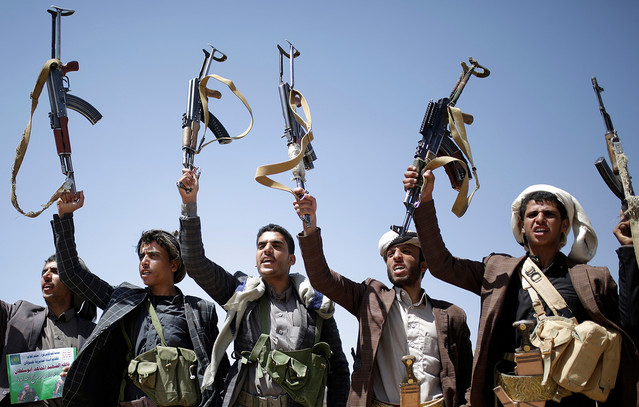
The Houthis, also known as Ansar Allah, emerged as a Shiite movement in northern Yemen and seized the capital, Sanaa, in 2014. Since then they have grown into one of the most significant armed groups in the Middle East, with military capabilities that go far beyond what would be expected of a group involved in an internal conflict.
According to Western governments, support from Iran has strengthened the Houthis' capabilities in ballistic missiles, drones, air defense systems and naval weapons, including attacks on ships.
Tehran denies that it controls Houthi operations, but the United States and its allies regard the group as part of the wider network of Iranian allies across the region.
From Gaza to a global shipping crisis
International attention turned sharply toward the Houthis after the start of the war in Gaza, when the group announced it was attacking vessels linked to Israel or its allies.
The attacks caused broader disruption to shipping, as many companies were forced to avoid the Red Sea altogether and instead take the longer route around the Cape of Good Hope.
The crisis exposed a new reality: a small regional force with relatively limited resources can, through geography and low-cost technology, generate consequences for the global economy.
Why Washington is worried
For the United States, the Houthi threat is not only about protecting commercial shipping. It concerns the overall balance of power across the Middle East.
Washington fears that Iran is using its regional allies to build a network of pressure stretching from Lebanon and Syria to Iraq and Yemen.
In the event of a larger regional conflict, the Houthis could act as an additional lever of pressure, threatening not only Israel but also the sea lanes that supply the global economy.
A difficult equation for the West
Countering the Houthis presents a hard equation for Western countries. Military operations can strike infrastructure and weapons systems, but Yemen's experience shows that eliminating a group like this is extremely difficult.
The Houthis have survived for years against far stronger opponents and have turned control of territory and coastal areas into a strategic asset.
At the same time, the international community is having to confront a new kind of threat: armed groups that can affect global markets without holding the power of a state.
The Red Sea as a new Middle East front
The crisis in the Red Sea is now part of a larger geopolitical contest. On one side, the United States and its allies are trying to keep international trade routes open. On the other, Iran and its allies are seeking to preserve their ability to apply pressure at critical points in the region.
The Bab-el-Mandeb strait may lie thousands of kilometers from the world's major economic centers, but its security directly affects prices, trade flows and global economic stability.
That is why Houthi movements are now being watched not only across the Middle East but in major capitals around the world.