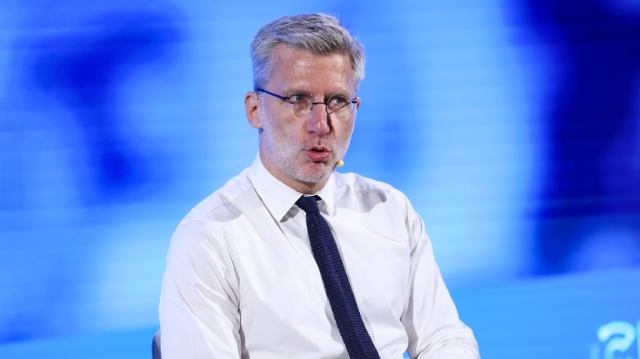
Greek Minister of State Akis Skertsos has launched a fierce attack on former prime minister Alexis Tsipras over his visit to Paris.
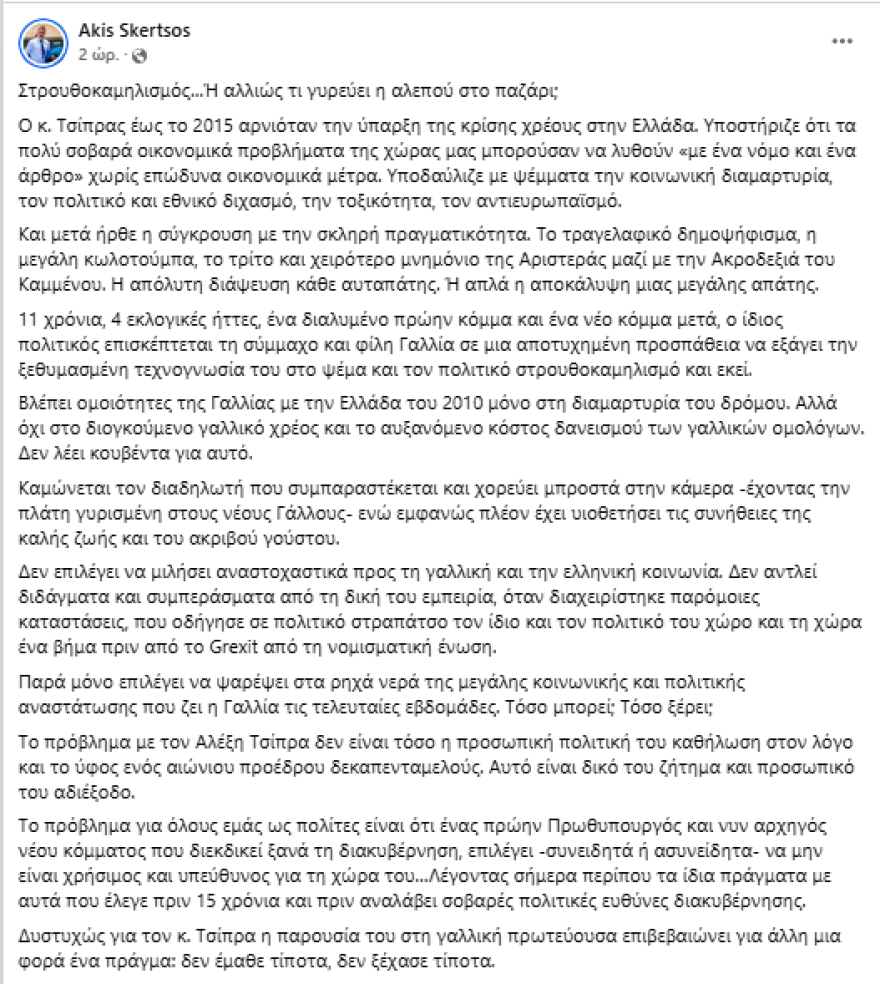
Writing on social media in a post titled with a proverb asking what the fox was looking for in the marketplace, Skertsos accused Tsipras of political ostrich behaviour and said he was attempting to export his stale expertise in deceit to France.
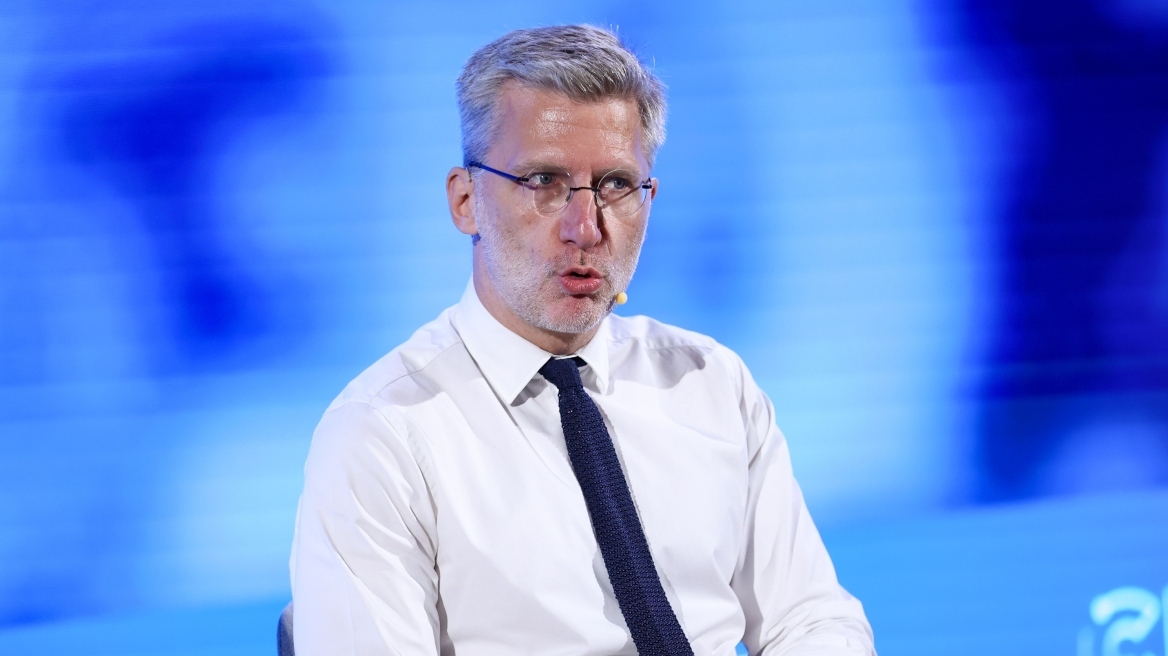
Skertsos alleged that Tsipras was seeking to capitalise on recent social unrest in the French capital while turning his back on French citizens and ignoring the economic challenges facing the country.
Skertsos is a prominent cabinet member in Greece's centre-right New Democracy administration, where he coordinates government policy. The source article identifies Tsipras as a former prime minister and the head of EL.AS. who now leads a new political party seeking a return to national office.
Debt crisis and the 2015 referendum
In his social media post, Skertsos claimed that Tsipras had denied the existence of the Greek debt crisis until 2015. He said the former leader had claimed Greece's severe economic difficulties could be resolved with a single law and a single article, without any painful economic measures.
Skertsos stated that Tsipras had used falsehoods to stoke social protests, political and national division, toxicity, and anti-European sentiment during that period.
The minister added that those claims led to a harsh collision with reality later in 2015. He cited what he described as a farcical referendum, a massive political U-turn, and the third and worst economic bailout memorandum signed by the Left in partnership with the far-right faction of Panos Kammenos, calling it the total shattering of every illusion or simply the revelation of a grand fraud.
Tsipras governed Greece from 2015 to 2019, coming to power on an anti-austerity platform before agreeing to a third multi-billion-euro international bailout after a dramatic referendum to prevent Greece from crashing out of the euro currency. His left-wing Syriza party governed in a coalition with Kammenos's right-wing Independent Greeks party throughout that term.
French protests and bond markets
Addressing Tsipras's presence in France, Skertsos said the former prime minister saw similarities between France and Greece in 2010 solely in the street demonstrations. The minister noted that Tsipras said nothing about ballooning French national debt or the increasing borrowing costs of French government bonds.
Skertsos accused Tsipras of pretending to be a supportive demonstrator dancing in front of cameras with his back turned to young French people, while visibly adopting the habits of the good life and expensive personal tastes.
France has experienced weeks of contentious protests and political turbulence over budgetary pressures, alongside growing investor focus on the French deficit and rising bond yields in European debt markets.
Student politics and governance
Skertsos argued that Tsipras had chosen not to speak reflectively to French or Greek society and had drawn no lessons from his own experience handling similar turmoil, which the minister said brought Greece to the brink of a Grexit from the eurozone. Skertsos alleged that Tsipras preferred to fish in the shallow waters of the major social and political upheaval France had witnessed in recent weeks, asking whether that was all he was capable of doing or knowing.
The minister remarked that the issue was not Tsipras's personal political fixation in the rhetoric and style of an eternal president of a fifteen-member school committee, which Skertsos described as Tsipras's own problem and private dead end.
In the Greek school system, fifteen-member committees represent high school student bodies, and the phrase is commonly used in Greek political discourse to characterise rivals as immature student union activists. Tsipras first gained national prominence in Greece as a student leader during secondary school protests in the 1990s.
Electoral defeats and party leadership
Skertsos stressed that the real problem for citizens was that a former prime minister and current party leader seeking power once again was choosing, consciously or unconsciously, not to be useful or responsible for his country. He pointed out that eleven years, four election defeats, a dissolved former party, and a new party later, Tsipras was still saying roughly the same things he said fifteen years ago before taking on serious governmental duties.
Skertsos concluded that Tsipras's visit to the French capital proved once again that he had learned nothing and forgotten nothing.
Tsipras lost the general election in July 2019 to New Democracy and stepped down from the leadership of Syriza in 2023 following further electoral defeats, after which the party experienced multiple splits and leadership crises.