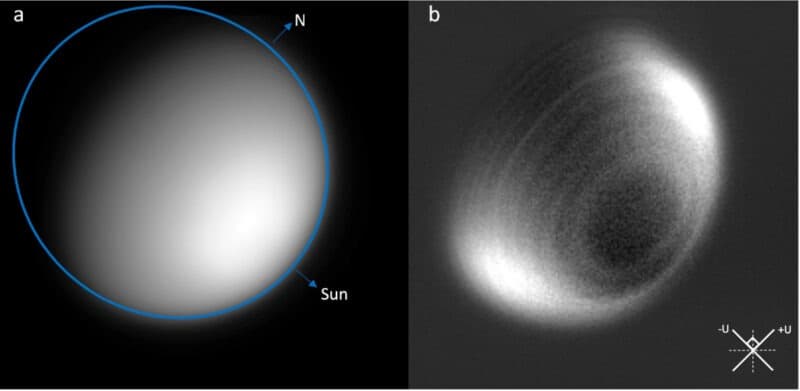
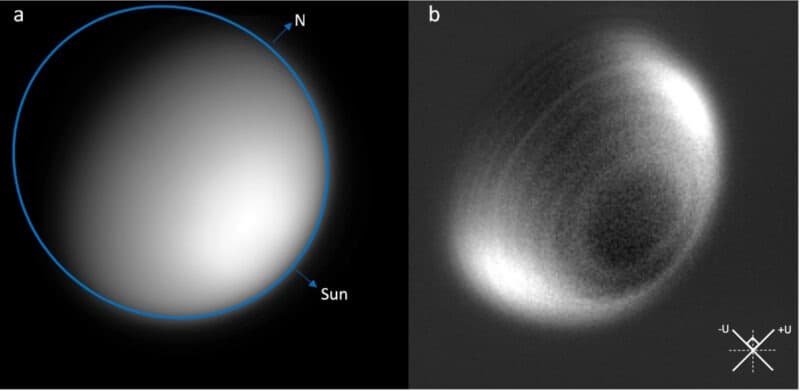
Astrophysicists from the Netherlands have discovered giant ring-shaped structures in the upper atmosphere of Venus that had never been observed before. The rings are not solid like Saturn's, but large-scale atmospheric waves circling the planet.
The researchers found the structures by reanalyzing images captured in 2010 by the William Herschel Telescope in the Canary Islands. The rings appeared only in polarized light.
According to the researchers, the rings are likely linked to changes in gas density above the upper boundary of Venus's clouds. Computer modeling suggested gravitational waves could be the cause. Similar processes occur on Earth, where such waves affect atmospheric circulation and weather.
Ruling out an instrument error
Scientists first suspected the pattern was an artifact of the ExPo (Extreme Polarimeter) instrument, which was built to search for circumstellar disks around other stars. But analysis of images taken through six different polarization filters showed the rings appeared only in part of the data, and the instrument's known characteristics could not explain the effect. The researchers concluded the signal could be real.
The researchers cautioned it is too early to call this a confirmed discovery. ExPo was an experimental instrument that was dismantled after its program ended, and no polarimeter with similar sensitivity currently exists, so the observations cannot be repeated under the same conditions soon. Independent measurements are needed to confirm the signal.
A future mission to confirm the find
The European Space Agency's EnVision mission, planned for launch in 2032, could provide that opportunity. The spacecraft will carry a high-precision polarimeter to study Venus's atmosphere. If the ring structures are confirmed, new observations could reveal how often they form, how long they last, and what role they play in the planet's atmospheric dynamics.