

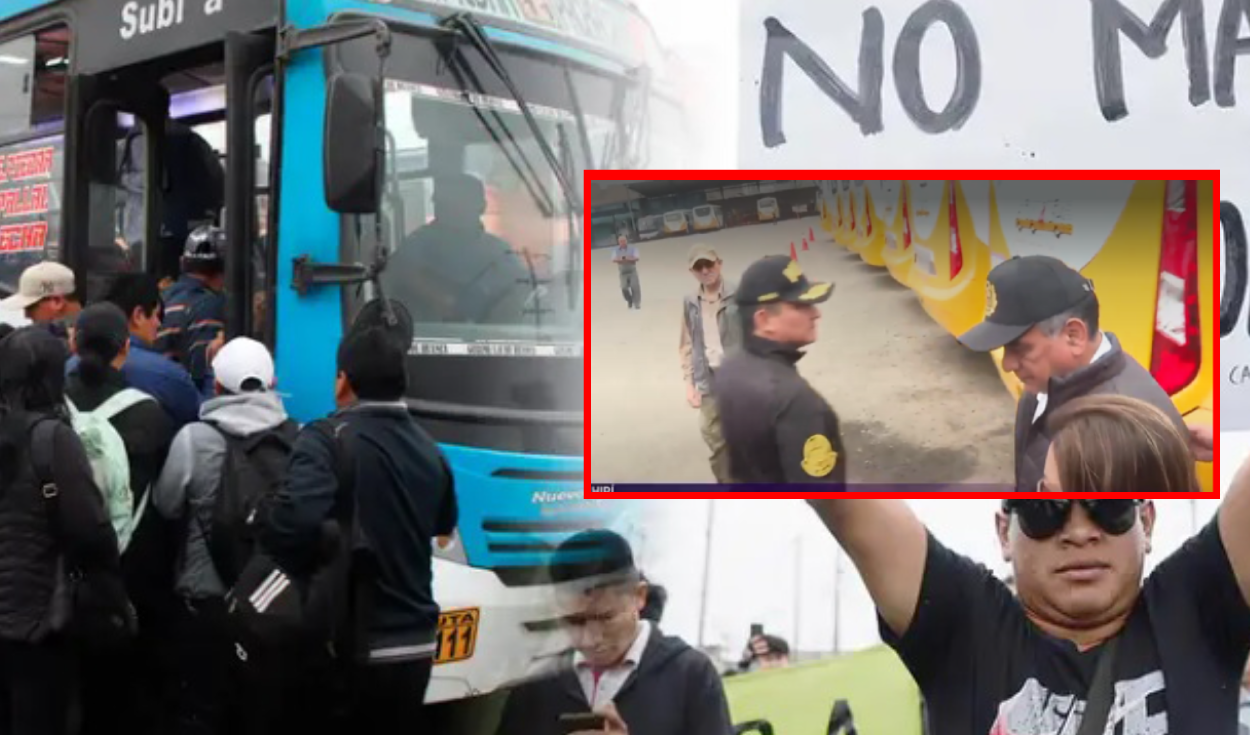
Peruvian Interior Minister César Astudillo avoided journalists in Huarochirí after transport unions rejected the national police security plan known as Escudo.
The minister entered his official vehicle and drove away without providing explanations, despite repeated requests for comment from reporters attending a public event in the province east of Lima. Following the minister's departure, the congressional political coalition Juntos por el Perú announced a motion of interpellation against Astudillo.
The silent exit occurred during an official ceremony in Huarochirí marking the delivery of a new bus fleet to transport company ETUL 4 S. A. Once the presentation concluded, Astudillo walked straight to a waiting black car, declining to address growing discontent over government anti-extortion measures.

General Jorge Luis Castillo, chief of the Lima Centro Police Region who accompanied the minister at the event, also refused to comment on the security situation facing transport workers or the implementation of the police plan.
Transport sector backlash and extortion attacks
Transport unions across Metropolitan Lima have voiced strong opposition to the Escudo plan, arguing that government anti-extortion initiatives fail to stop continuous violent attacks against bus operators and drivers. Transport companies in Peru have faced persistent extortion networks that demand protection fees under threat of armed violence.
The security crisis directly affects the firm hosted at the Huarochirí event. Company records show that ETUL 4 S. A. has suffered five violent attacks since 2024. Despite the high visibility of the fleet presentation, government officials offered no updates on investigations into the incidents.
Criticism of the Escudo plan has also come from former government officials. Former Interior Minister Wilfredo Pedraza stated that the initiative is severely limited in scope, reaching only 53 of the more than 500 public transport companies operating across the Lima metropolitan area.
The security situation is further complicated by the widespread availability of illegal firearms. Official figures show that more than 340,000 unregistered weapons are currently circulating across the country, heightening risks for public transport workers and commuters.
Disputed homicide statistics and police leadership
The controversy surrounding the Escudo plan coincides with intense scrutiny over official crime statistics used by the Ministry of the Interior. Astudillo had previously defended the performance and continuity of police chief Óscar Arriola by claiming that homicides had fallen by 500 cases compared to the previous year.
However, an independent data analysis revealed that the minister's claim relied on severe recording errors within the National Police database. Data analyst Juan Carbajal identified abnormal entries in the system's category for other objects under the DIVCOP police division.
Carbajal found that this statistical category accumulated 494 entries during the first half of 2025. That total represents nearly four times the 125 cases logged in the first half of 2024 and the 120 cases recorded during the same period in 2026.
The database error included 133 entries between April and June 2025 classified as alleged homicides of newborn infants. Medical examiners from Sinadef, the national death registry, confirmed that those cases were never reported or certified in real life.
After correcting the registry anomalies, Carbajal calculated that the first half of 2025 saw approximately 1,330 homicides rather than the 1,680 reported by authorities. The correction reduces the homicide drop claimed by the Ministry of the Interior from 24.6 percent to just 4.7 percent.


