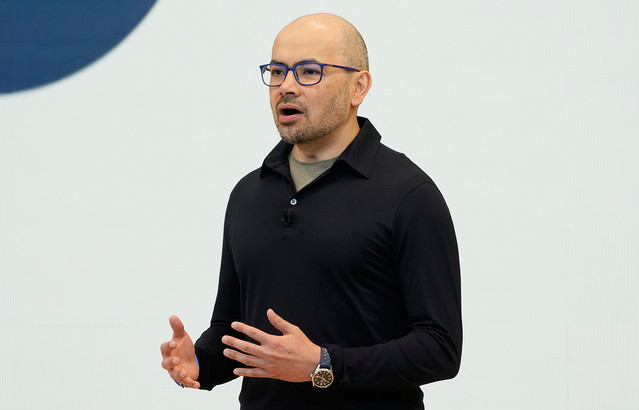
Google is raising Sir Demis Hassabis higher in its internal hierarchy as the competition over artificial intelligence becomes an existential battle for technology giants. The promotion serves as a clear sign of corporate pressure, with Google needing a major discovery to regain its role as an industry pioneer.
At the centre of these expectations is a scientist with Greek-Cypriot roots who began as a chess child prodigy, worked in video games, founded DeepMind, and transformed protein biology. Google now expects a new strategic direction from him to secure a competitive advantage.
In recent years, Google faced challenges to its public image in the artificial intelligence race from more aggressive competitors, despite having laid the foundations of modern AI. The choice of Hassabis indicates that the company intends to respond with scientific depth rather than public relations moves.
The decision builds on the success of AlphaFold, the DeepMind system that solved protein structure prediction and led Hassabis to the 2024 Nobel Prize in Chemistry. That breakthrough demonstrated that artificial intelligence could generate knowledge with direct applications in medicine, pharmacology, and biotechnology.
Family Origins and Early Chess Career
Demis Hassabis was born in London on July 27, 1976, under the full name Dimosthenis. His father, Kostas Hassapis, came from Famagusta, Cyprus, and moved to Britain in the early 1970s. Plans to return to Cyprus ended after the 1974 Turkish invasion, keeping the family in London.
His mother, Angela, of Sino-Singaporean origin, moved to Britain to train as a nurse before working as a teacher. Hassabis grew up between distinct cultural backgrounds without the privileges of an easy path.
His talent appeared before he began school. At age four, after watching his father and uncle play chess, he asked to learn the rules and quickly began defeating adults. By age 12, he was ranked among the top chess players in the world in his age group, and by 13, he was playing professionally.
Chess served Hassabis as a laboratory of thought rather than a final goal. He focused on how intelligence operates, specifically how it predicts, plans, and selects among prospective moves.
Video Games and Neuroscience Studies
Hassabis involved himself in programming during childhood and shifted from playing electronic games to developing them. As a young creator, he participated in making Theme Park, which became an international commercial success selling millions of copies.
He created the game while still a teenager, having completed his school education earlier than standard schedule while preparing to enter Cambridge. He later founded Elixir Studios to test advanced game ideas, and while commercial results fell short of expectations, the business provided insight into algorithms, strategy, and human behavior.
Following his initial business venture, Hassabis returned to university to study neuroscience, focusing on memory, amnesia, and imagination. His research established that memory acts as a mechanism to simulate future scenarios and plan outcomes, linking biological intelligence to computational design.
DeepMind Founding and Scientific Breakthroughs
In 2010, Hassabis founded DeepMind with the stated objective to solve intelligence and use that solution to understand the world. The company used games as testing grounds, achieving prominence when its AlphaGo system defeated top players in the ancient Chinese game Go.
The AlphaGo victory showed that artificial intelligence could formulate strategies that surprised domain experts. In 2014, Google purchased DeepMind for 650 million dollars, marking one of its most critical artificial intelligence investments.
The major scientific breakthrough occurred when Hassabis and John Jumper developed AlphaFold2, addressing the long-standing biological challenge of predicting three-dimensional protein structures from amino acid chains. The system predicted structures for hundreds of millions of proteins, giving global researchers tools to accelerate drug discovery, disease study, and biological applications.
Corporate Strategy and Scientific Research
The recognition of AlphaFold through the Nobel Prize in Chemistry confirmed artificial intelligence as an instrument for primary scientific discovery. Hassabis's expanded role at Google carries significant commercial and technical weight as artificial intelligence becomes a matter of geo-economic competition and industrial policy involving trillions of dollars in investment.
In interviews, Hassabis described science as the space to answer how life functions and how intelligence can comprehend it. Unlike a traditional Silicon Valley chief executive measured solely by product metrics and valuations, he remains a researcher whose scientific ambition forms a key asset for Google.
In his elevated position, Hassabis is tasked with merging deep scientific research with commercial speed. He must preserve the research culture of DeepMind while delivering products, infrastructure, and strategic advantages to Google.