

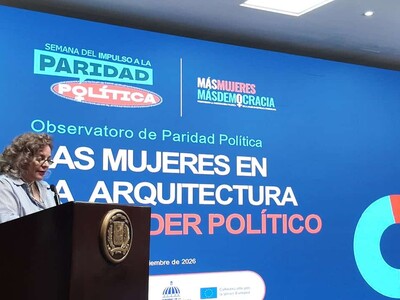
Women hold nearly half of central government jobs in the Dominican Republic but remain severely underrepresented in top positions of political and economic power, according to new research published by the Political Participation and Parity Observatory.
The study, conducted by the Center for Research for Female Action, known as Cipaf, revealed that women occupy 49.5% of the 5,064 analyzed positions across central government agencies. However, female officials head only two of the country's 23 executive ministries, accounting for just 8.7% of cabinet leadership.

The gap is even wider in ministries controlling major public funds. Women currently hold zero leadership posts in the ministries of Finance, Agriculture, Public Works, Industry and Commerce, Tourism, Environment, Energy and Mines, or Housing. Together, these eight ministries manage approximately 203 billion Dominican pesos in public resources.
Cipaf is a Santo Domingo based research organization dedicated to women's rights and gender parity in the Caribbean nation. The Dominican Republic operates a presidential government system where executive power is concentrated in cabinet ministries responsible for state expenditure, national infrastructure, and economic policy.
Executive director of Cipaf, Syra Taveras Pineda, said inequality in political participation remains an inequality in the distribution of power. She stated that counting how many women enter public service is insufficient without examining where they are placed, under what conditions they serve, and how much authority they exercise once appointed.
Local government representation
The observatory documented a matching gender imbalance across local government administrations. Women hold mayoral office in only 16 of the 158 municipalities in the Dominican Republic, representing 10.1% of mayors, while occupying 89.9% of vice-mayoral roles.
A similar pattern exists in municipal districts, where women account for barely 9.8% of district directors but hold 90.1% of deputy directorships.
Local administration in the Dominican Republic is divided into primary municipalities headed by mayors and secondary municipal districts led by district directors. Vice-mayors and deputy directors typically carry out administrative duties while executive authority and budget allocation remain with mayors and directors.
Gender gap in Congress
In the legislative branch, women hold four of the 32 seats in the Senate, representing 12.5% of the upper house, and occupy 36.8% of seats in the Chamber of Deputies. Furthermore, no woman has presided over the Senate in the past 11 years.
The National Congress of the Dominican Republic is a bicameral legislature headquartered in Santo Domingo. The Senate consists of 32 members, representing each of the nation's 31 provinces and the National District, while the Chamber of Deputies is elected through direct popular vote.
Majority in the judiciary
The findings showed a contrasting picture in the judicial branch. In positions where entry depends primarily on competitive civil service examinations and career progression, women represent the majority. Women make up 64% of the ordinary judiciary and 77% of magistrate courts.
Despite their strong representation in career judicial roles, women hold no top leadership positions in the judicial system. No woman currently presides over the Constitutional Court, the Supreme Court of Justice, the Superior Electoral Court, or the Central Electoral Board.
Cipaf reported that this contrast indicates the lower presence of women in top decision-making roles is not caused by a lack of qualification or capacity. Instead, the organization stated that the disparity stems from the mechanisms used to select leaders for high office. The Constitutional Court and Supreme Court of Justice represent the highest judicial authorities in the nation, with senior leadership appointed through specialized political and judicial councils rather than career civil service exams.
Campaign finance and party leadership
Data from the observatory also recorded a decline in the number of elected female officials. In the 2020 elections, 998 women won office, but that figure dropped to 940 in the 2024 elections, representing a 5.8% decrease.
Campaign finance filings submitted to the Central Electoral Board showed that women accounted for only 31.2% of total declared campaign spending. Female candidates who ended their campaigns in deficit registered a median debt 5.25 times higher than male candidates.
Disparities also remain entrenched inside political party leadership structures. Women constitute approximately half of registered members in the governing Modern Revolutionary Party, the Dominican Liberation Party, and Fuerza del Pueblo, yet women hold only five of 41 party presidencies, or 12.2%.
The Modern Revolutionary Party, or PRM, is the governing party in the Dominican Republic, while the Dominican Liberation Party, or PLD, and Fuerza del Pueblo are the primary opposition parties. The Central Electoral Board, known as the JCE, is the independent constitutional body responsible for supervising political parties, campaign finance reporting, and organizing national elections.
Public access to findings
Data gathered by the Political Participation and Parity Observatory has been made available for public consultation on the online platform hosted by Cipaf.


