
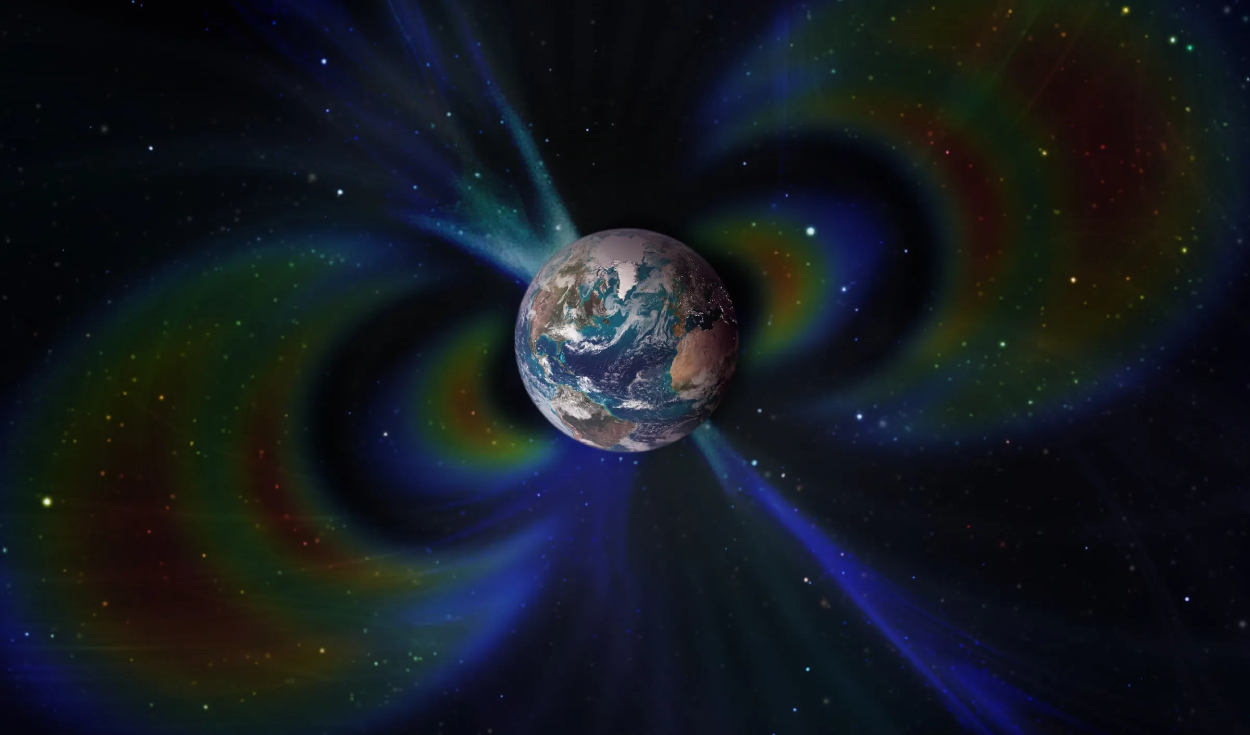
Earth's magnetic shield was breached during an extreme solar superstorm, according to data gathered by the Japanese satellite Arase and researchers at Nagoya University. The findings show that an invisible boundary once thought to be impenetrable was overcome, allowing highly energetic radiation to flood into an inner protective zone.
For more than a decade, scientists believed a distinct region within the planet's magnetic envelope served as a rigid barrier against high-speed killer electrons capable of disabling orbiting satellites. But during the historic space storm of May 2024, those defenses broke down, permitting a massive surge of ultrarelativistic particles into an area where experts thought they could not survive.
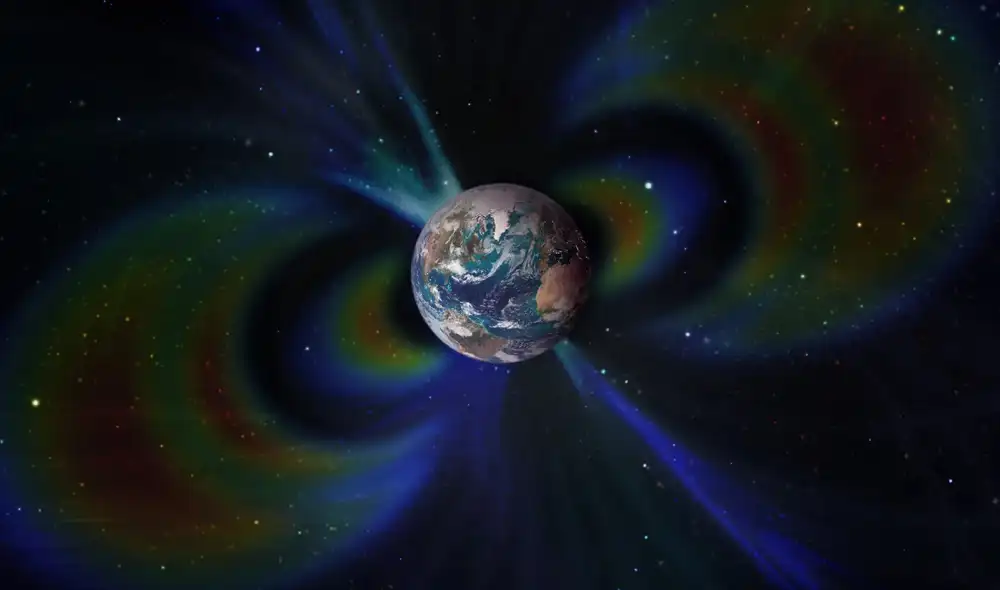
The evidence was collected by Japan's Arase satellite, an orbital observatory that has monitored Earth's radiation belts since 2017. During the peak of the geomagnetic event, instruments on board detected an extraordinary increase in ultrarelativistic electrons within a region where previous scientific consensus held they could never reach such high energies.
Earth is naturally encircled by the Van Allen radiation belts, two giant donut-shaped zones where charged particles remain trapped by the planet's magnetic field. The outer belt consists primarily of energetic electrons driven by activity on the Sun, whereas many of the protons in the inner belt originate from cosmic rays colliding with atoms in the upper atmosphere.
In 2014, observations from NASA's Van Allen Probes revealed a remarkably sharp outer limit to this inner zone, situated approximately three Earth radii from the center of the planet. Energetic electrons rarely crossed that perimeter, leading researchers to classify it as an impenetrable barrier protecting the inner reaches of near-Earth space.
The Impenetrable Barrier That Failed
The accepted explanation for that protective barrier centered on cold plasma, a cooler gas of charged particles surrounding Earth known as the plasmasphere. Scientists suggested that naturally occurring electromagnetic waves within this cold plasma scattered approaching high-energy electrons, knocking them out of alignment and sending them harmlessly down into the atmosphere before they could penetrate deeper.
While subsequent studies began to suggest the boundary might not be entirely rigid, researchers still expected it to hold against incoming space radiation. The particles at issue, known to astrophysicists as killer electrons, travel at speeds approaching that of light and carry immense kinetic energy. When they strike satellites, they can pierce outer shielding, induce severe electrostatic discharges, destroy sensitive microelectronics, and degrade solar power arrays.
Understanding the durability of that shield is essential for satellite operators, military navigation networks, and commercial communications companies whose hardware circles Earth inside or near these orbital corridors. If the inner boundary fails, spacecraft operating in what was considered a safe haven become vulnerable to sudden radiation damage.
How the May 2024 Superstorm Changed the Field
That theoretical protection collapsed in May 2024, when an intense G5 geomagnetic storm slammed into Earth's magnetosphere. A G5 classification represents the most extreme tier on national space weather scales, produced when violent coronal mass ejections from the Sun launch billions of tons of magnetized plasma across the solar system toward our planet.
The May 2024 storm triggered dazzling auroras visible across vast parts of the world, but in orbit it caused severe disturbances. The blast significantly depleted the cold plasma that fills the plasmasphere, stripping away the environment that normally deflected energetic particles.
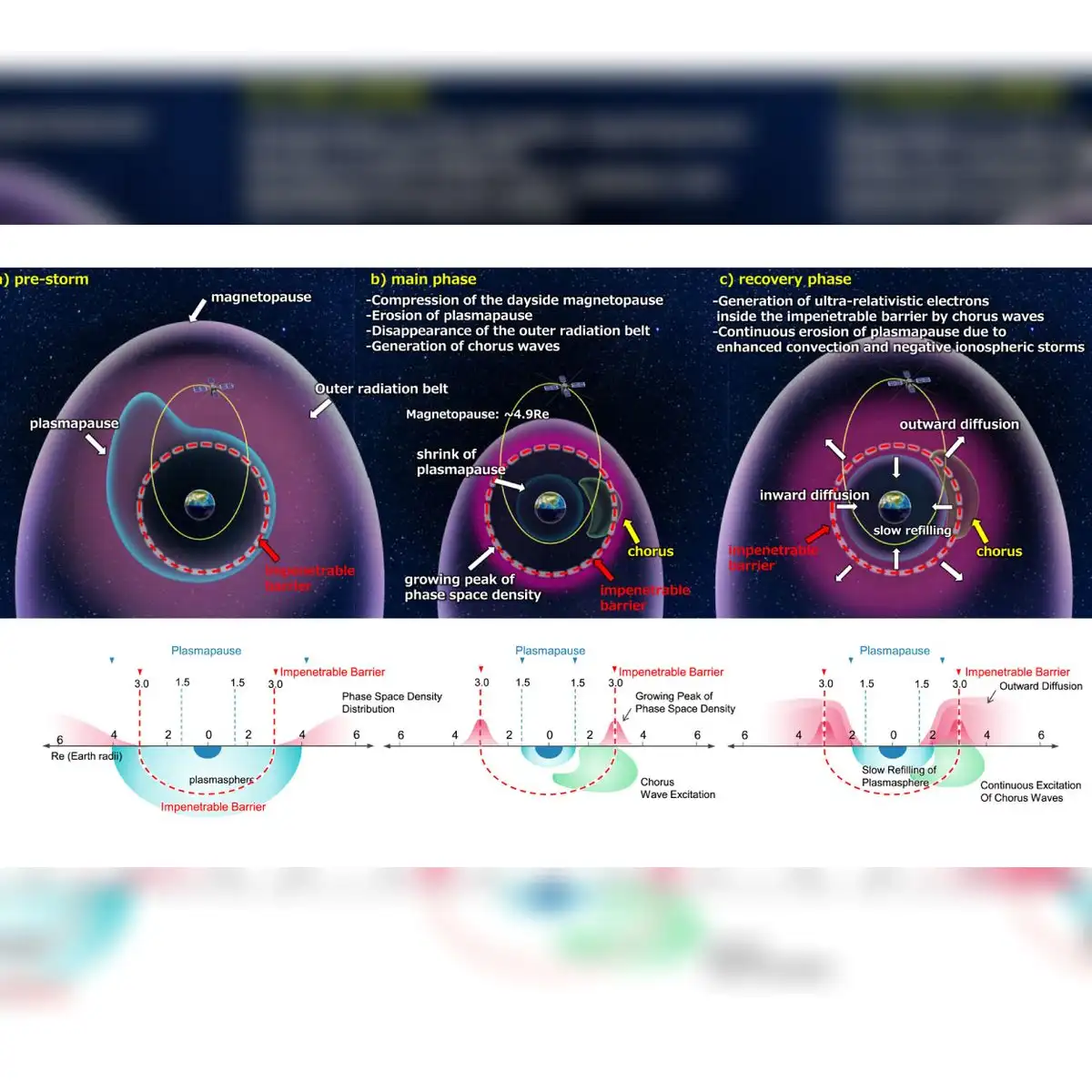
With the cold plasma diminished, conditions became ideal for the proliferation of specialized electromagnetic waves known as chorus waves. Named because their audio conversions resemble the sound of birds chirping at dawn, these waves resonate through planetary magnetospheres and interact vigorously with surrounding charged particles.
Instead of scattering radiation away from Earth, the chorus waves appeared to accelerate electrons directly inside the protected zone itself. During the recovery phase following the storm, the Arase satellite recorded an increase of more than 5,000 times in the flux of electrons with energies near three megaelectronvolts compared to baseline levels measured before the event.
Internal Acceleration and Lingering Hazards
The sequence in which the particles appeared proved especially revealing to researchers tracking the storm's aftermath. Instruments on Arase detected that lower-energy electrons increased first, followed roughly 12 hours later by particles at higher energy levels. Approximately 24 hours after the event began, the satellite recorded a dramatic surge in electrons exceeding three megaelectronvolts.
That delay provided critical evidence about how the radiation entered the forbidden zone. Rather than being pushed or transported in from outer regions of the magnetosphere, the particles were being energized locally from within the barrier itself as chorus waves pumped energy into them over the course of hours.
Writing in the scientific journal Geophysical Research Letters, the research team led by space physicist Yoshizumi Miyoshi of Nagoya University said they demonstrated that this barrier can be breached under extreme space weather conditions.
The consequences of the superstorm lasted far longer than the initial geomagnetic event. Arase continued to track the slow decline of the trapped ultrarelativistic electrons for five months, recording elevated particle levels until October 2024, when another solar storm battered near-Earth space.
Implications for Spacecraft and Forecasts
The findings present immediate challenges for space agencies, satellite manufacturers, and telecommunications operators managing constellations in low and medium Earth orbit. Modern satellites depend on accurate models of space weather to determine radiation shielding specifications, electronic component tolerances, and satellite orbital paths.
Miyoshi said the discovery highlighted the need to understand and predict how energetic electrons behave during severe space weather events. He noted that this knowledge is vital for assessing radiation risks to spacecraft and improving future space weather forecasting systems.