An English farmer ploughing a field in 1693 discovered an ornate jewel made of gold, enamel and rock crystal, bearing an unusual inscription that historians have since linked to one of the most important figures in English history, according to futura-sciences.com.
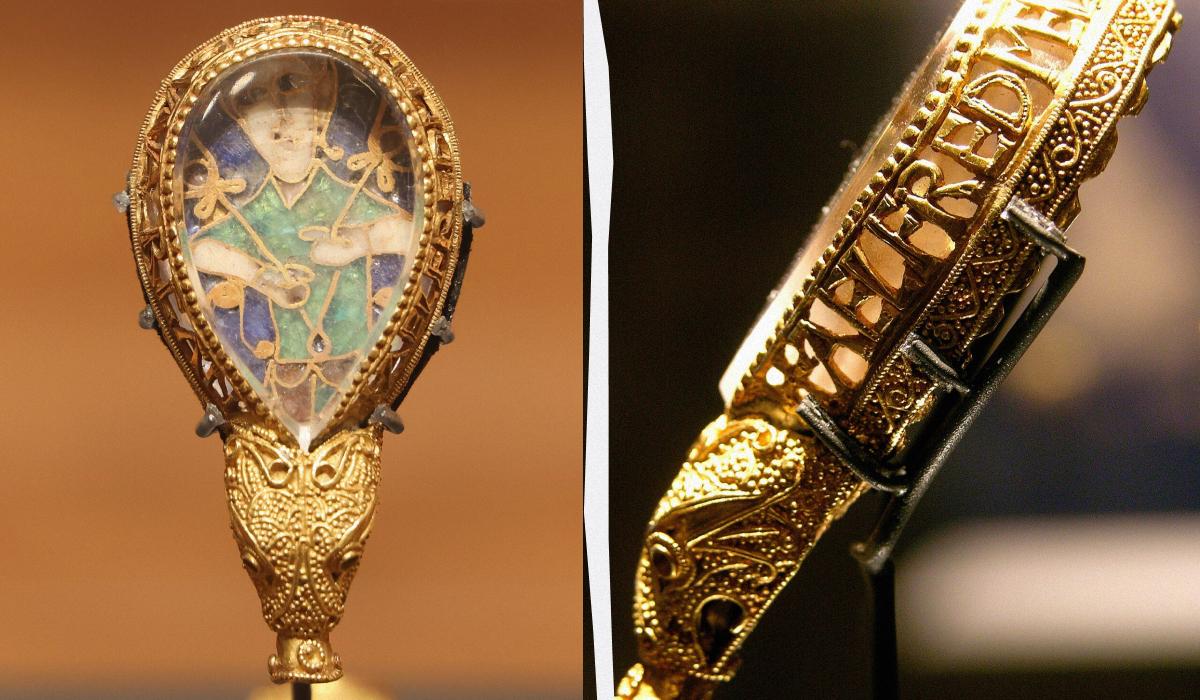
The object, known today as the Alfred Jewel, measures about 6.2 centimetres in length and 3.1 centimetres in width. Its gold frame carries the inscription "AELFRED MEC HEHT GEWYRCAN," Old English for "Alfred ordered me to be made."
Link to Alfred the Great
The inscription connects the piece to Alfred the Great, who ruled the Anglo-Saxon kingdom of Wessex from 871 to 899. Alfred is remembered as the ruler who fought off Viking invaders and extended his power across southern England. He is sometimes described as the first king of England, though the unification of the English kingdom was a gradual process that was only completed under his successors.
The jewel is now held at the Ashmolean Museum, part of the University of Oxford.
A royal artefact
The jewel features a human figure made using the cloisonné enamel technique, in which sections of the design are separated by thin gold partitions. The image is protected by a thin, polished plate of rock crystal.
At its base sits a dragon-like head with a cylindrical hole in its mouth. This detail has led specialists to suggest the object originally topped an aestel, a type of pointer used to track lines of text while reading manuscripts. That interpretation fits with what historians know of Alfred's interest in education and the study of religious texts.
Who exactly the enamelled figure represents remains unclear. One theory holds that it personifies the sense of sight, a fitting symbol for a tool designed for reading.
Where it was found
The location of the find strengthens its historical link to Alfred. North Petherton lies just a few miles from Athelney Abbey, near the fortification amid the marshes from which the king organised resistance against the Viking "Great Army."
Even so, while the inscription shows the piece was commissioned by someone named Alfred, historians cannot say with certainty that the king personally used or owned the object.
UNIAN previously reported that wild animals in the Czech Republic had dug up one of the largest hoards of 17th-century coins.
Test yourself
What is the Alfred Jewel made of?
What does the inscription on the jewel say in English?
What do experts believe the jewel was originally used as?
Have your say
Do you find stories about accidental historical discoveries like this interesting?
Where it happened
North Petherton, United Kingdom