

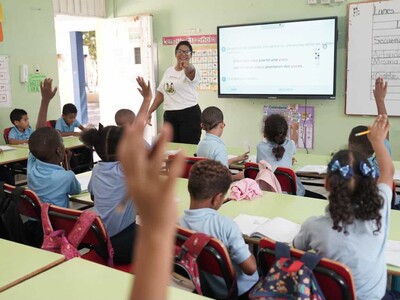
The Dominican Republic government has delivered school grants to 483,862 families, allocating 1.251 billion pesos to promote class attendance and student retention across the country.
Education Minister Luis Miguel De Camps announced the figures on Monday during the debut broadcast of LA Agenda Semanal, a new weekly program where President Luis Abinader discusses issues of social interest with government officials.
Speaking from the Green Room of the National Palace in Santo Domingo, De Camps said the grant aims to bring peace of mind to the population and is distributed between August and January. He added that 58 percent of the total allocation, covering all 483,862 beneficiary families, was already available in their accounts as of Sunday.
President Abinader urged beneficiaries who have not yet withdrawn their funds to do so promptly to help meet expenses associated with the start of the school year.
School year preparation and infrastructure
During Monday's meeting, educational authorities addressed key preparations structured around four main pillars: school preparation, infrastructure and well-being, educational quality, and future-oriented education.
De Camps noted that authorities successfully identified the required teaching and non-teaching personnel across the national territory ahead of the term. For the 2026-2027 academic year, more than 8,000 educational centers are operational, catering to an enrollment of more than two million students.
The ministry has also incorporated hundreds of school transportation units to facilitate student mobility. De Camps said the government was committed to ensuring that every child had access to education, adding that extended school day coverage now reaches 80 percent of the nation's educational centers.
The Ministry of Education, known locally as MINERD, oversees public primary and secondary education in the Caribbean nation. The government's extended school day initiative is designed to provide full-day instruction and nutritional support, aiming to improve educational outcomes in state schools.
Government broadcast format and regional challenges
Monday marked the official launch of the Presidency's new live broadcast format led by Abinader, streamed directly via official presidential social media channels. Authorities confirmed that the weekly sessions will take place every Monday at 5:00 p.m., though the new format does not currently allow in-person media access. The initial broadcast experienced several technical interruptions.
Despite national preparations, local challenges remain as the school year begins. At least 11 educational centers in Santiago failed to start classes on schedule for the new academic term.


