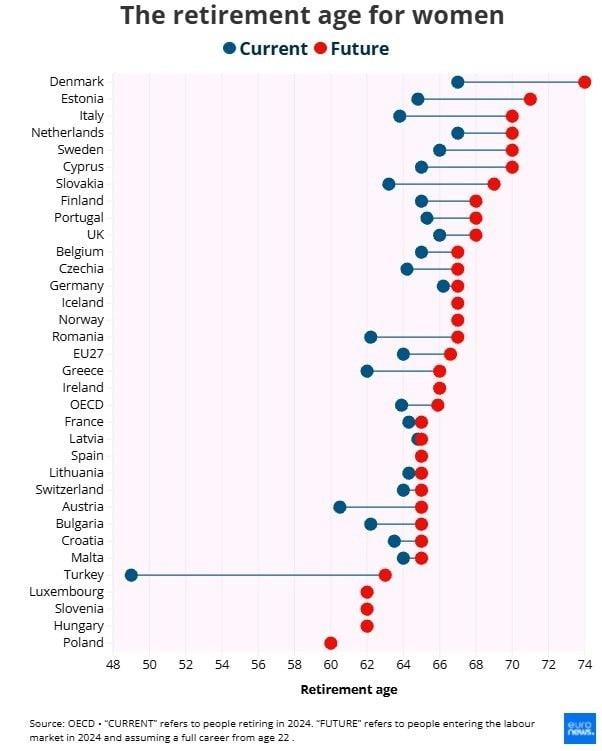
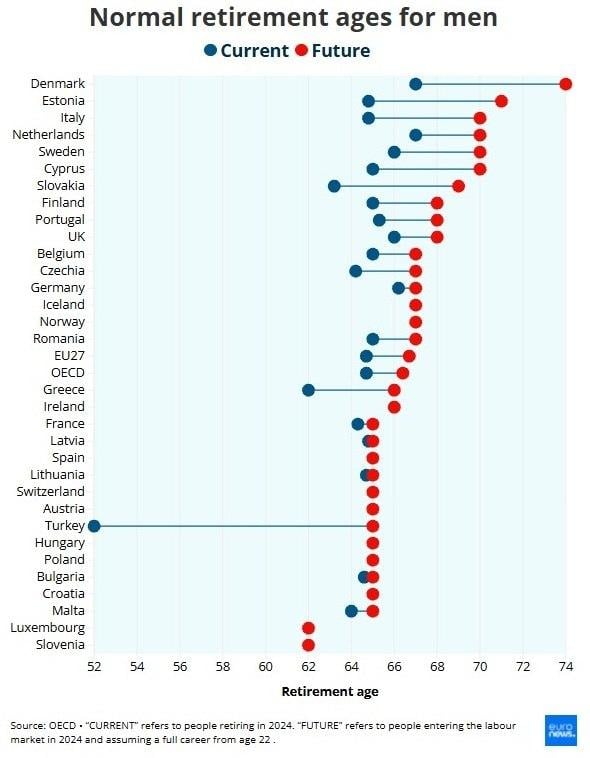
Retirement age across the European Union will climb from 64.7 to 66.7 for men and from 64 to 66.6 for women by the end of the 2060s, according to a study by the Organisation for Economic Co-operation and Development cited by Euronews.
About two thirds of European countries are expected to raise the retirement age for men, while three quarters will raise it for women. The study compared people who retired in 2024 with those who began working at age 22 that same year, assuming a continuous career. The second group is expected to retire in the late 2060s.
The study said raising the retirement age remains a common strategy for keeping pension systems financially stable without cutting benefits, adding that the alternative would be to raise pension contributions or reduce payouts.
Retirement age for men
As of 2024, the highest retirement age for men, 67, was set in Denmark, Norway, Iceland and the Netherlands, according to the OECD. The EU average stood at 64.7. Turkey, which is not an EU member, was an outlier in the study, with men able to retire as early as 52. The next lowest figures, 62, were recorded in Greece, Slovenia and Luxembourg. Among Europe's five largest economies, Germany had the highest retirement age for men at 66.2, while France had the lowest at 64.3.
On average across the EU, men who started working at 22 in 2024 are expected to retire at 66.7, around 2069. Denmark will have the highest retirement age at 74. By the late 2060s it will also reach 71 in Estonia and 70 in Italy, the Netherlands, Sweden and Cyprus. Slovenia and Luxembourg will keep the lowest retirement age for men at 62. Among Europe's largest economies, Italy will have the highest future retirement age for men at 70, followed by the United Kingdom at 68 and Germany at 67. In France and Spain, men will retire at 65. The biggest increase is expected in Turkey, where the retirement age for men will jump 13 years, from 52 to 65. Denmark's will rise by seven years, while Estonia, Italy, Slovakia and Cyprus will each see increases of at least five years.
Retirement age for women
The current EU average retirement age for women is 64. The highest, 67, is set in Denmark, the Netherlands, Iceland and Norway. Turkey currently has the lowest retirement age for women at 49, followed by Poland at 60.
On average across the EU, women who started working at 22 in 2024 are expected to retire at 66.6, 2.6 years later than women who retired in 2024. As with men, Denmark will have the highest retirement age for women at 74, followed by Estonia at 71 and Italy, the Netherlands, Sweden and Cyprus at 70. Poland will keep the lowest retirement age for women among EU countries by the late 2060s, at 60. Among Europe's largest economies, Italy will have the highest retirement age for women at 70, followed by the United Kingdom at 68, Germany at 67, and France and Spain at 65. Because Turkey's current retirement age for women is extremely low, the country will see the largest increase, 14 years, from 49 to 63.
OECD experts warned that the populations of OECD member countries will age rapidly over the next 25 years. For every 100 people aged 20 to 64, the number of people aged 65 and older will rise from 33 in 2025 to 52 in 2050, up from just 22 in 2000.